

What’s the difference between Easter egg chocolate and regular chocolate?
- Written by The Conversation
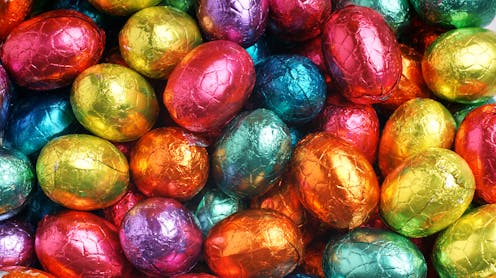
With Easter around the corner, you’ll have seen chocolate Easter eggs on supermarket shelves. Maybe you’ve bought some already.
But is there a difference between Easter chocolate and the everyday kind? Does Easter chocolate really taste better, as some people say?
As we’ll see, any difference is less about the ingredients and more about how we experience the chocolate when we eat it.
What do they contain?
When we compared the ingredients and nutrients of Easter egg chocolate and regular chocolate from the same company, we found no major differences.
Cadbury Dairy Milk hollow Easter egg and Cadbury Dairy Milk chocolate block both contain per 100 gram:
Both products have a minimum 24% milk solids. The egg has a marginally higher percentage of cocoa solids (28%) than the block (27%).
So if they contain pretty much the same ingredients, what else is going on?
It’s more about the taste, texture and smell
The difference between Easter chocolate and regular chocolate is more about how we experience the flavour of chocolate – via taste, texture and smell.
Taste is the recognition of simple ingredients dissolving in saliva and entering the taste pores on our tongue. In the case of chocolate, we perceive the taste as sweet (sugar), fatty (cocoa butter) and potentially bitter (caffeine and other cocoa-based compounds).
However, texture and smell make us most likely to tell the difference between Easter and regular chocolate.
The mouth is incredibly sensitive to the texture of foods. We perceive multiple physical qualities of a food, which we call “mouthfeel”.
Smoothness, creaminess and mouthcoating (for example, an oily feeling) are important components of chocolate’s mouthfeel.
Consumers also expect round-shaped chocolate to be creamier than angular-shape chocolate.
So even before we’ve taken a bite, we perceive a chocolate egg will be creamier than a block. These expectations can shape how we experience the flavour of chocolate.
However, if the chocolate egg is not as creamy as expected, this can be disappointing.

The temperature at which chocolate is made and stored also impacts its texture. Sometimes chocolate gets a whitish haze on its surface called chocolate bloom. This is when the fat and sugar separate from each other, forming fat or sugar crystals.
It is safe to eat chocolate with bloom, but it may taste less creamy or more gritty than chocolate without bloom.
Because the demand is so high during Easter, chocolate manufacturers sometimes use rapid-cooling techniques to produce hollow Easter eggs at a faster rate. This may make them more susceptible to chocolate bloom. Cheaper Easter chocolates using these rapid procedures may have a different texture than chocolate made the traditional way.
Finally, smell contributes the most to how we perceive flavour in foods. When chocolate starts to melt in our mouth, aromas are released. These aromas make their way through the back of the nose where we smell the complex scents and notes of chocolate. Depending on the chocolate, this could include fruity, earthy, buttery or floral aromas.
The shape of chocolate
We’ve already heard the shape of chocolate influences how creamy we think it is. But the shape of chocolate also influences other aspects of our eating experience.
Easter chocolate in the shape of an egg or an animal provides a large contact area inside the mouth meaning it will melt faster than a block. This impacts how quickly aroma compounds are released from the chocolate.
Biting into hollow chocolate, such as eggs and animals, may also require more time to chew and swallow. This results in Easter chocolate spending longer in our mouths with a greater release of aromas. This means we perceive a greater intensity or diversity of flavours compared to eating small squares.

Are you a sucker or a chewer?
How someone eats chocolate can also change its flavour. One study categorised people who ate chocolate as “suckers” or “chewers”.
Chewers tend to swallow chocolate more quickly and may perceive it to have a weaker flavour because of the shorter time for aromas to be released.
So how a person eats Easter chocolate may also impact whether they prefer it over regular chocolate.
Easter is only once a year
Last of all, eating Easter eggs (and hunting for them) are often part of a shared family ritual. This can make Easter chocolate seem special. No wonder we enjoy the whole Easter egg experience.
So whether you are a sucker or a chewer, Easter is a great time to slow down and celebrate with loved ones. Enjoy and savour your Easter chocolate in moderation, egg-shaped or otherwise.


