

Hipster bikes and the talking cure: Philip Salom's loveable losers provide a glimpse of an islanded generation
- Written by The Conversation

Philip Salom, now 72, has built a strong reputation as a poet and novelist. Sweeney and the Bicycles is his sixth novel, and his third in four years.
Salom was born in the same year as Alexis Wright. He is slightly younger than Peter Carey and Amanda Lohrey, and slightly older than Gail Jones, Kim Scott, Michelle de Kretser, Tim Winton and Richard Flanagan. If the term had not become derogatory, one might class all of these writers within the “baby boom” generation.
Review: Sweeney and the Bicycles – Philip Salom (Transit Lounge).

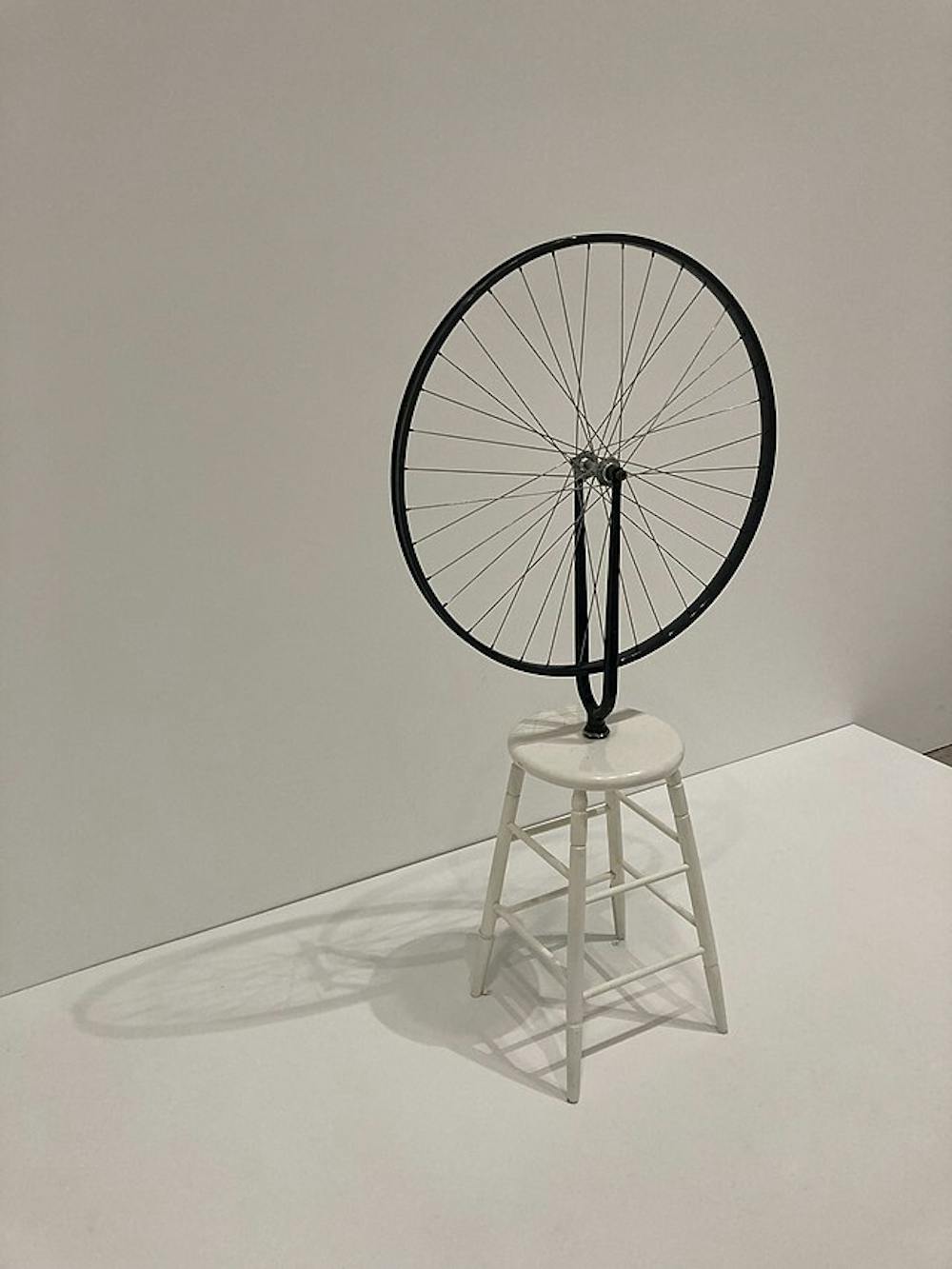 Bicycle Wheel – Marcel Duchamp.
Wikimedia Commons
Sweeney and the Bicycles is interesting because it replays, quite directly, the interchanges in the therapeutic moment. In his treatment, Sweeney is directed towards his “negative memories” and asked to give them a severity score out of ten. He is then asked to recollect them in detail, while the doctor passes her finger in front of his eyes in order to simulate the patterns of eye movement experienced during REM sleep. The theory is that this eye movement restores a plasticity to the psyche and allows memories to be recoded from negative to positive. After a “set” has been completed, Sweeney is again asked to measure the hurt of his memory. He finds it has lessened.
Outside Asha’s clinic, Sweeney lives a knockabout life, having at some point graduated from social dropout to fully-fledged dropkick. He seems never to have held a conventional job, having gone directly from University to a commune of artisans, who sold their handmade wares at local markets and stole their drugs from local pharmacies. It was this latter activity that landed Sweeney in prison, a place he was poorly equipped to survive.
In his post-prison life, Sweeney splits his residence between a house he has fortuitously inherited from his grandmother in Parkville and a rough rooming house in North Melbourne. The boarding house is run by the Sheriff, a former standover man, whom Salom seems to have openly styled on Chopper Reid. In his gruff and emotionally clumsy way, the Sherriff takes Sweeney under his wing. There is a tenderness to this relationship that comes through the gentle social comedy they enact. If Asha is Sweeney’s adopted mother, then the Sheriff is very clearly his adopted father.
Read more:
Luke Carman, the circle of life, and the world as an ecstatic masterpiece
Key memories
These compensating parental figures provide a constancy of regard and an ethical matrix to Sweeney, who seems to have come into a notional adulthood bereft of these things. The biographical strata of Sweeney’s life are laid out gently. Beginning in the present day with Sweeney adjusting to life outside prison, we gradually see something of the life inside prison that culminated in his bashing. Before that, we are offered glimpses of life in the artists’ commune, which Sweeney had helped found, and the inexorable erosion of its ideals.
The refusal of authority at the centre of this utopian community becomes comprehensible when we witness Sweeney’s memories emerge in therapy. These take us to into Sweeney’s childhood. A domineering father and a weak alcoholic mother left Sweeney with no capacity to win legitimate approval and sustain a viable self-esteem.
Bicycle Wheel – Marcel Duchamp.
Wikimedia Commons
Sweeney and the Bicycles is interesting because it replays, quite directly, the interchanges in the therapeutic moment. In his treatment, Sweeney is directed towards his “negative memories” and asked to give them a severity score out of ten. He is then asked to recollect them in detail, while the doctor passes her finger in front of his eyes in order to simulate the patterns of eye movement experienced during REM sleep. The theory is that this eye movement restores a plasticity to the psyche and allows memories to be recoded from negative to positive. After a “set” has been completed, Sweeney is again asked to measure the hurt of his memory. He finds it has lessened.
Outside Asha’s clinic, Sweeney lives a knockabout life, having at some point graduated from social dropout to fully-fledged dropkick. He seems never to have held a conventional job, having gone directly from University to a commune of artisans, who sold their handmade wares at local markets and stole their drugs from local pharmacies. It was this latter activity that landed Sweeney in prison, a place he was poorly equipped to survive.
In his post-prison life, Sweeney splits his residence between a house he has fortuitously inherited from his grandmother in Parkville and a rough rooming house in North Melbourne. The boarding house is run by the Sheriff, a former standover man, whom Salom seems to have openly styled on Chopper Reid. In his gruff and emotionally clumsy way, the Sherriff takes Sweeney under his wing. There is a tenderness to this relationship that comes through the gentle social comedy they enact. If Asha is Sweeney’s adopted mother, then the Sheriff is very clearly his adopted father.
Read more:
Luke Carman, the circle of life, and the world as an ecstatic masterpiece
Key memories
These compensating parental figures provide a constancy of regard and an ethical matrix to Sweeney, who seems to have come into a notional adulthood bereft of these things. The biographical strata of Sweeney’s life are laid out gently. Beginning in the present day with Sweeney adjusting to life outside prison, we gradually see something of the life inside prison that culminated in his bashing. Before that, we are offered glimpses of life in the artists’ commune, which Sweeney had helped found, and the inexorable erosion of its ideals.
The refusal of authority at the centre of this utopian community becomes comprehensible when we witness Sweeney’s memories emerge in therapy. These take us to into Sweeney’s childhood. A domineering father and a weak alcoholic mother left Sweeney with no capacity to win legitimate approval and sustain a viable self-esteem.
 Philip Salom.
Author provided
The key memory from his childhood is when his father gives him a bicycle for his eleventh birthday, only to turn around and take it away from him as a punishment for riding it at night. For Sweeney, riding a bicycle gave him an exquisite, ecstatic pleasure, particularly when it was wedded to the illicit. That his pleasure needed to be forbidden in order to function suggests that the anti-authoritarian stance derives its energy from the authority it ostensibly denies.
This particularity has carried through into Sweeney’s current life, where his principal pleasure is derived from stealing bicycles. Not just any bicycles – they have to have some element of beauty or charisma. Fortunately, the hipster bikes that plague Melbourne’s inner-city leave Sweeney with no shortage of options.
In most cases, he returns the bikes, but if he is particularly fond of one he keeps it at his grandmother’s house, which functions as his secret retreat, the storehouse of his illicit pleasure. Indeed, when the Sherriff discovers that Sweeney has a second house, he is hurt and offended, as if Sweeney had been two-timing him.
The romance plot of the novel is initiated when Sweeney swipes a bike belonging to Rose, a middle-aged data analyst working in town-planning and a patient of Asha Sen. At the time, Sweeney was not himself seeing Dr Sen, but the novel is not short of uncanny coincidences and by the end all the seemingly separate circles have coalesced.
Conscious of the ubiquitous CCTV cameras of the contemporary city, Sweeney applies makeup to his face designed to flummox facial recognition software. He paints his face with numbers and letters, or pixelates his features with painted blotches. As it happens, Dr Sen’s husband is a software engineer, whose firm specialises in facial recognition. One of the key dialectics in the novel is between a surveilling eye that can capture your face and find you guilty, and a therapeutic eye that can see within and find you innocent.
Philip Salom.
Author provided
The key memory from his childhood is when his father gives him a bicycle for his eleventh birthday, only to turn around and take it away from him as a punishment for riding it at night. For Sweeney, riding a bicycle gave him an exquisite, ecstatic pleasure, particularly when it was wedded to the illicit. That his pleasure needed to be forbidden in order to function suggests that the anti-authoritarian stance derives its energy from the authority it ostensibly denies.
This particularity has carried through into Sweeney’s current life, where his principal pleasure is derived from stealing bicycles. Not just any bicycles – they have to have some element of beauty or charisma. Fortunately, the hipster bikes that plague Melbourne’s inner-city leave Sweeney with no shortage of options.
In most cases, he returns the bikes, but if he is particularly fond of one he keeps it at his grandmother’s house, which functions as his secret retreat, the storehouse of his illicit pleasure. Indeed, when the Sherriff discovers that Sweeney has a second house, he is hurt and offended, as if Sweeney had been two-timing him.
The romance plot of the novel is initiated when Sweeney swipes a bike belonging to Rose, a middle-aged data analyst working in town-planning and a patient of Asha Sen. At the time, Sweeney was not himself seeing Dr Sen, but the novel is not short of uncanny coincidences and by the end all the seemingly separate circles have coalesced.
Conscious of the ubiquitous CCTV cameras of the contemporary city, Sweeney applies makeup to his face designed to flummox facial recognition software. He paints his face with numbers and letters, or pixelates his features with painted blotches. As it happens, Dr Sen’s husband is a software engineer, whose firm specialises in facial recognition. One of the key dialectics in the novel is between a surveilling eye that can capture your face and find you guilty, and a therapeutic eye that can see within and find you innocent.
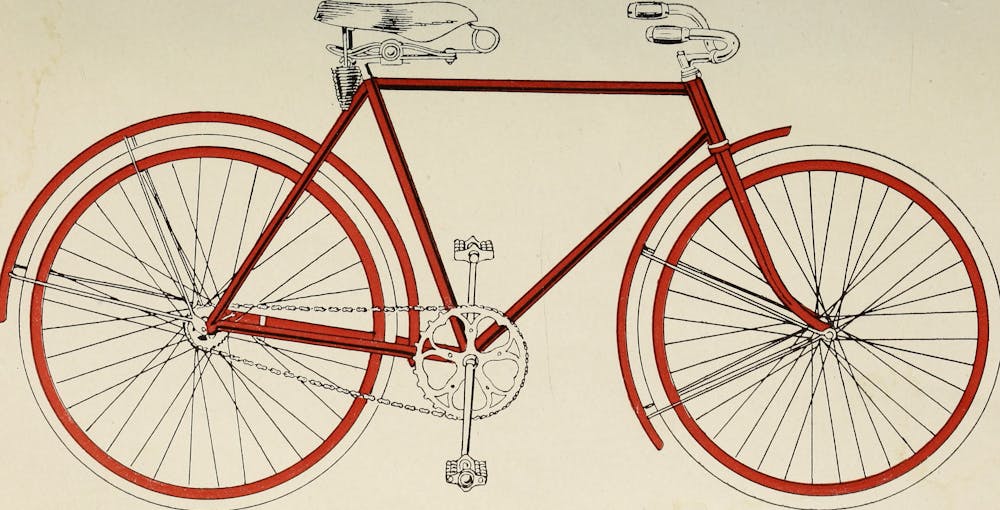 Bicycles and Supplies. T.W. Boyd & Son, Montreal (1918).
Public domain
Read more:
Noir and nostalgia inform Chris Womersley's tale of forgery, grief, and the seamy side of urban life
Radical self-absorption
With its lovingly rendered characters and sharp aphoristic prose, Sweeney and the Bicycles is an enjoyable novel. It moves at a leisurely pace; indeed, it moves at the pace of a bicycle.
Most of the story transpires in the register of mild satire, particularly the sections that focus on the lovable losers in the rooming house. The life of this assemblage of misfits resembles the rough and tumble underworld of Robert G. Barrett’s Les Norton crime novels. The one thing missing, though, is a detective who might provide an ordering sense of mission to the haphazard incidents.
One of the odd features of the novel is Sweeney’s extreme passivity. His only decisive action is the stealing of bicycles, which absorbs the totality of his libidinal life. It is a little surprising that when Rose finds her stolen bicycle at Sweeney’s house, nestled amongst others he has collected, she decides that this is the man for her. Not only that, she becomes his amanuensis, transcribing his freeform but utterly illegible diaries.
What also stands out is the way that the characters seem islanded in their generation. The resentment they feel towards their self-absorbed parents – the sad, emotionally crippled beings of the war generation – seems to have been transferred directly onto the self-absorbed generation that is replacing them, whether they like it or not. The only representative of this younger generation is Asha Sen’s good-for-nothing stepson, who sits in his room all day playing video games and stalking women on Tinder. By contrast, the radical self-absorption of Sweeney is treated with an almost endless sympathy and as part of his charm.
While the novel espouses a certain kind of freedom, Sweeney’s life shows a marked tendency toward incarceration or managed care – the commune, the prison, the boarding house. In fact, although the novel ends with Rose moving in with Sweeney, it is by no means clear on what basis their relationship might exist.
That Sweeney’s subjective vacuity casts a cloud over his capacity to relate in meaningful terms to another is strange in a novel devoted to psychotherapy. This points to a certain limitation, in my view, in the nature of the treatment espoused in the novel. The limitation lies not so much in its technique, but in the clinical aim.
As described in this novel, the therapy makes no attempt to understand what Sweeney wants (the structure of his desire); it seeks only to find traumatic memories and excise them, as if by a kind of psychic surgery. Once freed of blame for things that were not his fault, the subject is free.
But free to do what? Desire is taken for granted, and yet there is no reckoning, in the context of his therapy, with the most singular element of Sweeney – his compulsion to steal bicycles. In this respect, the therapy seems to belong to the faintly magical dimension of the novel, underpinned by a wish that there is someone to wave a wand and make it all good again.
Bicycles and Supplies. T.W. Boyd & Son, Montreal (1918).
Public domain
Read more:
Noir and nostalgia inform Chris Womersley's tale of forgery, grief, and the seamy side of urban life
Radical self-absorption
With its lovingly rendered characters and sharp aphoristic prose, Sweeney and the Bicycles is an enjoyable novel. It moves at a leisurely pace; indeed, it moves at the pace of a bicycle.
Most of the story transpires in the register of mild satire, particularly the sections that focus on the lovable losers in the rooming house. The life of this assemblage of misfits resembles the rough and tumble underworld of Robert G. Barrett’s Les Norton crime novels. The one thing missing, though, is a detective who might provide an ordering sense of mission to the haphazard incidents.
One of the odd features of the novel is Sweeney’s extreme passivity. His only decisive action is the stealing of bicycles, which absorbs the totality of his libidinal life. It is a little surprising that when Rose finds her stolen bicycle at Sweeney’s house, nestled amongst others he has collected, she decides that this is the man for her. Not only that, she becomes his amanuensis, transcribing his freeform but utterly illegible diaries.
What also stands out is the way that the characters seem islanded in their generation. The resentment they feel towards their self-absorbed parents – the sad, emotionally crippled beings of the war generation – seems to have been transferred directly onto the self-absorbed generation that is replacing them, whether they like it or not. The only representative of this younger generation is Asha Sen’s good-for-nothing stepson, who sits in his room all day playing video games and stalking women on Tinder. By contrast, the radical self-absorption of Sweeney is treated with an almost endless sympathy and as part of his charm.
While the novel espouses a certain kind of freedom, Sweeney’s life shows a marked tendency toward incarceration or managed care – the commune, the prison, the boarding house. In fact, although the novel ends with Rose moving in with Sweeney, it is by no means clear on what basis their relationship might exist.
That Sweeney’s subjective vacuity casts a cloud over his capacity to relate in meaningful terms to another is strange in a novel devoted to psychotherapy. This points to a certain limitation, in my view, in the nature of the treatment espoused in the novel. The limitation lies not so much in its technique, but in the clinical aim.
As described in this novel, the therapy makes no attempt to understand what Sweeney wants (the structure of his desire); it seeks only to find traumatic memories and excise them, as if by a kind of psychic surgery. Once freed of blame for things that were not his fault, the subject is free.
But free to do what? Desire is taken for granted, and yet there is no reckoning, in the context of his therapy, with the most singular element of Sweeney – his compulsion to steal bicycles. In this respect, the therapy seems to belong to the faintly magical dimension of the novel, underpinned by a wish that there is someone to wave a wand and make it all good again.


