

How the Liberals lost the 'moral middle class' - and now the teal independents may well cash in
- Written by The Conversation
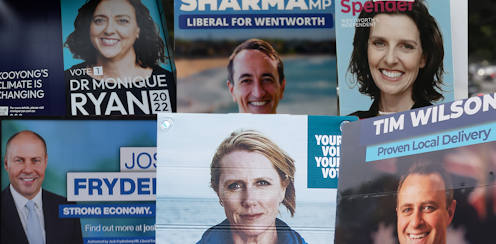
Josh Frydenberg says they are fake independents, John Howard called them anti-Liberal groupies, Scott Morrison points out they are only standing in Liberal seats, and that a vote for them is in fact a vote for Labor.
Well, they would say this, wouldn’t they, as the Liberal heartland fractures, risking not only the return of the government but the careers of its more promising golden sons.
It is now clear Frydenberg is fighting for his future in Kooyong, against paediatric neurologist Monique Ryan. If he loses, he won’t be the next federal Liberal leader.
There are 15 teal candidates standing against incumbents in the lower house, but the ones to watch are in the once blue ribbon Liberal seats of the comfortable middle and upper middle class: Kooyong and Goldstein in Victoria, Wentworth, North Sydney and Bradfield in New South Wales, and Curtin in Western Australia.
The challengers are all well-educated, well-connected professional women, from a range of occupations – medicine, journalism, business, finance. Tellingly, none has been a political staffer. They would bring real life experience into the parliament, and they are backed by strong community campaigns.
The strength of support for these candidates in once blue ribbon Liberal seats reveals a fracturing of the Liberal Party’s traditional support among the upper middle class. Two of the women, Allegra Spender and Kate Chaney, are from families with deep connections to the Liberal Party. Both have the name recognition an independent needs to win.
These candidates have taken the “Voices of …” identity from Cathy McGowan’s successful 2013 campaign against Sophie Mirabella in the Victorian seat of Indi. McGowan has also been an important source of advice on how to organise a community-based campaign.
But these candidates are crucially different from McGowan, who was elected to make a noise about local issues in a rural electorate, such as an unreliable mobile phone network.
The teal candidates in these once safe Liberal seats are not campaigning for better local facilities. They are arguing instead for different national policies - on climate change, a federal integrity commission and the treatment of women, with climate change the most important. These are all matters of national policy on which the federal government has failed to lead. In terms of the history of the Liberal Party, these candidates represent a significant class defection.
Read more: Why teal independents are seeking Liberal voters and spooking Liberal MPs
In the early 20th century, when it became clear Labor aspired to be a party of government, the established middle-class parties fought off the challenge with two core arguments: poorly educated working men and trade unionists did not have the skills or experience to provide competent government; and the party of the trade unions and the working class would be a sectional party that would govern on behalf of its supporters and not of the nation as a whole.
As Labor’s electoral support grew, these two claims buoyed the political self-confidence of the social formation I call “the moral middle class”. They were the people with the education and worldly experience to manage the nation’s affairs. They had the character, integrity and perspective to put the national interest before their own.
We hear weak echoes of these arguments in Morrison’s repeated refrain that only the Coalition can be trusted with the national government’s core responsibilities of economic management and national security. But that is all they are now, the weakest of echoes that Morrison barely understands.
Read more: Final 2019 election results: education divide explains the Coalition's upset victory
The plausibility of the Liberals’ claims to superior competence has been undermined both by its policy failures in government since 2013 and the poor calibre and performance of many of its ministers. The team Morrison is taking to this election cannot claim to be more competent than Labor’s. It is the B team of a tired government, with some spectacularly poor performers, such as the bumbling Richard Colbeck.
Likewise, the plausibility of the Liberals’ historic claim to a commitment to national rather than sectional interests has been undermined by the government’s failure to take climate change seriously and its capture by the fossil fuel lobby, the soft corruption of its electoral bribery, its refusal of an effective federal integrity commission, and its electoral strategy of largely ignoring the interests of those unlikely to vote Liberal in favour of men in hard hats.
Morrison thinks more like a campaign director than a prime minister, so if your vote is already locked in you are of little interest, no matter what contribution your work might be making to the nation.
Since John Howard, the Liberal Party has increased its support among less well-educated, suburban and regional manual workers, and argued Labor is the party of the inner-city elites. The culture wars morphing into the climate wars were crucial in this shift, as were election campaigns focused on the hip pockets of aspirational voters.
The relationship between tertiary education and voting has shifted, with higher levels of education increasingly correlating with voting for Labor or the Greens. The cost is the increasing alienation of the well-educated elites who once gave the Liberals their support.


