

Does Australia face a gas shortage? No – just Victoria, where empty wells meet a lack of planning
- Written by The Conversation
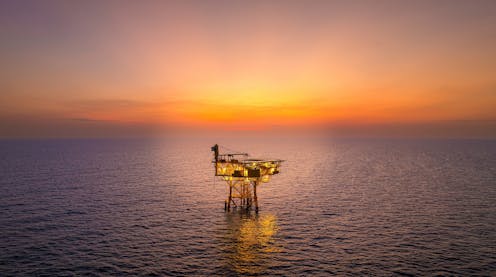
This week, outgoing Senex Energy chief executive Ian Davies made headlines when he warned within a few short years, Australia won’t have enough gas to meet our demand, due largely to government inaction and intervention.
This is both true and not true. Australia-wide, there is no shortage of gas. We’re the world’s second largest exporter of liquefied natural gas (LNG), after all. Critics see the purported supply crisis as a move by the industry to open up new gas fields.
But in gas-dependent Victoria, the risk of shortages is very real. That’s because the state’s offshore gas wells are running out, and governments and industry haven’t acted to boost supplies until renewables can cover the gap.
Since 2010, production from offshore gas wells in Victoria has fallen by 70% and there’s not been enough new gas to replace it. The state government has banned fracking. And while New South Wales will soon have a gas import terminal (Australia’s first), Victoria knocked back a similar proposal on environmental grounds three years ago, and another, proposed for Geelong, is yet to secure environmental approval.
Victorian leaders will be relieved winter is ending and the gas heaters will be turned off. But the problem will not go away without concerted action.
What’s the shape of the problem?
Australia’s energy market operator has issued increasingly direct calls for more investment in Victoria’s straining gas system. Early this year, the operator warned:
Investment uncertainty in gas supply and infrastructure projects remains high, and many [potential projects] have not materially progressed.
Since the late 1960s, Victoria has relied on its wealth of offshore gas in Bass Strait, extracting enough for its own needs and exporting to South Australia and NSW. Its abundance and affordability led to more homes and small businesses taking up gas than in any other Australian jurisdiction. More than two million Victorian homes still use gas.
Change is coming slowly – last year, the state used about 177 petajoules of gas, the lowest demand this century. Annual output from Bass Strait’s gas fields is now around 300 petajoules and falling steadily. But this is an annual figure – it’s hard to ramp up production to meet sudden increases in demand.
The problem came to a head this cold, still winter. Wind and hydro power production fell. People fired up gas heaters, and gas power plants had to cover more electricity demand. Stored gas rapidly ran low.
At winter’s end, demand for gas falls off sharply. But this seasonal problem will soon become continuous as production keeps falling.
The state government is belatedly planning to phase out gas. These plans are welcome, but too late to solve the immediate problem. Getting Victoria off gas means 200 households have to quit gas every day for the next 20 years.
In 1998, an explosion at the Longford gas plant in Gippsland left households and businesses without gas for weeks. A gas shortage would be less immediate but still bring disruption and financial pain for businesses.

What should be done?
Australia has a lot of gas, but it is unevenly distributed.
Most large current or future gas fields are in Queensland, Western Australia and the Northern Territory. To send it thousands of kilometres south would require major upgrades to existing pipelines or new, bigger pipelines. Investors have shown limited interest.
The NSW import terminal under construction at Port Kembla, near Wollongong, could deliver gas to Victoria via existing pipelines. But so far, energy retailers have not committed to use it, likely because potential seasonal shortfalls are not yet severe enough to cover the cost of its use.
That leaves shipping it directly to Victoria from overseas or from northern ports. It sounds odd for a major producer to import gas – but it could be the cheapest solution.
Our major gas buyers – Japan, Korea and China – have built large LNG import terminals, with giant tanks and lots of infrastructure. A Victorian import terminal would look very different, as it would be a temporary measure to ensure gas keeps flowing until demand ceases.
 A floating storage and regasification unit is a large ship that can turn LNG back into gas and store it until needed.
Sanatana/Shutterstock
To do it, the terminal operator would build a wharf and lease a special type of ship – a floating storage and regasification unit, able to boil LNG back into gas and store it. While it would cost, say, A$100-200,000 a day to rent, that could still be cheaper than building new pipelines. When demand falls, the operator could stop leasing the ship.
Three years ago, AGL’s proposed import terminal in Westernport Bay was knocked back on environmental grounds.
Now there are plans for an import terminal in a less ecologically sensitive location in Geelong. Oil refinery owner Viva Energy wants to build a new wharf next to its existing one in Corio Bay, and then hire a regasification unit. Environmentalists have taken aim at this proposal too. If Viva is knocked back, it would leave Victoria dependent on the Port Kembla terminal.
 A new proposal would see a new wharf built at the Viva Energy oil refinery in Geelong to permit mooring of large regasification ships.
Dorothy Chiron/Shutterstock
Environmentalists do not like the idea of gas. They point out that burning methane is far from green. Environmentally minded voters are likely one reason why Victoria’s long serving Labor government has struggled to shore up gas supplies. In May, state energy minister Lily D’Ambrosio had to admit Victoria would need new gas supplies.
The harsh reality is we must get off gas – but we can’t erase Victoria’s long reliance overnight. Doing nothing means gas shortages will be inevitable, acting as an economic, social, and political disruption to tackling climate change.
Read more: Cold snap, low on gas: the possible gas shortage in Victoria is a warning


