

SBS’s Four Years Later is an immigrant love story that pushes the boundaries of onscreen representation
- Written by The Conversation
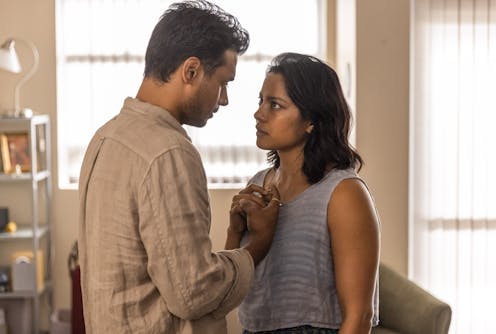
SBS’s new romantic drama Four Years Later comes in the middle of an eventful week for cultural diversity in the Australian media.
On one hand, there was a scathing review that revealed systemic racism across the ABC. On the other, there was the release of Media Diversity Australia’s Race Reporting Toolkit, intended to give journalists tools to report without resorting to racial stereotyping.
Four Years Later, an eight-part series commissioned by Screen Australia and SBS, epitomises the tension of making and watching racialised media in the current climate. The series follows an Indian couple, Sri (Shahana Goswami) and Yash (Akshay Ajit Singh), as they reunite in Australia after being forced to spend four years apart so Yash can complete his medical traineeship.

The series comes 14 years after writer and producer Mithila Gupta first introduced an Indian family to the long-running soap Neighbours. But is an Australian audience ready for content that doesn’t translate the non-white parts for a white audience?
This question may be redundant because the Australian audience itself is changing.
The changing face of Australian content
My and my colleagues’ interviews with intergenerational migrant audiences have revealed it’s largely the children of migrants who wish for more onscreen diversity to reflect their own lives. We also found young people of colour were turning away from Australian broadcasters to find said diversity on streaming platforms.
Four Years Later comes at a time when South Asian-Australian stories are finally creating ripples in Australia’s art sector, led in no small part by the success of the epic 2019 play Counting and Cracking.
Following the success of Netflix’s diverse Heartbreak High reboot, it’s heartening to see a public broadcaster take the “risk” of producing a series led by two Indian-Australian characters.
 Sridevi and Yash’s story is one that may resonate with Indian diaspora in Australia.
SBS
Sridevi and Yash’s story is one that may resonate with Indian diaspora in Australia.
SBS
As a scholar of migrants’ screen media, and someone who has been part of the Indian-Australian community for more than two decades, I’ve been party to countless conversations about how to authentically tell stories of Indian diaspora onscreen. This felt even more pressing in an Australian context as South Asian creatives in the United States and United Kingdom began gaining recognition for their outputs.
Having said that, it would be remiss to describe Four Years Later as just an Indian-Australian love story. Although it’s about migrants experiencing great precariousness while establishing themselves in Australia (and while still facing pressures from back home), the series has many universal elements.
It would appeal to most millennials trying to find themselves amid global crises and ticking clocks.
Countering stereotypes
While watching the show, I found the scenes set in India especially refreshing. The father’s typical patriarchal attitudes notwithstanding, the young characters display a kind of nuance that helps to counter common stereotypes about Indian people and culture.
For instance, Sri uses dating apps and attends meetings unchaperoned. And while she and Yash meet through a matchmaker arranged by their parents, their romance blossoms despite their families – not because of them. Also, despite being a stoic and dutiful son, Yash chooses Sri against his father’s wishes.
 Four Years Later explores a range of universal themes that transcend cultural boundaries.
SBS
Four Years Later explores a range of universal themes that transcend cultural boundaries.
SBS
Both characters make mistakes and evolve during the four years between their wedding in India and reconvening in Sydney. However, Sri’s character stands out as being particularly flawed, making it an authentic and groundbreaking representation of a woman of colour onscreen.
The freedom Sri always craved – but only begins to inhabit in beach-side Australian settings in her late 30s – isn’t what you would expect from a kurta-clad Indian woman who has just arrived in a new country. You’re more likely to encounter images of such women behind a stove or a pram, rather than having a dip in the ocean.
Four Years Later is perhaps better described as a closeted feminist coming-of-age tale, rather than an immigrant love story. While there’s no dearth of feisty female leads in English-language literature coming out of India, seeing this narrative on Australian screens will be incredibly legitimising for local diaspora.
 Sri is portrayed authentically as an imperfect South-Asian woman.
SBS
Sri is portrayed authentically as an imperfect South-Asian woman.
SBS
The series also signals how personal agency can and does exist within “collectivist cultures” that are viewed as highly patriarchal and hierarchical.
Opportunities for change
Four Years Later features a range of diverse peripheral characters. These include the second-generation brown anaesthetist who supervises Yash, a Syrian woman who works as a cleaner in the hospital (and doubles as Yash’s friend and love interest), and Sri’s white Australian friend who runs a café.
 Sri’s Australian friend Gabs (Kate Box) runs a cafe.
SBS
Sri’s Australian friend Gabs (Kate Box) runs a cafe.
SBS
A second season could explore these relationships and story arcs in more depth. It could, for instance, investigate how many migrants of colour are vested in gaining social capital in new environments – and aren’t just chasing economic aspirations. It could also explore migrant stigmas around mental health, which are alluded to in Yash’s panic attacks.
Such shows have an opportunity to present nuanced narratives that both challenge and enrich viewers’ perspectives. They can also strike a balance between community-specific issues and universal themes in a way that Australia’s news media – grappling as it is with racism and bias – could learn from.
Four Years Later is available on SBS On Demand.


