

Ice Age shelter high up in the Blue Mountains reveals Aboriginal heritage from 20,000 years ago
- Written by The Conversation
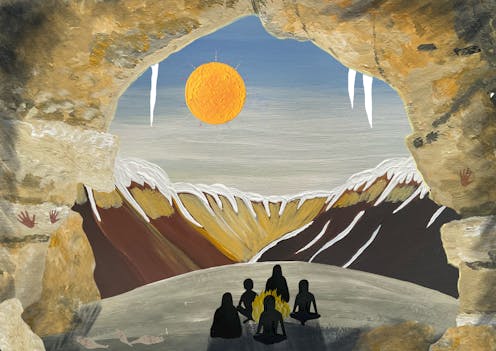
Travel back 20,000 years into the last Ice Age, to a time when the upper reaches of the Blue Mountains were treeless and the ridgelines and mountain peaks laden in snow and ice.
At an elevation of 1,073 metres, you will find Dargan Shelter, an ancient rock shelter resembling a large amphitheatre. Looking around, you could easily assume this cold and barren high country was too difficult for people to spend time in.
But our new research, published today in Nature Human Behaviour, indicates Dargan Shelter was occupied as early as the last Ice Age and repeatedly visited during this cold period.
Our excavation results provide the earliest known evidence of high-altitude occupation in Australia, establishing the Blue Mountains as Australia’s most archaeologically significant periglacial landscape – that is, an area which goes through seasonal freezing and thawing.
Cultural perspectives
This is a highly significant landscape concentrated with tangible and intangible cultural values for Aboriginal people.
For millennia, Aboriginal people have passed down the knowledge and stories of Country.
Knowing our Ancestors have lived here, in this Country, for thousands of years was on our minds as the team headed down into the site where we would sit alongside our Ancestors of yesterday.
We chose this site because of its location on a known Aboriginal travelling route, high elevation and its potential to hold deep deposits.
Archaeologically, a deep and undisturbed deposit is one of the most important things to look for. The sediment buildup over time preserves cultural material, and allows us to reconstruct past activities by associating cultural objects within distinct layers or bands of time.

When we enter the site, we pay respects to the Country and Ancestors before us. As part of the opening of the site for the archaeological works, a lyrebird song and dance were performed and, magically, a handful of lyrebirds began approaching the cave and singing out as if they were communicating between the current and old worlds through song.
We do not know who exactly the Aboriginal people who moved through the Blue Mountains in the deep past were, nor where they came from. But Dargan Shelter was probably an important stopover point for people to attend gatherings and ceremonies that could have included people from the western interior, the Cumberland coastal plains, and Country to the north and south.
Finds from the Dargan Shelter excavation
New evidence provides definitive proof of repeated occupation in this once frozen high-altitude landscape. It is now believed to be the oldest occupied site in Australia at high elevation.
We unearthed 693 stone artefacts, including 117 flakes from stratigraphic layers older than 16,000 years, and documented a small amount of faded rock art, including a child-sized hand stencil and two forearm stencils.
Charcoal from hearths (campfires) underwent radiocarbon dating, indicating Dargan Shelter had been continuously occupied since 22,000 to 19,000 years ago.

Among the findings, most of the stone tools were locally sourced and made. But, very interestingly some stones from the Jenolan Caves area, approximately 50 kilometres to the south-west, and the Hunter Valley region, 150 km to the north, were also found. This indicates people were travelling into this mountainous region from both the north and south.
We found a sandstone grinding slab, dated to 13,000 years ago, consistent with shaping bone or wooden artefacts such as needles, awls, bone points and nose points. A basalt anvil with impact marks consistent with cracking hard woody nuts and seed shells was dated to 8,800 years ago.
Greater Blue Mountains and world heritage
The Blue Mountains was listed as a UNESCO (United Nations Educational, Scientific and Cultural Organization) World Heritage area in 2000 for its outstanding biodiversity values.
Although the cultural heritage is remarkably intact and connected with an environmental system and natural features, the parallel nomination for cultural values listing failed due to a paucity of archaeological and cultural heritage information.
Our new research should be considered in a nomination for the UNESCO World Heritage area to also encompass cultural heritage alongside biodiversity.
The Blue Mountains landscape shrouds a silent yet rich tapestry of Aboriginal heritage.
Our people have walked, lived and thrived in the Blue Mountains for thousands of years. The mountains are a tangible connection to our Ancestors who used them as a meeting place for sharing, storytelling and survival. They are a part of our cultural identity.
We need to respect and protect our heritage for the benefit of all Australians.
 Archaeological works in progress: Imogen Williams, Rebecca Chalker and Tyrone Pal excavating the Ice Age layers.
Amy Way
Our results align Australia for the first time with ice age data from the world’s other inhabited continents, including sites in other places not traditionally thought of as cold climates, such as Mexico and Spain.
We now have a truly global story of people entering and living in high-altitude landscapes during the last ice age.
The continuation of research projects like this one, and the invaluable evidence it provides across the region, will allow Aboriginal people with connections to the Blue Mountains to begin to stitch back together much of the history and many of the stories that until now have had gaps.
The more we discover and piece together the movements, ceremonies and stories, the stronger we are as a community.


