

It's great education ministers agree the teacher shortage is a problem, but their new plan ignores the root causes
- Written by The Conversation
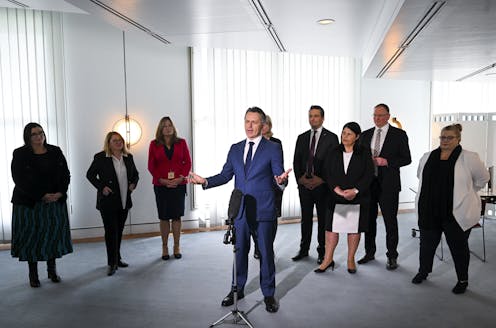
Last Friday, Australia’s state and federal education ministers met with emotional teachers, who spoke of working on weekends and Mothers’ Day to cope with unsustainable workloads – and how they were thinking about leaving the profession.
This was part of their first meeting hosted by the federal minister Jason Clare. The top agenda item was the teacher shortage.
The issue has certainly reached crisis point. Federal education department modelling shows the demand for high school teachers will exceed the supply of new graduate teachers by 4,100 between 2021 to 2025.
Meanwhile, a 2022 Monash University survey found only 8.5% of surveyed teachers in New South Wales say their workloads are manageable and only one in five think the Australian public respects them.
Ministers say they are working towards a plan to fix the crisis. But are they addressing the right issues?
What happened at the meeting?
On a positive note, all ministers agreed Australia has as problem and it is national one. As NSW Education Minister Sarah Mitchell said, “no matter which state minister would be speaking to you […], we’re all dealing with the same issues and challenges”.
Clare told reporters the ministers had tasked their education departments to develop a national plan to address the problem. This will be brought back to the ministers’ next meeting in December for tick off.
The “National Teacher Workforce Action Plan” will focus on five areas: “elevating” the teaching profession, improving teacher supply, strengthening teaching degrees, maximising teachers’ time to teach, and a better understanding of future workforce needs.
In the post-meeting press conference, Clare particularly emphasised the need for more opportunities for student teachers to get practical experience, more focus on how to teach maths and English and encouraging more teachers to mentor their colleagues.
Key questions are missing
Before the election, Labor promised to fix teacher shortages by attracting high-performing school graduates into teaching, paying additional bonuses to outstanding teachers, and importing experts from other fields to teaching.
Not surprisingly, these same ideas appear in the media release for the forthcoming national action plan.
But together Labor’s ideas and the new national plan don’t adequately address the root causes of teacher shortages: unproductive working conditions and noncompetitive pay.
Read more: Australia's teacher shortage won't be solved until we treat teaching as a profession, not a trade
One priority in the proposed new plan is to “maximise” teachers’ time to teach. In fact, Australian teachers already teach for more hours than their peers in other OECD countries.
What would improve teachers’ working conditions is not more time to teach per se, but enough time to plan and work with their colleagues to find more productive ways of teaching.
Workload is the most common reason for intending to leave the teaching profession. In the 2022 Monash University survey, teachers reported their workloads were intensifying and difficult to fit into a reasonable working week. This is due to overwhelming administration, reporting and paperwork for compliance purposes.
The detail we have so far from ministers is silent on how to fix current teacher workloads.
What about pay?
Another reason for teacher shortages is non-competitive pay, especially when it comes to salary progression over a teaching career.
So far, ministers are talking about “rewarding” high-performing teachers. International studies show unexpected things can happen when teachers strive for “excellence” to receive monetary bonuses. Performance-based pay can lead to declining creativity and collegiality in schools when test scores become the dominant driver of teachers’ work.
This also takes away from the main issue. Instead of paying some teachers more, every teacher in Australia deserves fair compensation that reflects the work they do.
A plan to have a plan
Australia is a Promised Land of action plans and working groups. But we are not so good at implementation.
For example, we have declarations and reviews about what school education should be (the Mparntwe Declaration), how schools should be funded (the Gonski Review), and what rights our children have.
But we struggle to turn these into practice. There is a real risk the new “National Teacher Workforce Action Plan” will just see more good intentions and little concrete action.
Australia can learn from other countries
The good news is, Australia is not alone. The United States and England have suffered from chronic shortage of teachers in their schools for some time.
Even in Estonia and Finland – the OECD’s highest-performing countries in education – teaching is not as attractive profession as it used to be. So, there is an opportunity to learn how other countries deal with the teacher workforce challenge.
Every year since 2011 the OECD and Education International have organised the International Summit on the Teaching Profession with the world’s top-performing education systems. Here education ministers and education leaders from 20 countries explore current issues in the teaching profession. Collaboration between ministers and teachers’ unions is the key principle of the summit.
Australia has been invited to these summits since 2011 but has never attended. So, a decade of opportunities to work with other countries has been wasted.
But it is not too late, Clare could attend in the 2023 summit that will be held in Washington DC. Not only to see what others do, but to learn what might be improved in governments’ action plan and teacher policies.
This is what all “education nations” do. Why don’t we?
Read more: Australia spends $5 billion a year on teaching assistants in schools but we don't know what they do


