

Who was Catherine de' Medici? The Serpent Queen gives us a clever, powerful and dangerous woman
- Written by The Conversation
In the last week, I’ve been contacted by several friends and colleagues telling me if you type #catherinedemedici in Twitter, a snake emoji automatically appears. Designed to sync with The Serpent Queen, the serpent now appears even with hashtags made in tweets years ago.
This new Catherine is now the old Catherine.
In a life lived across most of the 16th century, Catherine de’ Medici was Queen of France, the mother of three kings and two queens, and the mother-in-law of Mary, Queen of Scots.
Anyone with that degree and longevity of access to influence across Europe was bound to attract attention.
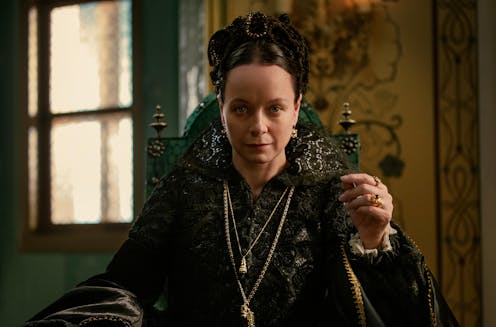
In The Serpent Queen, we get a clever and powerful Catherine (played by Liv Hill as a teenager and Samantha Morton as the woman in her 40s), beguiling and dangerous, forged in the violence of her childhood and as an emotional response to the rejection of her love by her husband Henri (Alex Heath as the young Henri and Lee Ingleby in adulthood).
This Catherine decides to govern aided by the dark arts, determined to teach her enemies a lesson. She is also playful, musing “it feels good to be bad,” to a backing track of rock guitar.
But do we actually have a new interpretation? Here, a familiar story of one of history’s favourite bad girls strikes again. And in the process, Catherine de’ Medici is again diminished.
It seems the well-crafted propaganda of her own century – and additions of those since – remain as compelling as ever.
A woman of power
Catherine was never the ruler of France, but she was intimately acquainted with politics at the highest level.
She was an assiduous networker. Her remaining letters (some 6,000 survive) give us just a sense of the enormous reach of the relationships she maintained over a long and well watched life.
Hers was a remarkable trajectory. The Medici were not a dynasty of royal blood, but she nonetheless became queen of France, served as regent for her husband and was governess and advisor to her sons.
Her access to influence as a wife and mother, while conventional, was perceived by political men and commentators beyond the court as dangerous because it sat outside formal mechanisms for regulating power.
Multiple versions of Catherine
Catherine was at the height of power when the French kingdom was at war with itself. The French Wars of Religion, lasting from 1562 to 1598, pitted Catholics and Huguenots against each other, fighting for the soul of France.
Widowed in 1559, Catherine remained close to the throne as the advisor to her three sons who became king.
Although Catholic, Catherine’s recommendations for her sons generally favoured a middle course that aimed to maintain the integrity of the realm, and the reputation of the dynasty she had married into.
This pleased few among the ardent on either side, who turned to the pen to respond, creating multiple versions of Catherine as suited their cause.
Sexualised tropes presented Catherine as a danger to men of either side in this conflict. A pamphlet of 1575 versified:
She unmans cocks, tearing off their crests and testicles, a virago holds sway over the French. An unbridled woman dines on the testicles of cocks, and as she devours this food, she smacks her lips and says: ‘Thus, I castrate Gallic courage, thus I unman the French, thus I subdue them!’
This version of Catherine was catchy.
There were many versions of Catherine. Some were the versions she made with her allies for public consumption: versions made in art, ceremony, palaces and acts.
Others had their own ideas about who Catherine was, or what version of Catherine best suited their objectives. Not all had the same reach and not all have been reproduced through to the present day.
Catherine knew the high stakes for women. She had a fraught and complex relationship with Mary, Queen of Scots, but she defended her to Elizabeth I’s courtier Francis Walsingham, telling Walshingham she “knew very well how often people said things of a poor afflicted princess that did not always turn out to be true.”
After her death, dozens of Catherines took free flight in novels. Alexandre Dumas’ Queen Margot (1845) has Catherine dissecting the brains of a chicken whose head she has severed with a single blow, for prophetic analysis. She conducts herself with a “malignant smile”.
She fared little better among 19th century scholars. The influential historian Jules Michelet, a Huguenot, famously termed Catherine “the maggot from Italy’s tomb”.
This version of Catherine was also catchy.
Read more: Mary, Queen of Scots was a poet – and you should know it
Women in the public eye
Catherine’s treatment throughout history reflects our problematic relationship with women’s roles in public life. There has been a long history of hostility to women of power and women in power.
The Serpent Queen traces Catherine’s life from the trials of her childhood to the beginning of what would become almost 30 years as a central figure in the reigns of her sons. Here we have an engaging Catherine with agency, narrated by Catherine herself. Her lines even echo speeches recorded by contemporary ambassadors.
Does Catherine at last have the final word?
This Catherine seems to seek our sympathy. She looks and speaks directly to us, seemingly eliciting our understanding of her decisions. “Tell me what you would have done differently?” she asks us.
But it is perhaps our collusion in the making of a familiar version of Catherine the series seeks to elicit.
Is this a new Catherine for new times, complex, contextualised, freed from the “bad girl” reputation that has followed her through time? Or a dangerously attractive, lavish rehash of Catherine as “bad girl” all over again?
The Serpent Queen is now airing on Stan.


