

About 200 dead whales have been towed out to sea off Tasmania – and what happens next is a true marvel of nature
- Written by The Conversation
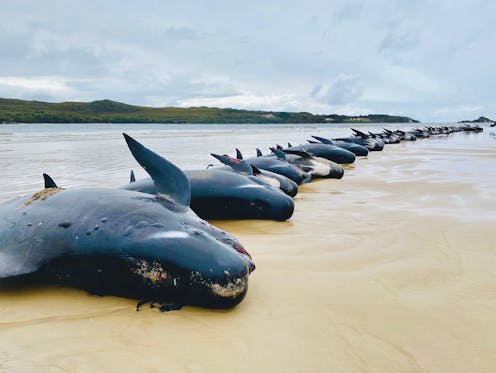
Australians watched in horror last week as 230 pilot whales became stranded at a beach near Macquarie Harbour on Tasmania’s west coast. Some whales were saved, but the vast majority died. This left a big problem: what to do with all the rotting whale carcasses?
Authorities decided to tow the dead animals out to sea, hoping they’ll eventually sink to the seafloor.
Such mass whale strandings are sad to witness. But in this case, the aftermath presents a fascinating opportunity for scientific discovery.
As the dead whales decompose, an astonishing and rare chain of events is likely to flow through the marine ecosystem – ultimately leading to an explosion of activity and new life.
A 600-tonne problem
Mass whale strandings happen fairly regularly – especially in Tasmania – yet no one really knows why.
Days before this latest incident, 14 sperm whales became stranded off King Island, northwest of Tasmania.
And in 2020, about 470 pilot whales became stranded at Macquarie Harbour. While many were pulled out to sea, some of those carcasses washed up and were left to rot on the beach – an entirely natural process.
However, pilot whales are big animals. Males weigh up to 2,300kg, which means they take a long time to decompose. The smell of two tonnes of rotting whale blubber soon becomes unbearable, so carcasses are frequently buried.
This time around, authorities decided to tow the dead animals out to sea. The ABC reported local salmon farm workers took almost 11 hours to dispose of 204 dead whales with a combined weight of between 500 and 600 tonnes.
They were tied to a 400 metre-long rope and towed by boats for 40 kilometres, before being dropped into deep water in the Indian Ocean.
Some carcasses may wash back to shore, but most are likely to disperse with the tides and currents.
Read more: Curious kids: why don’t whales have teeth like we do?
Shark bait? Probably not
The big question is: what happens to all that whale mass dumped at sea?
Initially, a dead whale tends to float to the surface as it begins to decompose and its innards expand with gas. As this happens, ocean scavengers such as sharks and seabirds are likely to feast on the remains.
Some people can be concerned that whale carcasses attract sharks that might pose a risk to humans.
Granted, encounters between sharks and humans, are on the rise in Australia and elsewhere. But they’re still very rare.
A report to the Western Australian government in 2012 found whale carcasses were a risk factors associated with shark attacks, and said caution should be exercised near a dead whale in the water.
But the same report noted that of 26 shark attacks investigated, the highest number occurred more than a kilometre offshore. While there is no doubt sharks are attracted to dead whales, the data is not clear on whether a whale carcass leads directly to an increase in shark attacks on people.
Research has shown the likelihood of whale carcasses washing towards shore, where shark scavenging can be observed, is low. So as long as the carcass is taken far from shore and people keep their distance from it, the threat to humans from shark encounters appears to be exceedingly low.
Read more: Why do whales keep getting tangled in shark nets? And what should you do if you see it happen?
From death comes new life
Inevitably, the whale carcass will start to sink. Most life in the ocean is found fairly close to the sea surface, so if the water is relatively shallow much of what’s left of the carcass will be quickly eaten by scavengers once it reaches the sea floor.
But these carcasses have been disposed of in deep water. The deep ocean can be a barren place, where rich food sources are rare. So the appearance of a single whale carcass can supercharge an entire ecosystem.
New life and activity can erupt around the dead animal in very little time. This process is known as “whale fall” and has been studied by scientists, sometimes using remotely operated vehicles. On the seafloor of the North Pacific, whale fall has been found to support the survival of at least 12,490 organisms of 43 species.
Deep sea sharks will make the most of the carcass. A host of other animals including hagfish, octopus, crabs, lobsters, worms and sea cucumbers will join in too. All the while bacteria work away quietly in the background.
According to Britain’s Natural History Museum, a single whale can provide animals with food for up to two years during the scavenging stage.
Other animals and bacteria survive off the chemicals produced from the rotting carcass.
These organisms, known as “chemotrophs” were thought to be unique to underwater volcanic vents, where they use hydrogen sulphide as the principal energy source. Research has shown a similar suite of animals recruit around dead and decaying whales – generating a completely independent ecosystem based on a gas that smells like rotten eggs.
Only a few organisms can break down the bones that remain, in a process that might take up to ten years.
So take a moment to consider the effect of 204 whale falls in a small part of the ocean off Tasmania. Right now, they are probably generating interconnected marine metropolises, the likes of which are rarely seen.


