

Labor's love lost: the tide is turning on private ownership of electricity grids
- Written by The Conversation
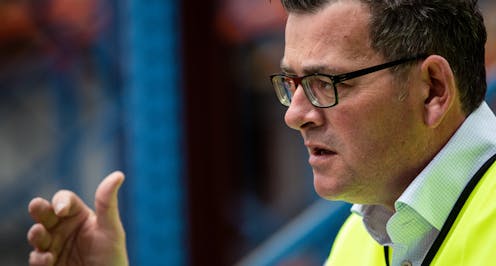
The promise by the Andrews government to reintroduce public enterprise to Victoria’s electricity industry, through a revived State Electricity Commission, is something of a shock.
The process of electricity privatisation in Australia began with Labor in Victoria, when the government of Joan Kirner sold 51% of the Loy Yang B power station in 1992. Her Liberal successor, Jeff Kennett, then sold the remainder of Loy Lang B, as well as the rest of the state’s publicly owned generation, transmission and distribution assets.
Labor has been office for all but four years since Kennett’s defeat in 1999. Until now it has made no attempt to reverse his policies. Rather, it has undertaken some rather dubious privatisations of its own, notably the Andrews government’s 2018 sale of the Land Titles and Registry office.
Premier Daniel Andrews’ statement that “it was wrong, it was a mistake, to sell our energy companies” therefore marks a clear shift.
Labor leaders change tack
The change is part of a broader shift in Labor’s position throughout Australia.
Arguably this shift began in Queensland after the trouncing of Anna Bligh’s Labor government in 2012, winning just seven of 89 seats. The Bligh government had sold a range of public assets (though retaining distribution and transmission networks, and coal-fired power generators). The remnants of the Labor party concluded privatisation was electoral and economic poison.
Labor was returned to power in 2015 after the LNP government of Campbell Newman, having sought to push privatisation further, was ousted after one term. Under Annastacia Palaszczuk the Queensland government is now investing in new renewable generation through the publicly owned CleanCo – including 18 wind turbines as part of the MacIntyre Wind Precinct, the largest wind farm project in the southern hemisphere.
NSW Labor went through similar contortions over privatisation, with a series of premiers and treasurers trying and failing to find a way of selling the electricity industry.
The disastrous defeat of the Keneally Labor government in 2011 was driven by this failure, along with the string of scandals that seem to be the rule rather than the exception in NSW politics.
Now, with the prospect of Labor returning to power next March, Opposition leader Chris Minns has given a guarantee there will be no more privatisations.
At the national level, the biggest single commitment of the Albanese government is the $20 billion Rewiring the Nation initiative, to build the transmission network needed for clean energy. The first two projects to be financed – the Marinus Link between Tasmania and Victoria, and the Kerang link, between Victoria and NSW – are publicly owned.
Taxpayers worse off
What explains this shift?
First, public opinion is now opposed to privatisation.
There was significant public support for privatisation in the 1980s, but this went into decline after major privatisations began in the early 1990s. Contrary to the hopes of supporters, experience with privatisation only made voters more hostile. This has finally permeated through to political commentary. The failings of formerly public enterprises like Qantas are now regularly traced back to the process of privatisation.
Read more: Public's view of the politics of privatisation comes full circle
More importantly, politicians now understand that the economics of selling income-generating assets don’t stack up.
The premise for privatisation was that it was better for taxpayers to sell state-owned assets and reduce public debt.
But, particularly when interest rates on public debt are below the rate of inflation, government-owned enterprises generate returns well above the cost of the capital invested in them.
Those states that kept ownership of their electricity networks, such as Queensland and Tasmania, have received a steady flow of dividends, and the value of their assets have appreciated. The proceeds of privatisation in other states have long dissipated.
Read more: The end of coal-fired power is in sight, even with private interests holding out
According to the ideology of privatisation, the low cost of borrowing for public enterprises is an illusion, because the public is on the hook for the cost of a bailout in the event of any business failure. But such bailouts have been very rare in Australia, and taking their costs into account does not change the calculation significantly.
The risk premium demanded by investors in private equity has always been large, and is now growing, making the gap between the private and public cost of capital even larger. There has been a corresponding drop in private investment globally, and (outside mining) in Australia. The case for public investment has never been stronger. Labor politicians seem finally to have realised this.


