

For the first time ever, we have a complete skull description of a true fossil giant wombat
- Written by The Conversation
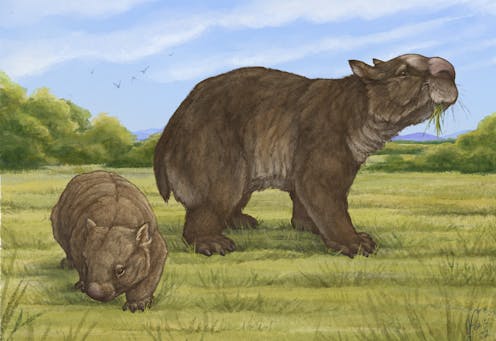
The place we call Australia today was in many ways vastly different 80,000 years ago.
Perhaps nowhere is this more evident than in the animals that would have roamed the plains and inhabited the forests of the continent. Huge marsupials ruled the land, including giant kangaroos, giant koalas and giant wombats.
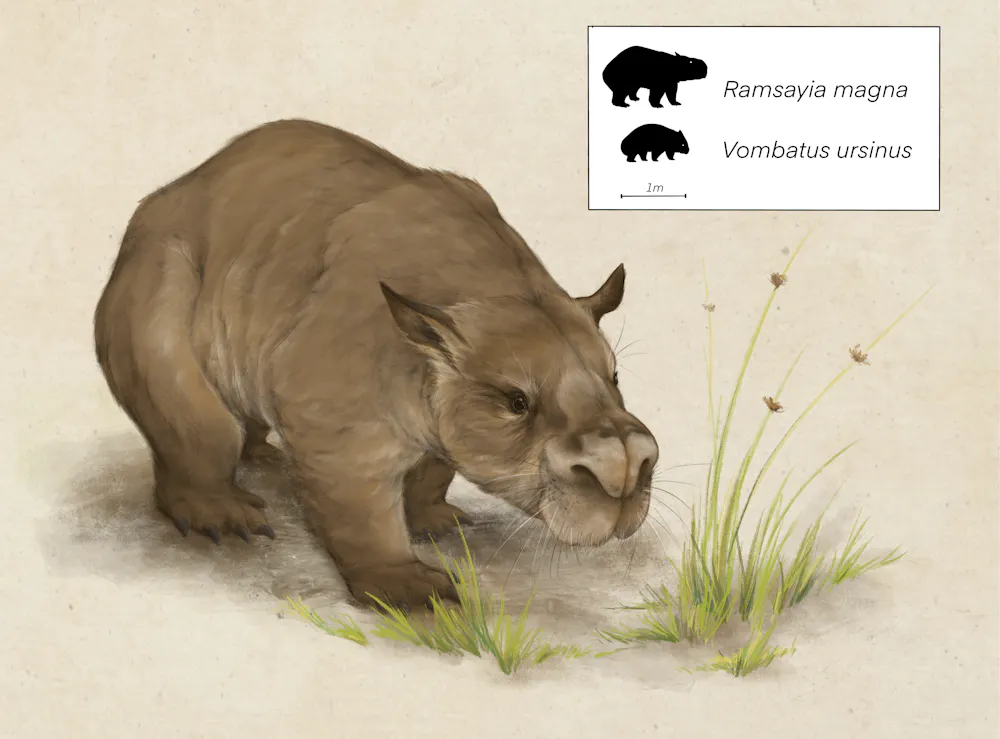
In a study published today in Papers in Palaeontology, we describe the most complete skull of one of these giant wombats, a hitherto poorly known species called Ramsayia magna. This marsupial bore more than a passing resemblance to a giant beaver crossed with a modern hairy-nosed wombat.
A wombat impostor and a unique skull
Among the charismatic megafauna of Australia, perhaps the best known is the giant marsupial Diprotodon, often referred to as the “giant wombat”.
Contrary to what this moniker suggests, however, Diprotodon is not a wombat at all. Rather, it belongs to a family as distinct from wombats as hippos are from pigs, or as we are from monkeys.
Nevertheless, “true” giant wombats are known from Australia – Phascolonus, the largest, Sedophascolomys, the smallest, and finally Ramsayia, the rarest (roughly cow, goat and sheep-sized, respectively). Ramsayia was previously only known from isolated tooth and jaw fragments.
In the caves of Mount Etna just outside Rockhampton in Queensland, we uncovered a fossil that turned out to represent the most complete remains of this animal ever found. Our detailed anatomical study of this remarkable new specimen revealed what the animal looked like, its unique adaptations to grazing, and the evolutionary history of the giant wombats.
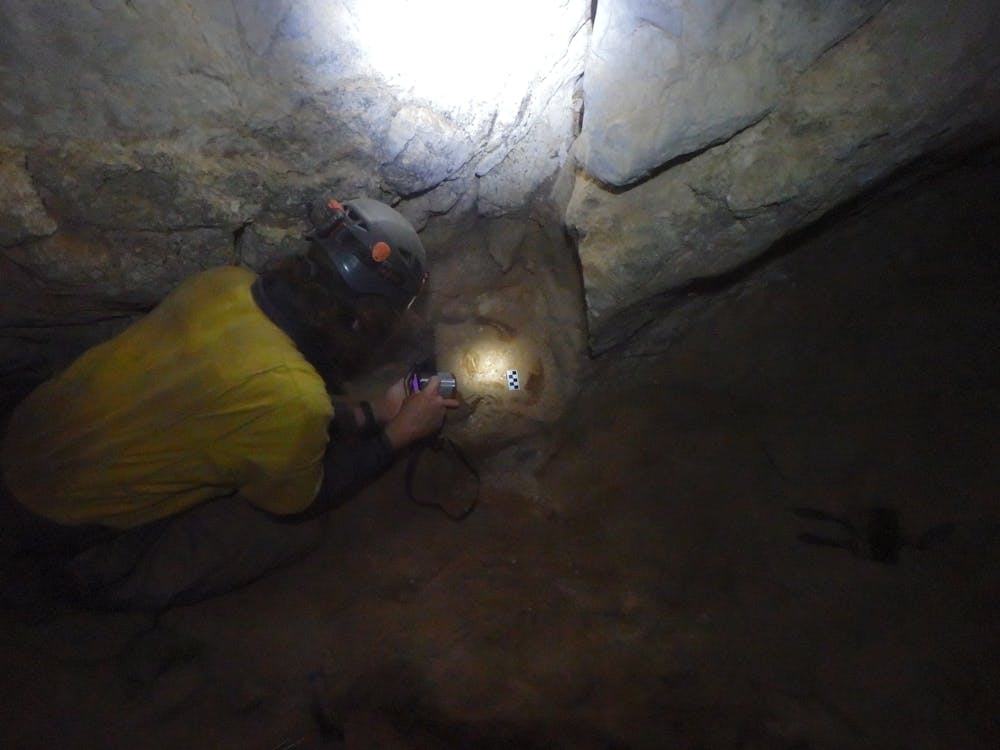 The skull of the giant wombat was found in the caves of Mt Etna, Rockhampton.
Julien Louys, Author provided
The skull of the giant wombat was found in the caves of Mt Etna, Rockhampton.
Julien Louys, Author provided
Air pockets in the skull
One of the first things we noted about Ramsayia was that the back of its skull preserved evidence of air pockets or sinuses not found in modern wombats.
These sinuses develop for two primary reasons. The outside of a mammal’s skull sometimes grows at a different pace to the brain cavity and the bones that directly surround it. While an animal (and its skull) can reach enormous sizes, its brain size may lag behind; a very large animal doesn’t always need a much larger brain than its smaller relatives.
To accommodate a huge skull and moderately sized brain without adding too much weight, sinuses develop – air cavities supported by bony struts. A larger skull with sinuses also provides more surface area for the attachment of larger chewing muscles, letting the animal process much tougher or poorer-quality foods than smaller species.
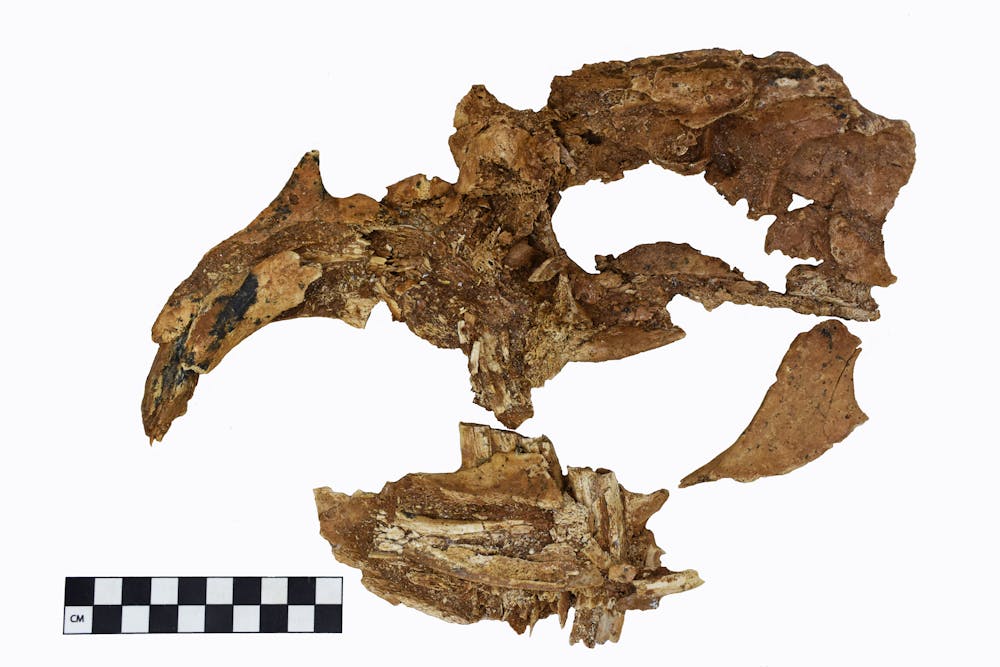 View of the inside of the skull of Ramsayia, showing the development of sinuses in the back of the skull (top right of image) and the distinct ‘premaxillary spine’.
(Louys et al., 2022), CC BY-NC
View of the inside of the skull of Ramsayia, showing the development of sinuses in the back of the skull (top right of image) and the distinct ‘premaxillary spine’.
(Louys et al., 2022), CC BY-NC
Although these sinuses have been found in other extinct giant marsupials, this is the first time they’ve been recorded in any wombat species.
They would have given Ramsayia a more rounded head than modern wombats, who have famously flat skulls that may be an adaptation to their underground lifestyle. This could mean Ramsayia did not live in burrows like wombats do today.
Interestingly, cranial material for another giant wombat, Phascolonus, (known for decades but still not studied in detail) suggests the top of its head was “dished-in”. This would indicate that like modern wombats, Phascolonus did not develop these sinuses and they may be unique to Ramsayia.
A sizeable snout
The second major feature we noted was the development of a vertical bony spine where most other marsupials have elongated, horizontal nasal bones.
Called a “premaxillary spine”, it most likely developed to provide structural support for a large fleshy nose: not quite a trunk, but certainly a sizeable nasal appendage. In this regard, as well as in the highly curved shape of its gape (the diastema) and incisors, it closely resembles Diprotodon, as well as giant fossil beavers found in America and Eurasia.
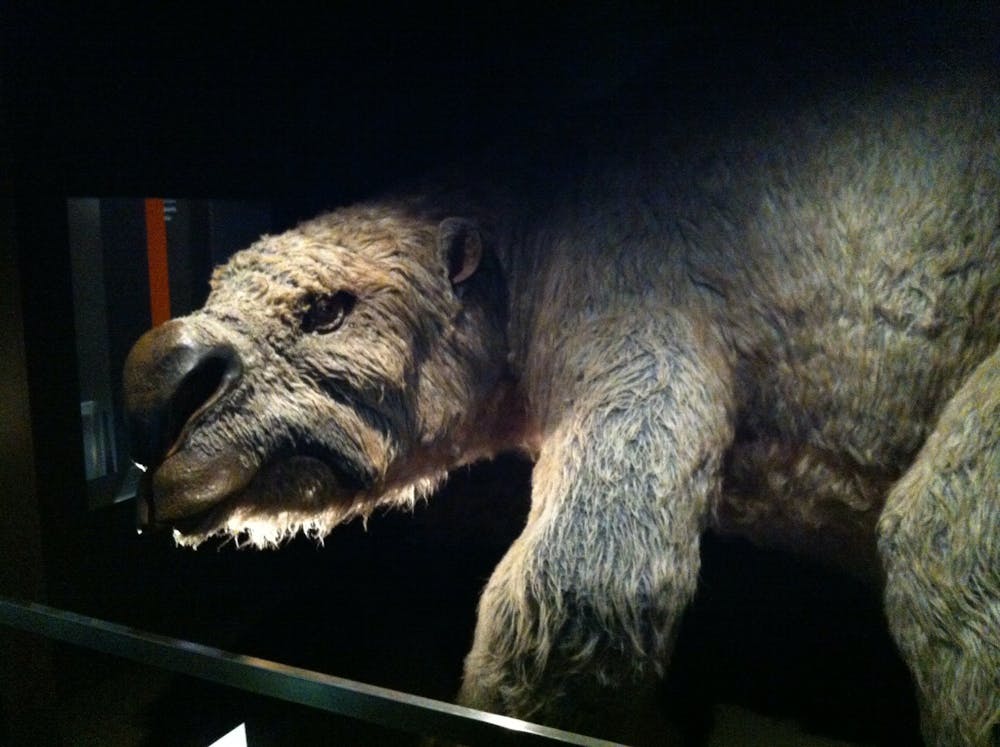 Diprotodon, often incorrectly called the ‘giant wombat’ showing its large, fleshy nose.
Julien Louys, Author provided
Diprotodon, often incorrectly called the ‘giant wombat’ showing its large, fleshy nose.
Julien Louys, Author provided
Using the features preserved in the skull of Ramsayia, we compared it to other wombats and wombat-like creatures, to better understand the evolution of giant wombats.
One interesting finding was that all three giant wombats – Phascolonus, Sedophascolomys, and Ramsayia – are more closely related to each other than they are to other extinct and modern wombats. This indicates that gigantism in wombats evolved only once and early in their evolutionary history.
A trend to gigantism was likely in response to the gradual drying out of the Australian continent that started about 20 million years ago and the need to process poorer quality food such as grasses – harder to ingest than leaves and fruits.
A mysterious extinction
To find out the age of the specimen, we used a combination of dating methods known as uranium series and electron spin resonance. These techniques allow us to date beyond the radiocarbon dating window of around 50,000 years.
Our results indicate this individual lived approximately 80,000 years ago in the Rockhampton region. We also found traces of this species even farther north, towards the Chillagoe area. This shows Ramsayia inhabited temperate to tropical grasslands of ancient Australia.
What caused its final extinction? While some have argued the species was wiped out by the arrival of humans, the truth is we don’t yet have enough data to be able to say.
Our paper provides the first ages for this species, and important insights into what it looked like and how it lived. But many more records will be needed to best determine why this giant wombat is no longer with us today.
We thank Eleanor Pease and Ian Sobbe who also contributed to this article.


