News Daily


Men's Weekly

Australia

  • Written by The Conversation
How FTX Australia was able to get away with claiming it was 'ASIC-licenced'

When cryptocurrency exchange FTX Group collapsed in the Bahamas last month, its local subsidiaries FTX Australia Pty Ltd and FTX Express Pty Ltd fell over too.

The Australian companies were placed into administration on November 11 and within days the Australian Securities and Investments Commission (ASIC) had suspended the Australian financial service licence FTX Australia had held since March 2022.

The fact that FTX Australia had an Australian financial service came as a surprise to some people, who had wrongly assumed everything crypto-related was beyond the reach of Australia’s regulators.

It also raised questions – including for Assistant Treasurer Stephen Jones – about how FTX Australia managed to acquire its Australian financial services licence, and how ASIC seemed to have missed the chance to intervene sooner.

And it draws wider attention to the 20-year-old licensing system and what an Australian financial service actually means for the firms that have them.

Licensed to do what, precisely?
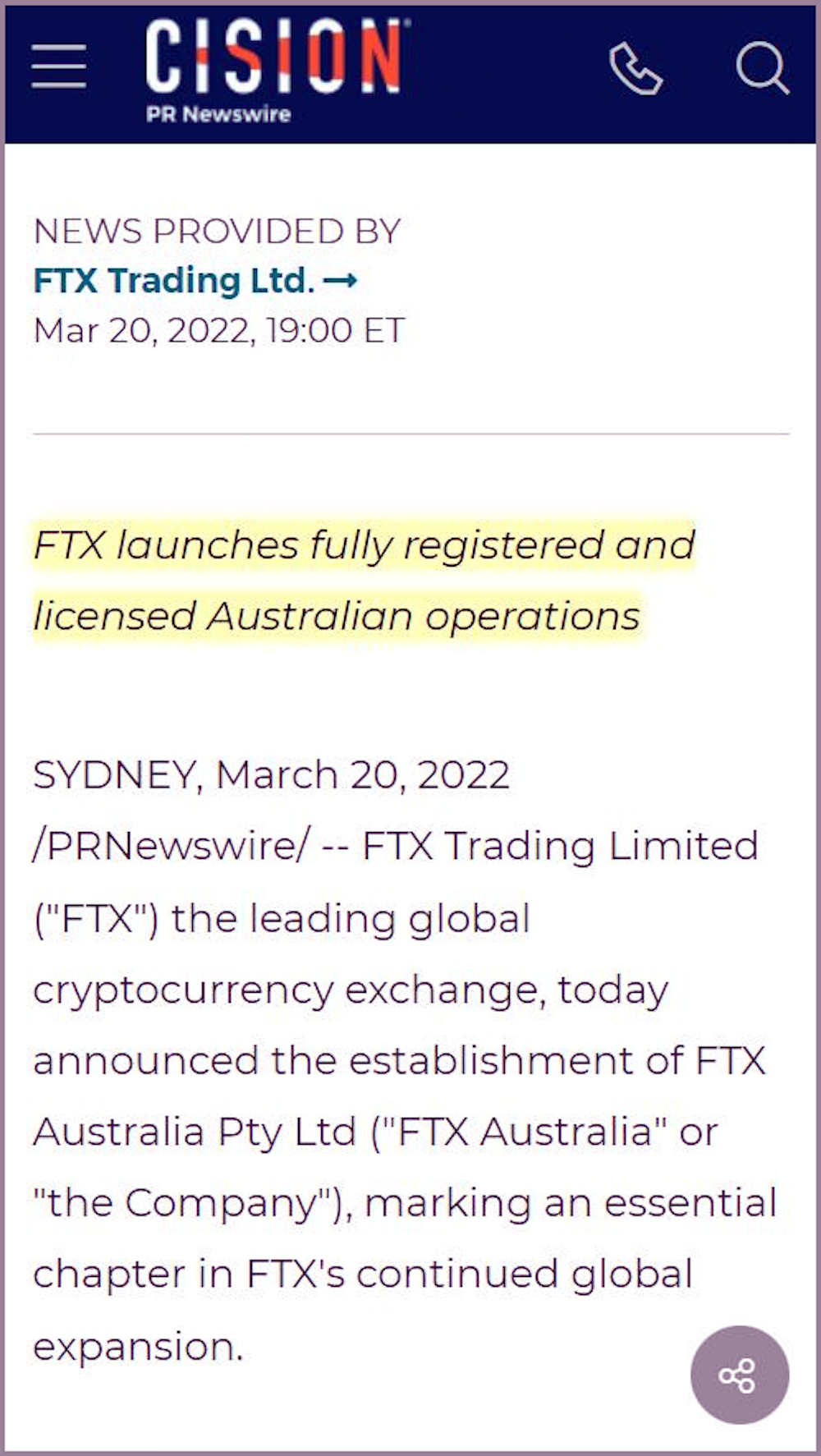
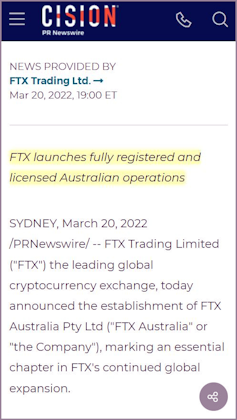
FTX Trading Limited When FTX commenced operations in Australia this year, its media release was headed: “FTX launches fully registered and licensed Australian operations”. But what exactly was it licensed to do? The Australian financial service (AFS) licensing regime in place since the late 1990s authorises each firm to do specified things, in relation to specified financial products, for specified clients. Each firm’s licence is different, and what is required by ASIC is different depending on what the firm is authorised to do. FTX Australia’s licence authorised it to deal in, make a market for, and provide general advice relating to derivatives and foreign exchange contracts to retail and wholesale clients. That’s it. Note that crypto-assets are not specified, nor is running a crypto-asset exchange. The jury is still out globally on whether crypto-assets (as distinct from investments derived from crypto-assets) are financial products at all. It is possible to think of them as like gold bullion or fine art – or pet rocks – where the asset itself is not a financial product, but a financial product might be constructed from it. If a cryptocurrency is not a financial product, then licensing laws can’t apply, which might explain why one of the two firms set up in Australia – FTX Express, which operated the crypto-exchange – was not AFS licensed. Read more: 'I thought crypto exchanges were safe': the lesson in FTX's collapse The lesson is that knowing a firm has an AFS licence only takes you so far, and often not very far at all. Unless you check the specific authorisations, there’s no way of knowing how little the firm you are dealing with is licensed to do. And ASIC-regulation doesn’t involve prudential regulation, which is directed at the stability of the company itself, ensuring among other things that it should be able to meet its financial commitments under reasonable circumstances. Prudential regulation is the job of the Australian Prudential Regulation Authority, which regulated neither FTX Australia nor FTX Express. Licences for sale FTX Australia’s ASIC licence was originally granted to someone else entirely back in 2008. A series of takeovers meant it passed through a number of hands until it ended up with FTX in March this year. While an original applicant has to satisfy rigorous checks, this hasn’t always been the case for subsequent purchasers. ASIC has known for years that its ASF licences were ending up in new hands when companies were bought and sold. In 2017, it asked the government’s ASIC Enforcement Review Taskforce to recommend changes to the law that would allow it to revisit an AFS licence when its owners changed. The change that was eventually legislated in 2020 only required licensees to notify ASIC when a licence changed hands, within 30 days. It did not require ASIC to approve the change in control. Limited ASIC powers ASIC is able to inquire further to determine whether there is reason to believe a new licensee was likely to contravene its statutory obligations or is “fit and proper” – but it is not required to do so. If it finds either that the licensee is likely to contravene its obligations or that it is not fit and proper, it is able to suspend or cancel the licence after giving the new owners a fair hearing. Read more: How 'bad credit' lender Cigno has dodged ASIC's grasp But such inquiries have not become routine. Most of the (hundreds of) licensee purchases notified each year seem to go through to the keeper, as did FTX’s. Even if ASIC had reviewed FTX’s purchase of the licence in March 2022, it might well have found no grounds to revoke it, given the very limited range of activities it authorised. The FTX collapse may result in ASIC changing its attitude to change-of-control transactions involving AFS licensees, for which it might need more resources. But even if that happens, clients would still be well advised to take care to understand exactly what “AFS licensed” really means.

Read more https://theconversation.com/how-ftx-australia-was-able-to-get-away-with-claiming-it-was-asic-licenced-196361

Cleaner Floors, Healthier Homes: Lefant M3L Arrives as Australians Prioritise Pet-Friendly Hygiene

As pet ownership continues to rise, Australians are placing greater emphasis on maintaining a hygienic indoor environment for both family members and their animals. Issues such as dander, loose fur, and tracked-in dirt require consistent cleaning to support better home... Read more

How Home Removalists Save Time, Money, and Energy During Your Move

Moving to a new home is an exciting chapter in life, but the process of getting there can be overwhelming. From packing and organizing to transportation and unpacking, relocation involves a long list of tasks that can consume both your... Read more

Fulfilment Australia: Streamlining ECommerce Operations for Business Growth

As eCommerce continues to thrive, efficient order fulfilment has become one of the most critical components of customer satisfaction and business success. Companies across the nation are turning to professional fulfilment Australia providers to manage inventory, packaging, and shipping operations... Read more

Evaporative Cooling Cleaning Melbourne: Keeping Your System Fresh, Efficient, and Healthy

As Melbourne’s summers grow hotter, many homes rely on evaporative cooling systems to stay comfortable. While these systems are energy-efficient and environmentally friendly, they require regular maintenance to perform at their best. Professional Evaporative Cooling Cleaning Melbourne services are essential... Read more

4 Benefits of Exploring Australia in an Off Road Caravan

Australia’s vast landscapes offer a kind of freedom that can only be fully experienced on the open road. For travellers seeking caravans for sale, choosing one built for adventure can transform any journey into a memorable one. This article will... Read more

The Importance of Professional eCommerce Web Design for Online Success

The online shopping industry has grown at a rapid pace, and with it, customer expectations have evolved. Today, having a basic website is not enough to attract and retain customers. Businesses must invest in professional eCommerce web design that not only... Read more