

Australians pay $163 a month on average to store all the stuff we buy – how can we stop overconsuming?
- Written by The Conversation
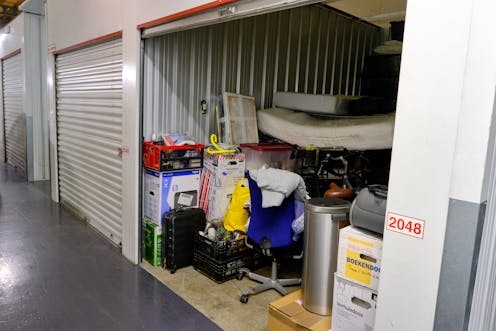
Many of us are drowning in “stuff”. To find space for all our possessions, we are paying off-site storage companies. Australians spend an average of A$163 per month on self-storage, one recent survey found.
The number one item stored in these facilities is furniture. Other items we cannot fit in our houses include appliances and electronics, hobby items, sports equipment, collectibles, memorabilia, books and photographs, cars and wine.
Around a quarter of customers cannot remember what is actually in their storage unit. Around 13% use them to hide their purchases from others.
The massive growth of the household storage industry is a sign of overconsumption. It’s a problem in many developed economies that’s doing increasing harm to the planet.
Unfortunately, the Earth does not have an off-site storage option. Curbing our desire to consume has to be the solution.
Costs are mounting for us and the planet
Australians owe, on average, about $3,800 in credit card debt and a further $17,700 in personal debt (excluding property debt, which averages $565,880).
This year Australian shoppers were expected to spend $63.9 billion in the six weeks before Christmas, about $2,458 per person.
We waste a lot of what we buy. For example, each year Australia wastes 7.6 million tonnes of food, with consumers accounting for half of this waste. The food we throw out is worth between $2,000 and $2,500 per household – or up to $1,000 per person.
Read more: Why 'best before' food labelling is not best for the planet or your budget
That’s just the start of the wasteful spending – think of all those gym memberships, gift cards, clothes, appliances and furniture we’ve bought but don’t use.
In total, Australian households produce about 12.4 million tonnes of waste each year. That equates to roughly half a tonne per person.
We are not just spending beyond our personal means but also beyond what our planet can sustain.
Eventually, we will run out of places for all this waste to go.
Read more: Spending too much money? Tempted by sales? These ways to 'hack' your psychology can help
I’m not a hoarder, but …
People who own lots of stuff, or who collect things, are not necessarily hoarders, but may struggle to part with personal and household possessions. The reason can in part be explained by Belk’s concept of the extended self. This is when possessions become part of our identity and signal to others who we are and, importantly, who we want to be.
This is certainly the case for those who collect things. Our collections become a part of us and our life story. It can be difficult to disentangle ourselves from these possessions.
Some things we own may have symbolic value because they remind us of special people, places and events, such as gifts from a friend or souvenirs from a holiday. Possessions that still have potential financial or utilitarian value can also be hard to give up.
Read more: Why and how retailers turn everyday items into 'must-have' collectables
Why buy so much in the first place?
Part of the problem is we are exposed to thousands of advertisements every day and a huge array of cheap products. The temptation to keep buying things can be too much for many people.
In their 2005 book Affluenza, Clive Hamilton and Richard Denniss describe the Western world as being in the grip of consumerism. Fast forward to 2022 and it appears we haven’t changed much. Behaving as though we have a chronic lack of stuff, we simply buy too many things we don’t need.
Many Australians live in small houses or apartments that lack space for all their things. Even those in large houses find they are overflowing with possessions but are loath to give up some of them.
The solution is we pay someone else to store our possessions – and we pay a lot. Self-storage in Australasia has grown into a $1.5 billion industry.
There are about 2,000 self-storage facilities across Australia and New Zealand. Some house hundreds of individual storage units.
Depending on the size, location and type of storage unit (for example, climate-controlled for wine collections), the costs can add up to thousands of dollars a year for some people.
Read more: Why kids should not have lots of toys (and what to do if yours have too many)
What can we do about it?
It is easy to be swept up in the shopping frenzies of Christmas and new year sales. We are “programmed” to spend by marketers and retailers who surround us with temptation in stores and online.
But there are things you can do to help counter the impulse to buy and reduce its impacts.
Make a list and set a budget before you head to the shops, and try to stick to it. Use cash instead of cards when you can. Research shows people feel the cost of paying more when using cash. Don’t shop on an empty stomach or when you are tired.
Where possible, shop locally and buy locally made items. It’s great for your local economy, and the planet benefits from fewer air miles.
Rather than products, consider gifts of experiences, which don’t involve accumulating “stuff”. Options include creative classes, entertainment, sports, or health and beauty services.
Look for products with less packaging or with biodegradable packaging. Buy loose products and choose refillable options where you can.
Ask yourself: do I really need to buy this? If I didn’t have a credit card, could I actually afford it today?
We can all use self-monitoring to improve our spending habits and reduce the environmental costs.


