

Win-win: how solar farms can double as havens for our wildlife
- Written by The Conversation
Australia’s renewable energy transition has prompted the construction of dozens of large-scale solar farms. The boom helps reduce Australia’s reliance on fossil fuels, but requires large areas of land to be converted to host solar infrastructure.
Solar farms are mostly built in rural areas. This has raised concerns about a potential decline in both agricultural production – as arable land is used for solar energy production – and wildlife habitat.
But there are ways to expand solar infrastructure so both nature and people win. We’ve already seen this in so called “agrivoltaics”, where land under and around solar panels is used to grow crops and graze livestock. But what about “conservoltaics”, combing conservation and solar energy?
My new research examines whether solar farms could also be used to help conserve native species. I found solar panels can provide valuable habitat for wildlife – and potentially benefit both the land and farmers.
A new place to call home
Our wild landscapes are diminishing and protected areas, such as national parks, cover only about 9% of Australia.
Many agricultural landscapes have been cleared of trees to provide pasture for livestock. It means wildlife that rely on trees have lost vast tracts of habitat.
So we must find new places for wildlife to forage, rest, shelter and breed.
My work examines how solar parks on agricultural land can double as wildlife habitat. It involves surveys and trapping to identify what plants and animals occupy solar farms, how long they take to recolonise, and how we can promote even more biodiversity.
My new paper coins a new term for this dual land-use: conservoltaics. I highlight research from overseas into how solar parks can bring conservation benefits, and describe the research still needed.
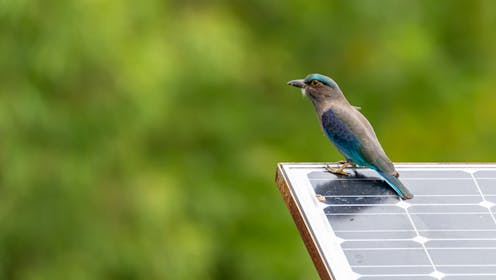
Solar panels add three-dimensional structure and complexity to an environment. They can provide animals shelter from predators and the elements, much like artificial reefs in lakes and oceans. They can also act as perch or nesting structures.
Solar infrastructure also creates a mosaic of sun and shade patches – and so provide many “micro-habitats” for plants and animals.
Research from Europe has shown large solar farms can enhance the diversity and abundance of plants, grasses, butterflies, bees and birds.
What’s more, vegetation between solar panel rows can also provide travel corridors, nesting sites and shelter for wildlife.
Read more: Why Queensland is still ground zero for Australian deforestation
Management is key
Research suggests several management strategies that can maximise the benefits of solar farms for wildlife.
Land managers should provide a diverse mix of flowering plant species to encourage pollinators. And grass between solar panels should not be mowed too short or too often. Pollinators prefer tall vegetation where they can forage – though vegetation should not be so tall that it shades the solar panels.
The use of herbicides and other chemicals should be avoided where possible. And solar farms should be connected to other vegetated areas, using features such as hedgerows and wildflower strips, so wildlife can move between the solar farm and other habitats.
Landholders who combine solar farms with wildlife habitat may reap several benefits.
They could receive financial returns by earning environmental credits through schemes that reward carbon sequestration and biodiversity improvements.
They may also improve the health of their land by, for example, increasing pollination or providing habitat for predators such as raptor perches or nest boxes – which in turn could help control pests.
Much work remains, however, to understand these opportunities.
Looking ahead
The benefit of renewable energy in reducing carbon emissions is well known. But more work is needed to understand how solar farms can benefit wildlife.
Research is also lacking on how to locate, configure and manage solar farms to best enhance biodiversity. Collaboration between industry, land managers and researchers is needed so clean energy production and conservation can go hand-in-hand.
Read more: Australia needs much more solar and wind power, but where are the best sites? We mapped them all
Read more https://theconversation.com/win-win-how-solar-farms-can-double-as-havens-for-our-wildlife-194920


