

A mega port in India threatens the survival of the largest turtles on Earth
- Written by The Conversation
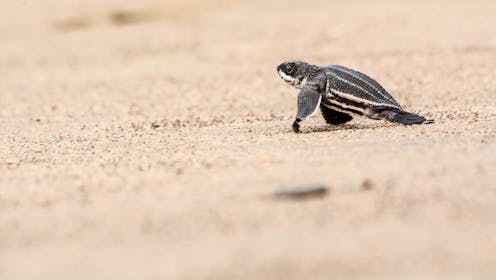
In a remote archipelago at the southernmost tip of India lies the Great Nicobar Island. This pristine ecosystem is a globally important nesting site of the largest turtles on Earth – leatherback turtles. But now, the site is threatened by a massive infrastructure plan.
The Indian government recently granted key approvals for an international container port on the island, which may prevent leatherback turtles from reaching their nesting sites.
Great Nicobar Island spans about 1,000 square kilometres and lies about halfway between India and Thailand. It is home to the indigenous Shompen and Nicobarese people, and a rich diversity of plant and animal species.
To date, the island has remained relatively untouched by large-scale development. The port proposal would change that.
A critically endangered turtle population
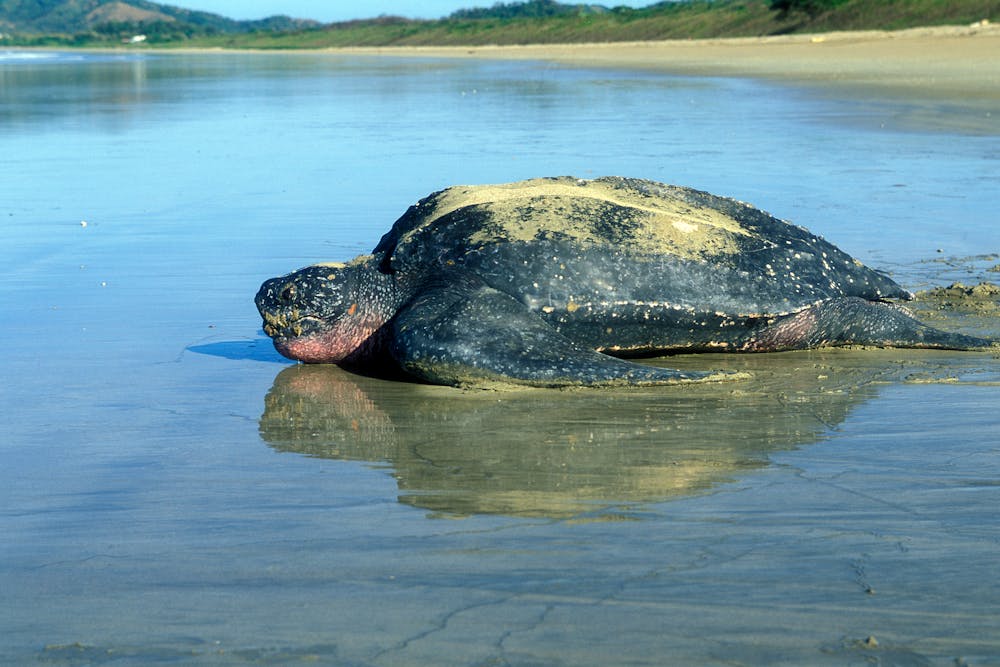
Leatherback turtles can grow up to two meters long and weigh as much as 700 kilograms. The species has existed since the age of the dinosaurs, but its numbers are in decline.
The sub-population of turtles that nests at Galathea Bay, where the port would be built, is listed as critically endangered. The turtles forage in temperate coastal waters in Australia and Africa, before making the long annual journey to the island.
According to the International Union for the Conservation of Nature, loss of nesting sites is one of the key threats to the turtles’ survival. Other threats include fishing activities, collisions with boats, egg collection for human consumption, and ingestion of plastic waste.
Galathea Bay was also heavily damaged by the 2004 tsunami, which destroyed most of the beaches where leatherback turtles nest.
Read more: Australian endangered species: Leatherback Turtle
Massive development, massive impact
The huge infrastructure project planned for Great Nicobar Island includes:
a mega trans-shipment port, where large volumes of cargo will be moved from one vessel to another for shipping to another port
an international airport which will handle 4,000 passengers an hour at its peak
a power plant
a new township.
Experts have raised concern about the environmental damage the project will cause. In particular, they say the port’s construction and operation is likely to prevent the leatherback turtle from accessing nesting sites.
The plan includes constructing breakwaters – barriers built in the sea to protect the port from waves. The barriers reduce the opening to Galathea Bay by 90% - from 3 kilometres to 300 metres.
Dredging and construction are likely to significantly alter other coastal habitats on the island, including mangroves, coral reefs, sandy and rocky beaches, coastal forests and estuaries.
One media report warned the plan will involve clearing almost a million trees.
The port is also likely to damage the habitat of scores of other rare and endemic species including macaques, shrews and pigeons.
Read more: India must stop deforesting its mountains if it wants to fight floods
 The Nicobar long-tailed macaque is among the species likely to lose habitat if the project proceeds.
Shutterstock
The Nicobar long-tailed macaque is among the species likely to lose habitat if the project proceeds.
Shutterstock
How was such a disastrous project approved?
The approvals granted so far rest on a proposal to “offset” the environmental damage caused by the port by improving bioldiversity elsewhere.
In this case, the offset involves planting trees in the Indian state of Haryana, thousands of kilometres from the project site and in a vastly different ecological zone.
This is allowed under Indian law. But it’s a gross violation of the internationally accepted “like for like” principle guiding biodiversity offsetting. This principle requires that the biodiversity affected by a given project be conserved through an ecologically equivalent offset, so no net loss of biodiversity occurs.
The Great Nicobar Island plan will damage complex and diverse tropical and coastal ecosystems and several rare and endemic species. This would purportedly be “offset” by planting trees in a sub-tropical semi-arid ecosystem thousands of kilometres away.
There is no provision in the plan to compensate for damage to turtle nesting. This alone violates the “like for like” principle.
Even more worryingly, research has shown most compensatory tree-planting in India involves monoculture timber species, which does not encourage a wide variety of native plant and animal species.
Looking ahead
The approvals granted to the port project contain a number of conditions. They reportedly include:
establishing a long-term research unit, focused on sea turtles, including a base at Great Nicobar Island
requiring that the company behind the project has a “well laid down environmental policy duly approved by the board of directors”
where possible, safeguarding trees that contain nesting holes for endemic owls.
But according to India’s Conservation Action Trust, approvals were granted before important impact assessment studies were carried out. What’s more, the conditions do not stipulate that work must stop if damage occurs to Indigenous communities or the environment.
Any large development project affecting a critically endangered species should meet rigorous environmental standards. This includes ensuring biodiversity offsets are consistent with internationally accepted principles.
And if the harm cannot be adequately offset, the project should not be allowed to proceed.
Read more: A China-backed dam in Indonesia threatens a rare great ape – and that's just the tip of the iceberg


