

Seven metals, ringed with four magical inscriptions: what other secrets does the 'Alchemical Hand Bell' hold?
- Written by The Conversation
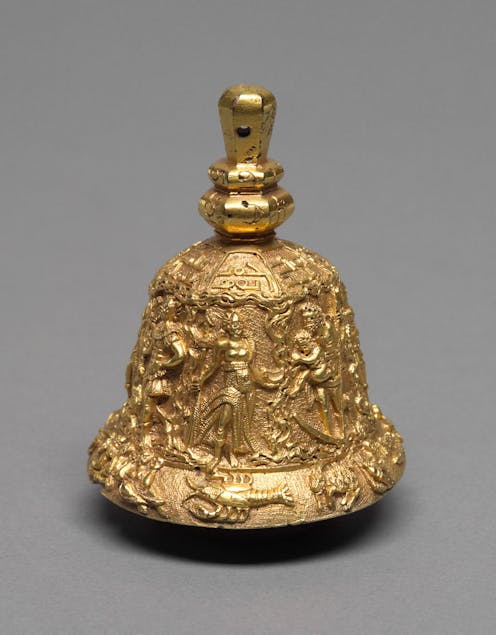
Scholars are baffled by a mysterious object from Emperor Rudolf II’s collection: a hand bell, made from an alloy of seven metals and said to have been used to summon spirits, contains an enigmatic cipher on the inside.
The Habsburg emperor Rudolf II (1552–1612) went down in history as one of the greatest patrons of the arts and sciences.
During his 36-year reign, he amassed unimaginable treasures and riches behind the walls of Prague Castle. Only a chosen few were granted access to his legendary Kunstkammer, or cabinet of curiosities, whose contents are spread all over the world today.
The emperor had a penchant for all things occult. Magic, alchemy, astrology and the kabbalah were among his favourite pastimes.
Alchemists and magicians from near and far – such as the English magus John Dee and his scryer Edward Kelly, the Danish astronomer Tycho Brahe, and the Polish alchemist Michael Sendivogius – were drawn to Prague around 1600.

Read more: The astronomer and the witch – how Kepler saved his mother from the stake
The Alchemical Hand Bell
Around 1600, the Prague goldsmith Hans de Bull created two curious objects for the imperial collection. The so-called Alchemical Hand Bell once belonged to a pair. The whereabouts of its counterpart are unknown.
From a letter by the artist, we know he cast both bells from an alloy of the seven metals associated with the heavenly bodies depicted on the mantle: gold (sun), silver (moon), copper (Venus), iron (Mars), lead (Saturn), tin (Jupiter) and mercury (Mercury).
Such a sevenfold alloy had been described by the Swiss physician and alchemist Paracelsus as “Electrum”.
As part of a complicated ritual, the chime of an Electrum bell could grant its owner wisdom and power. Emperor Rudolf II admired Paracelsian philosophy, and De Bull’s bell was a welcome addition to the imperial Kunstkammer.
Secrets in the script
Altogether, four different scripts can be discerned on this object.
In the trapezoidal fields above the deities’ heads are letters resembling Syriac, the language of ancient Syria.
The letters on the bell’s handle, above the planetary symbols, are reminiscent of Arabic.
The iron clapper is adorned with Hebrew letters which are also hardly legible.
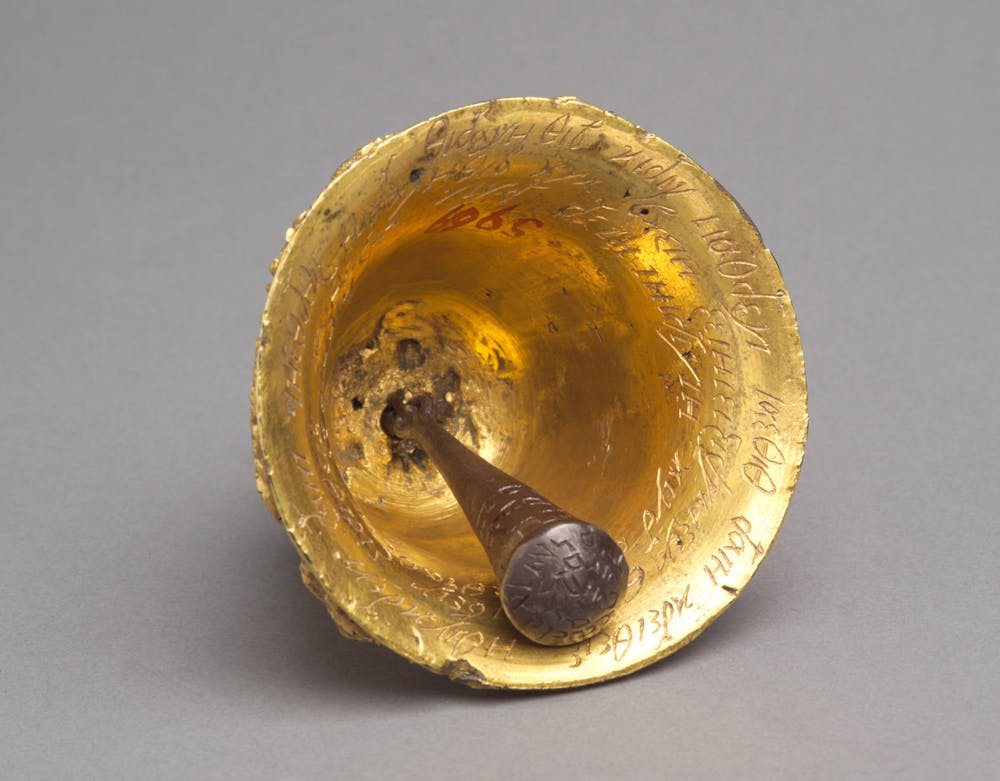 Interior of the Alchemical Hand Bell of Rudolf II.
Kunsthistorisches Museum Wien, CC BY-NC-SA
Interior of the Alchemical Hand Bell of Rudolf II.
Kunsthistorisches Museum Wien, CC BY-NC-SA
Surprisingly, the Greek inscription on the interior of the mantle can perfectly be transcribed:
θιδαγΗ θιβ κιδιγ ιιαθδεγι ιαεθιθ δαιΗ κδειθειζ Ηθιγκδεγι δαΗι ιΗεθδθιζ θιδαγ Ηθιβ κγκ βκειΗ ζειΗιει ζιδγΗειγ θιβ ιγαιβειγ ζιδιθειΗ καιθειζιΗ κιγδ δειΗ ιΗιδιγιΗ κιγδ δειΗ Ηεθιαθζειγ ζεθιΗθιΗ
However, every attempt so far to make sense of these 163 letters has failed: the “words”, composed of ten different Greek letters, are hardly pronounceable.
It is tempting to suspect the spiralling text contains some kind of invocation, maybe to summon the supernatural beings described by Paracelsus.
Is this another example of nonsense script that so often occurs on magical objects based on the principle of script for script’s sake? Or does the text contain a hidden meaning that still needs to be deciphered?
First attempts to decode the bell’s secrets
In order to try to understand the letters’ meaning, we looked at different kinds of ciphers used around the same time period.
One possibility is a so-called “polyphonic” cipher. This is one where each “cipher” symbol – here the ten Greek letters – corresponds to one or possibly several letters in the original language.
This is in contrast to a “homophonic” cipher, such as those created by the Zodiac serial killer in the 1960s, where each letter in the original text is replaced by one of several different cipher symbols.
Historically, there have been a few attempts at using polyphonic ciphers, such as the Papal ciphers of around the same time period. These ciphers used the digits 0 to 9 with dots above the numerals to distinguish different letters and groups of letters.
But these kinds of ciphers can be very difficult to solve where the exact enciphering method is not known. Here, we do not even know the underlying language.
Some plausible possibilities are Latin, German or Greek. Latin was the lingua franca of scholarly writing in Europe and any Westernised territory of the time, while German and Czech were spoken at Rudolf’s court.
We tried automated methods for solving these ciphers with various languages. But the shortness of the passage meant the usual techniques were unlikely to help.
The ultimate question is: is there actually an understandable message present?
The more general question for researchers is how much “ciphertext” do we need to extract the underlying message? We can only deduce this for ciphers we already know of.
If we could understand the writing, we could gain new insight into the meaning of this bell and cipher techniques used at the time, and perhaps uncover secrets from Emperor Rudolf’s fabled court. But for now, the mystery prevails.
Read more: Deciphering the Philosophers' Stone: how we cracked a 400-year-old alchemical cipher


