

Alone in a dark cave: what can we learn from extreme survival experiments?
- Written by The Conversation
Why do humans undertake journeys of personal exploration, or subject themselves to challenging conditions for long periods of time? What might we learn from their experiences?
British mountaineer George Mallory undertook his fatal attempt to summit Mount Everest in 1924 simply “because it’s there”. While such quests may have deeply personal motivations, research carried out during expeditions in extreme conditions can contribute to our understanding of how humans respond to environmental challenges.
The research outcomes can potentially be applied to a variety of settings, including remote locations here on Earth and even human space exploration.
Searching for extreme environments
Many explorers seek out “extreme environments”. This term describes harsh and unusual environmental conditions where it is difficult for life forms like humans to survive and thrive.
Examples include places that experience extremes of temperature, pressure, altitude, rainfall, breathable air, natural light, or hazardous chemical concentrations.
In recent years, humans have undertaken many extreme experiments, either alone or in groups.
In June 2023, Joseph Dituri, a biomedical engineer at the University of South Florida, completed a record-breaking 100 days living 9.15 metres underwater in a special habitat. At this depth, the pressure is approximately double what we experience on land. As he stated afterwards:
The human body has never been underwater that long. This experience has changed me in an important way, and my greatest hope is that I have inspired a new generation of explorers and researchers to push past all boundaries.
From November 2021 to April 2023, Spanish mountaineer Beatriz Flamini spent 500 days alone in a dark subterranean cave. She aimed to “learn more about how the human mind and body can deal with extreme solitude and deprivation”. When asked why she looked happy on emerging from the cave, she replied: “How would you feel if you had a dream and you fulfilled it? Would you come out crying?”
In 2021, a so-called Deep Time project in France isolated 15 volunteers in a cave underground for 40 days and nights without access to sunlight, clocks, or telephones. The project aimed to explore human adaptation to isolation and extreme conditions, together with the absence of the normal stimuli that provide a sense of time.
Training for space
As part of its astronaut training program, the European Space Agency holds a three-week course in an underground cave system. This work prepares astronauts to work safely and effectively in multicultural teams in a place where safety is critical.
Extreme environments can be useful not just for training and simulations. Places with physical similarities to space environments can also serve as locations for so-called analog missions.
These field tests are less expensive and more convenient than space-based research. They allow for the testing of technology, equipment, and experimental concepts alongside assessment of human physical and psychological responses to challenging conditions.
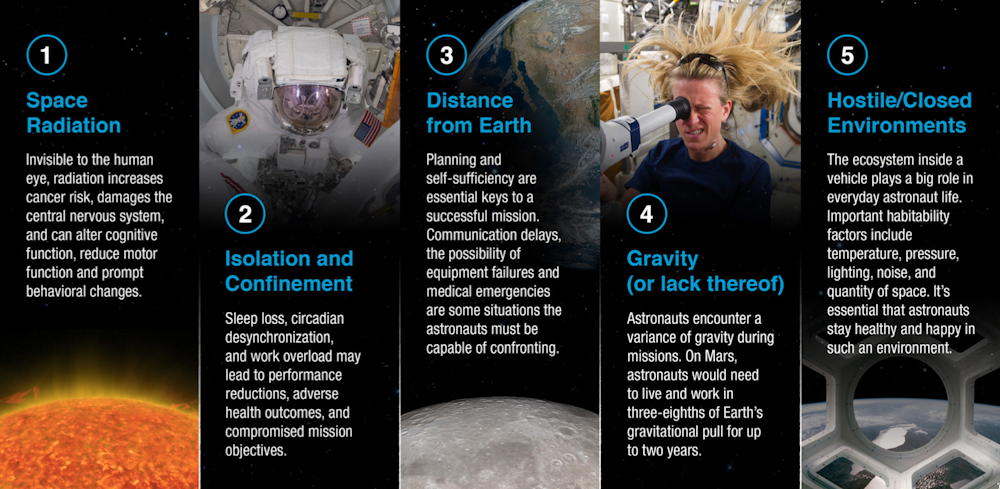
An additional goal of analog missions is to research possible safeguards, or countermeasures, against what NASA terms the “five hazards of human spaceflight”.
These are:
- radiation – exposure to high levels of space radiation beyond Earth’s magnetic field
- isolation and confinement – being far away from all that is familiar on Earth and confined in a relatively small and unchanging space can impact wellbeing, behaviour, and performance
- distance from Earth – the farther away from Earth, the greater the communication delays and challenges, and thus the need for autonomy and self-sufficiency
- gravity – astronauts could face up to four different gravitational environments. There is “normal gravity” or 1g on Earth; microgravity (“weightlessness”) in Earth orbit and in deep space transit; and partial gravity of 0.17g on the Moon and 0.38g on Mars. All of these have differing effects on the human body
- hostile and closed environments – life support systems aim to provide a controlled environment, but problems can occur. Microbial lifeforms are a further consideration for both astronauts and the spacecraft.
There are many different types of analog missions, including in Antarctic, Arctic, underwater and desert settings. There are also closed small-group habitats such as NASA’s HERA module at Johnson Space Center and the privately owned Hi-Seas habitat on Hawai‘i island.
What we learn in extreme environments can be helpful closer to home, too.
We’re all in this together
Research into isolation and confinement provided helpful advice for people experiencing lockdowns during the peak of the COVID pandemic.
Telehealth research already benefits people living in isolated and remote areas. The United Nations Office of Outer Space Affairs runs a Space4Health initiative aimed at assisting countries in leveraging space infrastructure for better global health outcomes. NASA’s Spinoff archive documents the rich history of how space research has benefited life on Earth.
Through pushing the boundaries of human exploration in challenging environments, people not only learn more about themselves and their place in the world, but also make a unique contribution to a better understanding of human boundaries.
This knowledge can help us in various ways, both here on Earth and in humanity’s ultimate quest to reach for the stars.
Read more: Why is extreme 'frontier travel' booming despite the risks?


