News Daily

The Times

Australia

  • Written by The Conversation
Optus said it didn't have the 'soundbite' to explain the crisis. We should expect better

Asked on Wednesday to explain why Optus broadband and mobile services had been simultaneously knocked out for five hours, its chief executive Kelly Bayer Rosmarin blamed a “technical network fault”, and then added:

There is no soundbite that is going to do it justice, so we want to really bottom-out the root cause, and when we have that very clear and in a digestible form, we will be forthcoming.

There are a couple of ways to interpret this statement. Either she didn’t want to indicate what her engineers really thought had happened, or she believed Optus users wouldn’t be able to understand the truth.

Or she might not have been thinking about Optus users.

Her reference to a “soundbite” seems to suggest Optus regards its key audience as the media rather than its customers.

Optus is baked into too much of what we do

With more than 10 million mobile customers alone, accounting for more than one-third of Australia’s population, the Singapore-owned Optus has become integrated into almost everything Australia does, from the operation of railways to automatic teller machines, to hospitals to emergency services.

Its customers, both corporate and personal, have become increasingly familiar with technical terms and technical explanations.

Those customers not only know more than they did – understanding many of the terms that apply to both software and hardware – but they expect more from technology, knowing that even some of their own jobs can potentially be replaced by artificially intelligent algorithms.

Many of those customers would be not only be asking “how did this happen”, but also “how could this be allowed to happen, given what technology is capable of”.
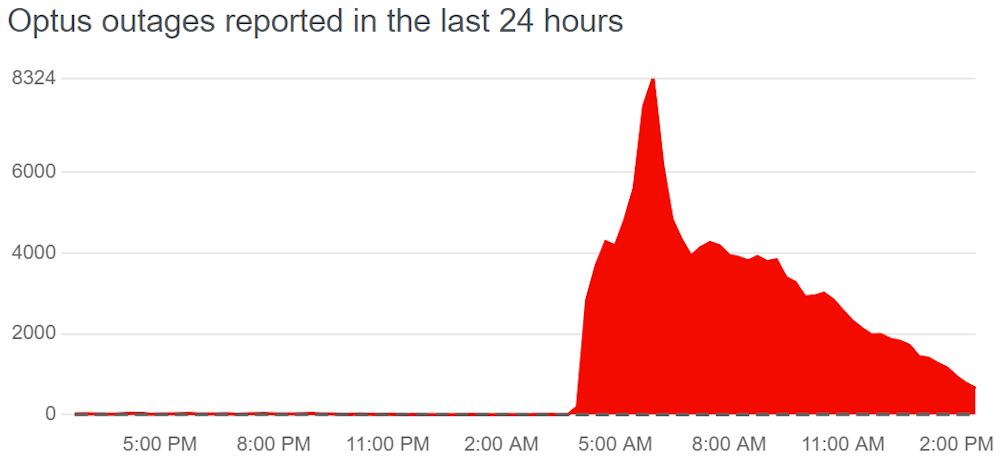
DownDetector, November 8 2023 The golden hour Crisis communicators have long spoken of the need to respond within the so-called “golden hour”, a concept taken from the emergency services where it is important to get to the injured party promptly. In an increasingly automated world, that’s what Optus ought to have been able to do. Its core business is using technology for communications. If it couldn’t use its mobile network, it ought to have been ready to use something else, even email. Technology firms have built-in intensifiers Crisis communications expert Timothy Coombs argues that the damage done to reputations during a crisis can be worsened by “intensifiers”, such as the organisation’s past history of crises, its track record, and sometimes the severity of damage caused. Significantly, he finds no “halo effect” from having handled things well in the past, only a “Velcro effect” from having handled things badly. Read more: In a crisis, Optus appears to be ignoring Communications 101 To that I would add that a further intensifier is the extent to which an organisation suffering from a technology failure is itself a technology organisation. It’s hard to argue you are a victim of something you have put yourself forward as a master of. Sharing what it knows, on the assumption that at least some of its users will understand it, would be one way of indicating that Optus trusts its customers and is worthy of their trust.

Read more https://theconversation.com/optus-said-it-didnt-have-the-soundbite-to-explain-the-crisis-we-should-expect-better-217302

Pinboard Solutions for Offices, Schools and Shared Information Spaces

Why a Pinboard Remains Useful A pinboard provides a simple way to display information that needs to remain visible without being rewritten. Lawdex supplies fabric and cork options for offices, schools, staff areas and other environments. A pinboard can be used... Read more

Calm Marketing: Why You Don’t Need Flash to Win Online

There is a growing trend happening across websites, social platforms and digital storefronts, and it goes by the name calm marketing. Rather than shouting for attention with flashing banners, countdown timers and aggressive pop ups, calm marketing invites people to... Read more

Australian Off Road Caravans: What Makes Them Different from Standard Touring Vans?

Australian off-road caravans are designed for travellers who want to go beyond sealed highways and established caravan parks. A standard touring caravan is perfect for bitumen roads and conventional holiday routes. On the other hand, off-road models are built with... Read more

Why Compact Designs of Caravan Travel Transform Short Getaways

A caravan makes exploring Australia more flexible. For many Australians, a compact and practical setup makes short breaks easier, more comfortable and far more spontaneous. The layout inside significantly impacts how comfortable, organised and enjoyable your travels become.  Travellers often compare... Read more

7 Situations Where GPR Scanning Can Prevent Costly Construction Mistakes

Construction projects often rely on accurate information before excavation, drilling, coring or demolition begins. While plans, utility records and visual inspections provide valuable guidance, they don't always reveal what's hidden beneath the surface. Unknown utilities, reinforcement, voids or buried structures... Read more

Key Terms to Review Before Signing a Business Lease

A business lease can be a large financial commitment, and the terms buried in the fine print can affect your operation for years. It can be tempting to skim past the legal detail once you’ve found premises you like, but... Read more