

The ‘devil comet’ 12P/Pons-Brooks has finally become visible from Australia. What can we expect?
- Written by The Conversation
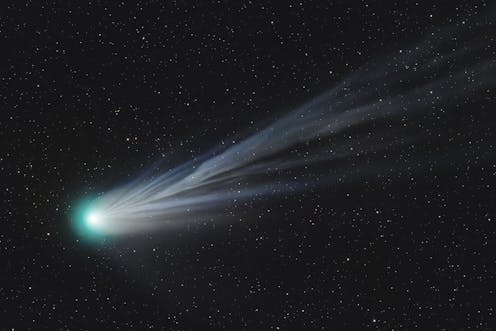
If you’re a fan of all things space, you’ve doubtless heard about the “devil comet”, which has been captivating keen-eyed observers in the northern hemisphere for the past few weeks. Now it’s our turn, as comet 12P/Pons–Brooks is creeping into view for the southern hemisphere.
Before you get too excited, let me quash your hopes. Comet Pons–Brooks is visible to the naked eye, but only if you know where to look. It will look like a fuzzy glowing patch, but nonetheless promises some amazing photo opportunities for the coming weeks.
Even better, it may serve as a celestial warm-up act for an even more special comet later in the year.
Here’s everything you need to know about Pons–Brooks, and how to get the best view.
Why do people call it the ‘devil comet’?
Named after two astronomers who independently discovered it in the 19th century, Comet 12P/Pons–Brooks (its full, official name) was last visible in 1954.
It takes around 71 years to orbit the Sun, making the comet’s visits to the inner Solar System a rare treat for us here on Earth.
At its heart (its nucleus), Pons–Brooks is a dirty snowball around 34 kilometres in diameter. As the comet came swinging back towards us in its orbit, astronomers spotted it back in 2020. At that time, the comet was almost 1.8 billion kilometres from the Sun, and lay dormant.
As the comet kept falling inwards toward the Sun, its surface temperature began to rise, making it “active”. Exposed ices started to sublime, turning directly from solid to gas. This activity is how a comet gets its tail: the nucleus becomes shrouded in a diaphanous “coma” of dust and debris from its sublimated surface, which is then blown away from the Sun by the solar wind.
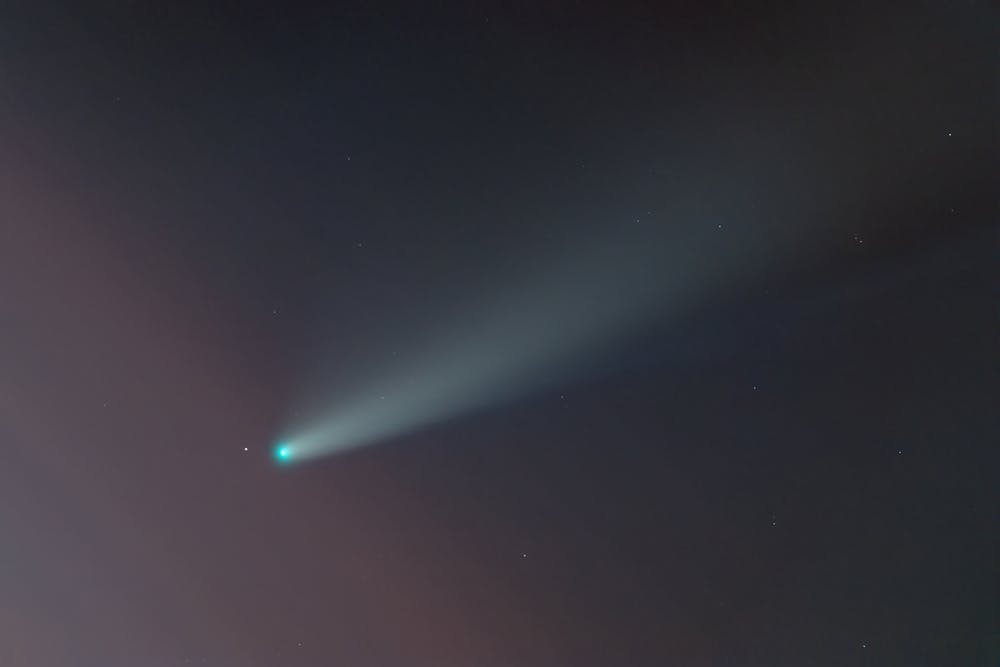
But comet 12P/Pons–Brooks didn’t activate gently and smoothly. Instead, it produces several large outbursts of activity, each time, emitting vast amounts of gas and dust in a very short period of time before settling down again.
In the first of those significant outbursts, on July 20, 2023, the comet brightened by a factor of a hundred times, shedding an estimated ten million metric tons of dust and ice.
The solar wind pushed the resulting dust, gas and debris away from the Sun, giving the comet an unusual appearance. To some, the comet looked like the Millennium Falcon from Star Wars. To others, it looked vaguely demonic – sporting the cometary equivalent of horns.
The moniker of “devil comet” took hold in media articles and appears to have stuck – even though the comet’s horned appearance is now a thing of the past.
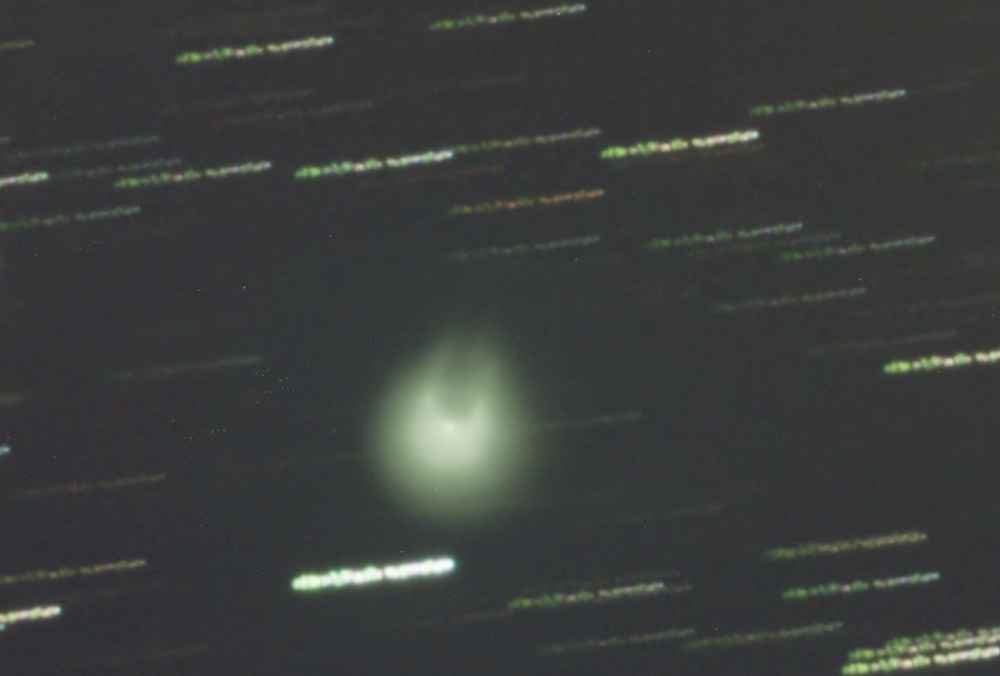 Comet 12P/Pons–Brooks on July 27, 2023, showing the unusual horned appearance that led to its ‘devil comet’ nickname.
Juan Iacruz/Wikipedia, CC BY-SA
Comet 12P/Pons–Brooks on July 27, 2023, showing the unusual horned appearance that led to its ‘devil comet’ nickname.
Juan Iacruz/Wikipedia, CC BY-SA
Where (and when) should I look?
Over the last few days, the first confirmed sightings of 12P/Pons–Brooks have come in from around Australia. It is currently visible low in the western sky after sunset, albeit almost lost in the glow of twilight.
In the next few weeks, the comet will slowly climb higher in the evening sky. The two videos below show the location of the comet’s head at 6:30pm from mid-April through to mid-June, as seen from Toowoomba and Melbourne.
Visibility of comet 12P/Pons–Brooks, as seen from Toowoomba, from mid-April to mid-June 2024. Visibility of comet 12P/Pons–Brooks, as seen from Melbourne, from mid-April to mid-June 2024.Remember, the comet is a diffuse object, rather than a single point of light. The head is where the comet is brightest (centred on its nucleus). The comet’s tails point away from the Sun – so will rise upwards from the western horizon in the evening sky.
While the comet is visible with the naked eye, you really need to know where to look. The best bet is to search with binoculars. Make sure to wait until the Sun is well below the horizon. Once you find the telltale blur of the comet, you will know where to look, and can switch to see if you can spot it with the naked eye.
For me, the most exciting time with Pons–Brooks will come during the first two weeks of May. At that point, the comet will be passing underneath the constellation Orion, which will serve as a signpost.
That period will be prime astrophotography season, so I expect to see many spectacular images of the comet’s tails cutting through the celestial hunter, shining next to the spectacular nebulae dotted throughout Orion’s body.
Read more: Want to get into stargazing? A professional astronomer explains where to start
But wait… there’s more!
While comet 12P/Pons–Brooks currently basks in the limelight, a potentially great comet is currently moving sunward, promising a spectacular show later this year.
That comet, C/2023 A3 (Tsuchinshan-ATLAS), was discovered in January 2023, and astronomers soon realised it has the potential to become truly dazzling.
Comet behaviour is hard to predict, so take the following with a pinch of salt, but things still look really promising.
Current predictions suggest Tsuchinshan-ATLAS will be at least as bright as the brightest stars in late September and early October this year. During that time, it will pass almost directly between Earth and the Sun. It might even briefly become visible in broad daylight at that time.
In the days following that chance alignment, the comet will gradually become visible in the evening sky and could be an incredible sight, up to a hundred times brighter than Pons–Brooks at its best.
So, with any luck, the current apparition of 12P/Pons–Brooks is merely the warm-up act, with an even greater spectacle to come later this year. Fingers crossed!


