

Job scams are on the rise. What are they, and how can you protect yourself?
- Written by The Conversation

In the digital era, the job market is increasingly becoming a minefield – demanding and difficult to navigate. According to the Australian Bureau of Statistics, the number of job vacancies fell by 6.1% between November 2023 and February 2024. Every click on a job ad can either open doors to amazing opportunities, or plunge job seekers into perfectly set up cyber traps.
The latest annual Targeting Scams report shows a seemingly encouraging 13.1% decline in scam losses reported by Australians – down to A$2.74 billion in 2023. But it doesn’t mean we should get complacent. Scammers are continuously refining their techniques and expanding their reach.
Particularly alarming is the volume of job scams (also known as employment or recruitment scams). These scams were among the top ten scam categories in 2023, with a dramatic 150% increase in financial losses compared to the year before.
How exactly do job scams work? And how can job seekers distinguish between legitimate job offers and deceptive schemes?
What is a job scam?
Job scammers attract people by promising fake jobs that require little effort but promise a substantial financial reward or “guaranteed” income, or perhaps even a “dream job” at a real company they’re impersonating. The end goal in all cases is to extract money and/or personal details from the victim.
Employment scams may take many forms, but there are several tell-tale signs.
Scammers use social media, unsolicited emails, encrypted chat applications (such as WhatsApp or Telegram), phone calls or even legitimate employment websites to advertise non-existent jobs.
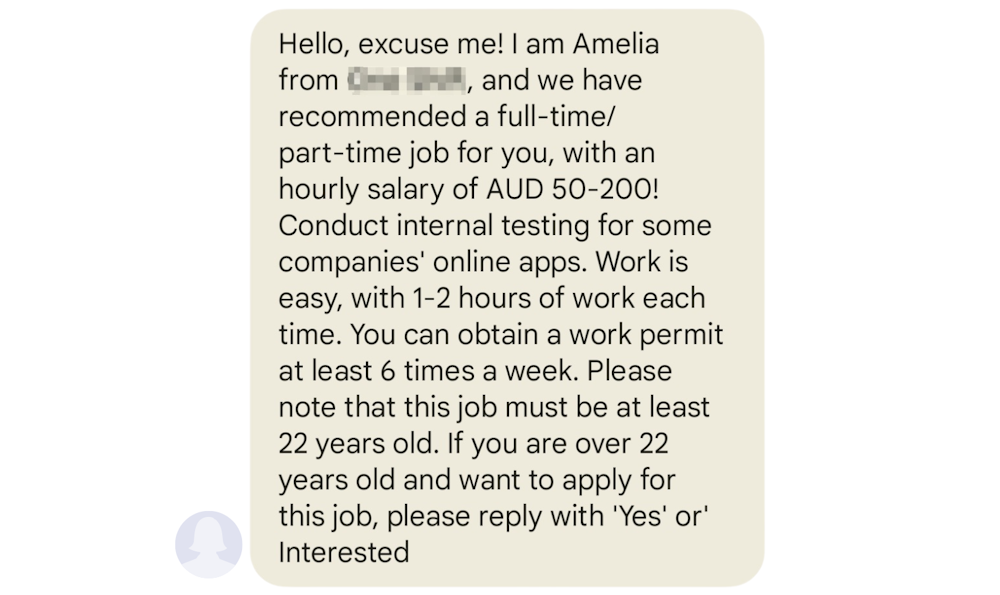
Job scammers may also impersonate recruiters from genuine organisations, including high-level executives or even hiring managers conducting interviews for jobs that do not exist.
 An example of a job scam impersonating a recruiter from a legitimate company.
The Conversation
An example of a job scam impersonating a recruiter from a legitimate company.
The Conversation
For some of these jobs, the scammer will ask for some type of upfront fee to secure the employment, pay for onboarding, or to purchase (non-existent) products the job seeker is supposed to sell. The moment the fee is paid, the scammer will instantly disappear.
Sometimes, job scammers promise a high commission if the person uses their own bank account to transfer existing funds into an offshore account, cryptocurrency exchange or gift cards. This is likely money laundering.
Depending on the type of job scam, cyber criminals conducting a fake application and onboarding process may even gain access to sensitive information such as your passport number, driver’s licence and other credentials. This puts you at high risk of identity theft.
Who is vulnerable to job scams and why?
Scammers target their victims based on their online behaviour, financial situation, needs and even vulnerability to certain types of persuasion.
The increasing cost of living in Australia is creating a fertile ground for job scams. People in desperate need of employment, those who have been unemployed for a very long time and those seeking additional income via part-time (usually remote) jobs are all at high risk of becoming victims to these job scams.
These individuals are driven by economic need and will easily overlook or not recognise red flags. University students and recent graduates looking for valuable work experience in tough job markets are increasingly becoming targets of job scams, too.
Immigrants can be particularly susceptible to job scams, mainly because they may not be familiar with legitimate employment processes, standard recruitment practices and Australian employment rights.
In extreme cases, employment scams can even result in international human trafficking, as shown by an incident in Cambodia last year, with victims being locked into compounds, having their passports confiscated and being trained to scam others. Captors would release them only upon receiving a ransom fee payment.
How can I avoid a job scam?
Apart from using a “stop, think and protect” approach, here are more tips on how to protect yourself from job scams:
Use only legitimate job boards and networking sites. For example, LinkedIn verifies recruiters with a visible badge on their profiles.
Critically evaluate and check job listings by looking for comprehensive information and list of qualifications. Seek advice from trusted professionals to validate the legitimacy of the job offer.
Don’t respond to non-corporate emails, texts or other messages offering “too good to be true” unsolicited employment opportunities with high returns.
Conduct thorough research by always verifying the legitimacy of the offer. Check the company’s official website, read trusted reviews, call or even visit.
Avoid providing credentials including passport details, a driver’s licence, Medicare number, or financial information (a bank account number or PayID) during the application or onboarding process.
Don’t provide an upfront payment and don’t pay fees for training, equipment or software as a condition of being hired.
Never agree to receive or transfer funds through your own bank account on behalf of someone else for a commission.
Overall, stay vigilant. If you do come across any job scams, make sure to report them to the Scamwatch website.


