

New fossils show what Australia’s giant prehistoric ‘thunder birds’ looked like – and offer clues about how they died out
- Written by The Conversation
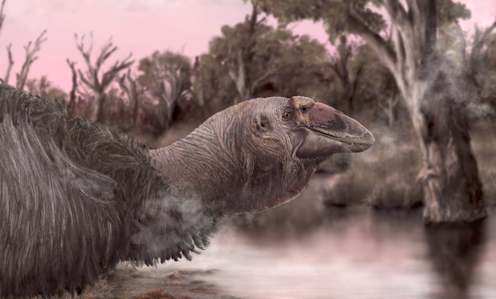
Until around 45,000 years ago, Australia was home to a giant flightless bird called Genyornis newtoni, which was two metres tall and weighed up to 230 kilograms.
Palaeontologists first discovered these so-called “thunder birds” in the late 1800s. Yet exactly what Genyornis looked like has remained a mystery, because until now no well-preserved fossil of a Genyornis head has been found.
Scientists have instead interpreted its appearance based on large, flightless relatives, such as Dromornis and the more distantly related emus.
From the dry salt lakes in north-eastern South Australia, we have now discovered several new Genyornis fossils, including a complete skull. These finds show what this ancient thunderbird really looked like, and offer clues to how it evolved, lived and died. This research is now published in Historical Biology.

The skull
Genyornis and its cousins in the family Dromornithidae (known as dromornithids) have unusually large skulls for flightless birds. They also have short braincases and oversized jaws. Genyornis is set apart from other dromornithids by a distinctive upper jaw which gives the bird a unique appearance.
Genyornis has a tall skull, joined to a large and robust lower jaw, suiting the name Genyornis, which roughly means “jaw bird” in Greek.
The upper jaw is long and a bit higher than it is wide, with an especially spatulate, or goose-like, rounded tip, and an enclosed palate. A tall ridge runs down the centre of the beak, and a bulbous structure called a casque is positioned just in front of the eyes, above its small nostrils. The casque’s purpose is unknown but it might have been for sexual display.
Highly flexible joints in the skull allowed Genyornis to open its mouth wide, like parrots can, and the arrangement of jaw muscles suggests a higher bite force than originally expected. Powerful muscles attaching to the back of the braincase allowed a strong backwards pull of the head.
How did Genyornis evolve?
The fossil record for dromornithids extends back to at least 55 million years ago, though their origin is certainly more ancient. Although Genyornis existed relatively recently, this long evolutionary history, paired with a shortage of older fossils, has made understanding dromornithid evolution very complex.
The Dromornithidae family is part of a broader group which includes landfowl (such as chickens and quails) and waterfowl (including ducks and geese). Dromornithids share skull features with both.
Only through extensive comparisons of dromornithid skull fossils with those of these relatives could we interpret the anatomy and evolution of Genyornis’ surprising skull.
Several skull features dromornithids share with landfowl appear to have been present in the last common ancestor of dromornithids, landfowl, and waterfowl.
 How Genyornis newtoni and the dromornithid family are related to land- and waterfowl – and how they compare with the modern horned screamer and the unrelated southern cassowary.
Phoebe McInerney
How Genyornis newtoni and the dromornithid family are related to land- and waterfowl – and how they compare with the modern horned screamer and the unrelated southern cassowary.
Phoebe McInerney
However, skull features that dromornithids share with ducks and geese are likely linked to the early evolution of waterfowl from a more chicken-like ancestor. Notably, the arrangement of jaw muscles and bony structures on the side of the braincase and lower jaw are almost identical to those of the screamers (Anhimidae) found in South America today.
Screamers are the most early-diverging waterfowl still alive today. Our research shows dromornithids were closely related to screamers and other early waterfowl. Interpreting how skeletal structures relate between dromornithids and their relatives was crucial to this understanding.
What do we know about Genyornis’ lifestyle?
The structure of the new Genyornis skull also supports previous ideas about how the species lived. This includes their dietary preferences for soft, non-fibrous plants including fresh new growth, shoots and fruit.
Newly discovered though, are adaptations for immersing the head in water, including an enclosed palate, nostrils far back by the eyes, and isolation of the ear from the regions involved in jaw movement. All help to prevent water inflow and limit hearing interference while feeding submerged.
These features indicate Genyornis was adapted to thrive around swamps, wetlands and lakes. Fittingly, Genyornis fossils have been recovered from areas associated with these environments – and of course they were closely related to early waterfowl.
Today, the large bodies of freshwater once present in northern South Australia are mostly dry salt lakes. While Genyornis had broad, short toes and hoof-like claws for moving across open ground between bodies of water, their partial reliance on freshwater and new plant growth would have become more difficult as ponds and lakes shrunk and disappeared.
While not the whole story, the drying of the Australian continent likely contributed to the eventual extinction of Genyornis – and the demise of the dromornithid dynasty.


