

The chaotic history of the Olympics in Paris, where one games nearly ended the movement – and the other helped save it
- Written by The Conversation
Paris is about to host its third summer Olympics. While we don’t yet know what the legacy of this year’s games will be, let’s take the opportunity to reflect on the city’s previous Olympics of 1900 and 1924 – the first of which nearly ended the modern Olympic movement, whereas the second set it alight.
The disaster of Paris 1900
The 1900 Paris Olympics was negatively impacted by the decision to link the games with the World Fair, held in Paris at the same time. The committee of the much larger and more popular fair was given control of organising everything, despite its minimal knowledge of sport. The organisers saw the Olympics as far less important than the fair’s exhibits, focused on fashion and new technologies such as escalators and audio recorders.
As a result, the Olympic games were treated like a sideshow. This poorly organised event was held at inadequate venues over nearly six months and almost ended the modern Olympic movement in its infancy.
Sports historians refer to 1900 as a farcical games and have debated whether it should even be considered an Olympics. The founder of the modern Olympics, Pierre de Coubertin, later commented it was a miracle the Olympic movement survived.
Confusing scheduling led to few spectators. Minimal venues were built and there were no officially agreed rules and regulations, which led to numerous disputes. There were no opening or closing ceremonies and many athletes were unaware they were competing in the Olympics.
Competing for one’s country was also not a concept yet, so numerous medals were won by teams with athletes from different countries. One Danish journalist became a last-minute substitute on a combined Danish-Swedish tug-of-war team that defeated France in the final. A young unknown French boy was also pulled out of the crowd to cox a Dutch rowing team to a gold medal, because the team had decided the adult cox was too heavy.
Australian sprinter Stan Rowley, who referred to the games as a “huge joke”, became the only person to win medals for two different countries in the same Olympics. He won medals in athletics for Australia and then as part of the British cross country team. The strange points system meant he just had to finish and record a time for the British team to win – so he walked. In the end he didn’t even have to finish; officials got sick of waiting and awarded him last place so they could leave.
Some people who attended the World Fair signed up for the Olympic games while they were there. One example is Margaret Abbott, who entered the golf tournament along with her mother and won gold. These were the first Olympic games that saw women competing. Unfortunately, the poor organisation meant Abbott was never informed of her victory as the United States’ first female Olympic gold medallist. Her family was notified by a sports historian years after her death in 1955.
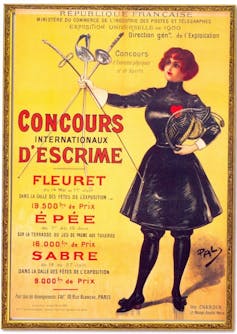
Athletics events took place in a wet, uneven field with trees in the way. Discus and hammers ended up in the trees or the crowd, as the area was too narrow. The long jumpers had to dig their own pit before they could start competing. Fencing events were held in the cutlery section of the World Fair.
Swimming events took place in the polluted Seine river – which had a strong current, resulting in unrealistically fast times. The shooting events used live pigeons. And the marathon winner was accused of taking short cuts – and didn’t receive his medal until the dispute was settled 12 years later.

Many of the events held in 1900 are no longer part of the Olympics, such as fishing, cannon shooting, obstacle course swimming, kite flying, motor racing and hot air ballooning. One competitor in the long-distance ballooning competition landed in Russia and was arrested for not filing a passport request. The winner of the contest landed some 2,000 kilometres away in modern-day Ukraine and had to make his own way back to Paris.
These, and other strange events out of de Coubertin’s control, resulted in him pushing for the International Olympic Committee to be in charge for the next Paris Olympics in 1924, which was his last Olympics as president of the committee.
Paris 1924
The success of the 1924 games is often considered to have saved the Olympic movement. The games were widely regarded as a major success that announced the arrival of the Olympics as a major international event. The number of countries and athletes taking part significantly increased from previous games, as did the number of spectators. More athletes from lower social classes also boosted public interest.
The event’s rising popularity was confirmed by worldwide media coverage. More than 1,000 journalists reported on the games, including with live radio coverage for the first time. This attention made superstars of gold medallists such as the Uruguayan football team, Finnish runner Paavo Nurmi and US swimmer Johnny Weissmuller, who went on to become a Hollywood actor.
 Olympians Johnny Weissmuller, left, and Duke Kahanamoku, right, participated in the 1924 Paris Olympic games.
AP
And while female athletes were still rare in those years, the media coverage allowed them to grab headlines and reshape perceptions of women in sport. Athletes of colour also started to gain more recognition when US athlete DeHart Hubbard won the 1924 long jump, becoming the first black sportsman to win an individual Olympic gold medal.
The 1924 Olympics remained famous in popular culture for decades. They were even the subject of the 1981 Oscar-winning film Chariots of Fire, based on the true story of British runners Eric Liddell and Harold Abrahams.
Many Olympic traditions were first seen at the 1924 Paris games. It was the first games to use the closing ceremony ritual of raising four flags – the Olympic flag, the flag of Greece (which hosted the first modern Olympics in 1896), the host nation’s flag, and the next host nation’s flag.
It was also the first games in which athletes stayed together in a purpose-built Olympic Village, the first time the Olympic motto, “Citius, Altius, Fortius” (“Swifter, Higher, Stronger”) was used, and the first time a 50-metre pool was used for swimming events. This pool, Piscine des Tourelles, is still operational and will be used as a practice venue for swimmers and triathletes in 2024.
Another lesser known but potentially more influential impact of the 1924 games was the organisers’ decision to establish exclusive rights to all photos and videos of the games. This model – and the lucrative media and sponsorship deals it has garnered over the past 100 years – have been a key contributor to the funding and success of the Olympic movement.


