

Can AI pick IVF embryos as well as a human? First randomised controlled trial shows promise
- Written by The Conversation
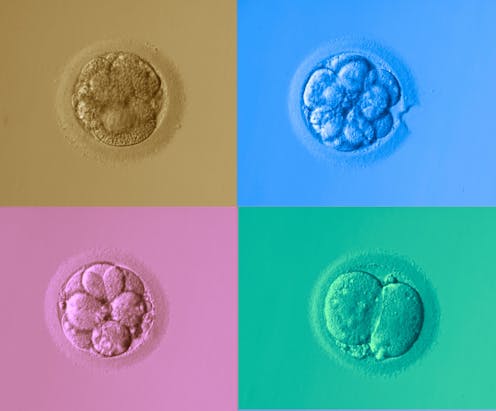
During in vitro fertilisation (IVF), a number of different embryos are produced from eggs and sperm. Then, embryologists choose which one of the embryos is most likely to lead to a successful pregnancy and transfer it to the patient.
Embryologists make this choice by using their expertise to apply a set of widely accepted principles based on the appearance of the embryo. In recent years there has been a lot of interest in using various artificial intelligence (AI) techniques in this process.
We developed one such AI system and tested it in a study of more than 1,000 IVF patients. Our system chose the same embryo as a human expert in about two-thirds of cases, and had an overall success rate only marginally lower. The results are published in Nature Medicine.
Can deep learning help IVF?
Over the past few years, with colleagues in Sweden, we have been developing software to identify which embryos will have the best chance of IVF success. Our system uses deep learning, an AI method for finding patterns in large amounts of data.
While we were developing our system, we carried out retrospective studies comparing the system’s choices with past real-world decisions made by embryologists. These early results suggested the deep learning system might do an even better job than a human expert. So the next step was to test the system properly with a randomised trial.
Our trial involved 1,066 patients at 14 fertility clinics in Australia and Europe (Denmark, Sweden and the United Kingdom). For each patient, both the deep learning system and a human expert selected an embryo to be implanted. Then, a random choice was made of which of the two to use.
This study is the first randomised controlled trial ever performed of a deep learning system in embryo selection. Deep learning may have many medical applications, but this is so far one of only a few prospective randomised trials of the technology in any area of healthcare.
What we found
What we found in the study was that there was virtually no difference between the two approaches. The clinical pregnancy rate (the likelihood of a fetal heart being seen after transfer of the first embryo) was 46.5% when the deep learning system chose the embryo and 48.2% when the embryologist chose the embryo.
In other words, there was very little difference. Indeed, 65.8% of the time, the deep learning system chose the same embryo as the embryologist. However, we also found that the artificial intelligence system did the task of embryo selection ten times more quickly than the embryologist.
One aim of our study was to prove the “non-inferiority” of our deep learning system. This is common in medical research, as we always want to make sure that a proposed new technique doesn’t lead to worse results that the existing standard.
Despite the fact the deep learning system produced very similar results to those of human experts, our study did not quite clear the hurdle of proving “non-inferiority”.
As it happened, the overall success rates in the study were much higher than we had expected. This changed the statistics of the situation, and meant we would have needed a much larger study – with almost 8,000 patients – to prove the new method is non-inferior.
No significant differences
A number of ethical concerns have previously been raised about deep learning in embryo selection. One of these concerns is a potential alteration of the sex ratio – that is, ending up with more male or female embryos – through biased selection by the deep learning model.
However, we found no alteration in the sex ratio as a result of deep learning embryo selection.
We concluded from our study that there is no significant difference for the pregnancy rate between having an embryo chosen by a deep learning system or having the embryo chosen by an experienced embryologist.
It seems from this that the use of a deep learning tool for embryo selection will not radically change the outcome (as it mostly chooses the same embryo) for a patient undergoing IVF. However, the use of a reliable automated tool of this sort may make embryology laboratories more efficient and consistent.
A further conclusion from this study is that randomised trials, which take years to conduct, may not be the optimum approach for studying rapidly advancing technologies such as this. Our future work in evaluating this technology will need to examine alternative, but still clinically valid, approaches to this subject.
_The author would like to acknowledge the work of Peter Illingworth in writing this article and the research it reports. _


