

View from The Hill: Should we accept displaying the Hezbollah flag as (shocking) free expression?
- Written by The Conversation
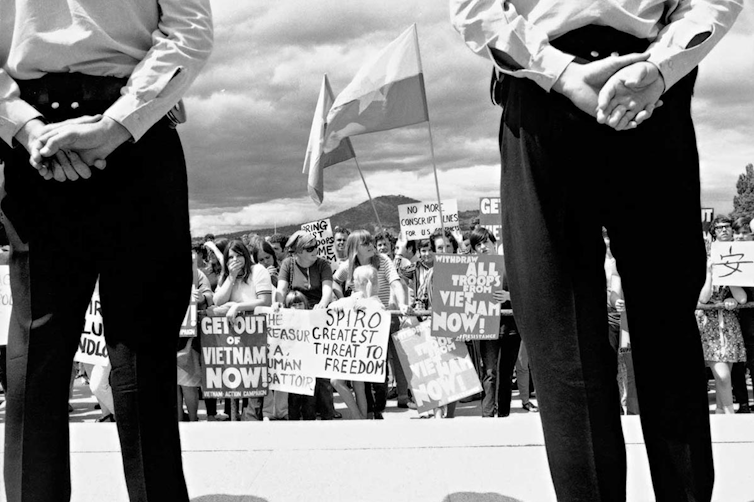
In May 1970, about 70,000 people occupied the Melbourne CBD for the moratorium protest against the Vietnam war.
The Age newspaper reported:
There were Viet Cong flags – carried mainly by members of the Monash Labor Club, who chanted ‘Ho, Ho, Ho Chi Minh …’. ‘Join us, join us’, the marchers shouted to shoppers and the pavement bystanders.
Labor left-winger Jim Cairns (who went on to be deputy prime minister) led the march. The then Victorian Liberal premier Henry Bolte was dismissive, contesting the numbers and saying “they were all of the one ilk”.
In Canberra during those heady days, at the Australian National University Jack Waterford, a student (and later Canberra Times editor) held a Viet Cong flag behind attorney-general Tom Hughes. Hughes grabbed Waterford, wrestling him down.
Those Viet Cong flags were being carried when our Australian soldiers were fighting the Viet Cong, in a war in which more than 500 Australians died.
The context of the present row over demonstrators carrying the Hezbollah flag is a war in which Australia has no direct involvement, although the local Jewish and pro-Palestinian communities have indirect stakes (and often relatives in the Middle East) and the strongest of views.
This week’s political battle over symbols carried at the weekend demonstrations – not just the Hezbollah flags but also the pictures of its former leader, Hassan Nasrallah, killed by an Israeli strike – is feeding into the mainstream pre-election debate.
It risks further weakening our already badly strained social cohesion.

Opposition leader Peter Dutton is exploiting the latest developments to further fuel his law-and-order campaign.
Dutton wants to see immediately enforced the recently passed law making it an offence to display a Nazi symbol or the symbol of a listed terrorist organisation such as Hezbollah.
If this law isn’t strong enough, he wants it strengthened.
“The laws already exist, and if the laws are inadequate then the Australian Federal Police Commissioner should advise the minister and the parliament should deal with it as a matter of urgency,” he told a news conference on Tuesday.
“We would support the government in any changes that are required to stop the glorification of a terrorist organisation.”
Dutton’s behaviour at the Tuesday press conference, in turning on an ABC reporter who (quite politely) asked what he saw as a provocative question, was reprehensible.
It’s one thing if he wants to criticise the ABC, or challenge a reporter, but this came across as bullying.
The government, meanwhile, seems fearful of not appearing tough enough in dealing with the flag-wavers.
Immigration Minister Tony Burke has declared he stands ready to cancel visas, but admits he expects most of the protesters wouldn’t be on visas anyway.
Caught in the middle of this is the Australian Federal Police.
It explained on Monday: “The mere public display of a prohibited symbol on its own does not meet the threshold of a Commonwealth offence.
"The Criminal Code sets out very specific elements that must be met in order to charge an individual with a prohibited symbol offence.”
For the offence to be made out, one of the following must apply:
a reasonable person considers the public display involves the dissemination of ideas based on racial superiority or hatred or could incite others to offend, insult, humiliate or intimidate;
a reasonable person considers the public display involves advocacy of hatred of a group of persons distinguished by race, religion or nationality or a member of the targeted group, and constitutes incitement of another person or group to offend, insult, humiliate, intimidate or use force or violence;
the conduct is likely to offend, insult, humiliate or intimidate a reasonable person who is a member of a group distinguished by race, colour, sex, language, religion, political or other opinion or national or social origin.
Burke, normally a smooth political operator, sounded flummoxed on Tuesday when pressed on how the new law on symbols would apply.
He told the ABC Radio National’s breakfast program: “I understand later in the program you’ve got the Australian Federal Police on, and they’ll be able to give you more up-to-date [information]”.
Told the program had already spoken to the police, he said he couldn’t speak about what the police had said because he hadn’t heard that interview.
The most measured political voice in this week’s hyped-up debate is coming not from Labor left-wingers or Liberal moderates but from a conservative Queensland Nationals senator, Matt Canavan.
Canavan is, incidentally, at odds with his leader David Littleproud, who said, “You can’t have people walking the streets showing those symbols about an organisation that is a terrorist organisation, that would actually kill us, kill every one of us.”
Canavan says the support “in small pockets” for terrorist groups is worrying, but he does not “believe a police crackdown on this type of extreme behaviour works”.
He told The Conversation he had doubts at the time about the new law, which the opposition supported. It was a kneejerk reaction to a protest at which Nazi symbols were seen, he said.
“We’re not going to suppress the idea by banning the symbol.”
The threat of “locking people up for flying a flag is a halfway measure. It won’t defeat extremism – rather it risks spreading it”.
“We don’t actually have a stake in this fight, yet we seem to be reacting to this conflict in a way we haven’t reacted when Australians were actually fighting.”
Canavan fears such action won’t do anything other than “fire up the issue”.
He also sees it as a distraction from dealing with the real problem of the incitement to violence that we’ve seen from some hate preachers and in some demonstrations.
As we move to the anniversary of the start of this war, the October 7 Hamas atrocities against Israelis, local tensions and demonstrations will ramp up and likely become more inflamed.
This makes it particularly important that politicians retain a clear distinction between what is passionate (if shocking) protest and what is incitement. The line can be blurred but in a free society it needs to be carefully sought and respected.


