

700 million plastic bottles: we worked out how much microplastic is in Queensland’s Moreton Bay
- Written by The Conversation
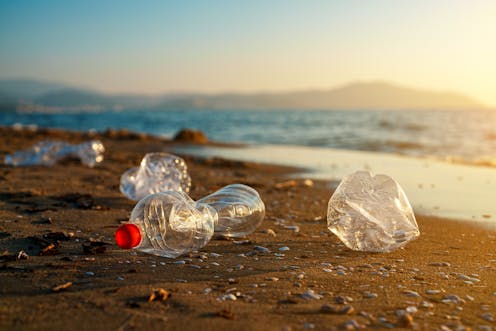
When it rains heavily, plastic waste is washed off our streets into rivers, flowing out to the ocean. Most plastic is trapped in estuaries and coastal ecosystems, with a small fraction ending up offshore in the high seas.
In the coastal ocean, waves and tides break down plastic waste into smaller and smaller bits. These micro and nanoplastics linger in the environment indefinitely, impacting the health of marine creatures from microorganisms all the way up to seabirds and whales, which mistake them for food.
When we look at the scale of the problem of microplastics (smaller than 5mm) and nanoplastics (defined as 1 micrometer or less), we find something alarming. Our new research shows the shallow embayment of Moreton Bay, off Brisbane in Southeast Queensland now has roughly 7,000 tonnes of accumulated microplastics, the same as 700 million half-litre plastic bottles.
This bay accumulates plastics fast, as the Brisbane River funnels the city’s waste into it, along with several other urban rivers. The research hasn’t yet been done, but we would expect similar rates of microplastics in Melbourne’s Port Phillip Bay and Sydney Harbour.
Our research shows how much plastic waste from a big city makes it into its oceans.

Plastic buildup in Moreton Bay
What volume of microplastics does a large city accumulate offshore? It’s hard to measure this for cities built on open coastlines. That’s because sediments and microplastics are rapidly washed away from the original source by waves and currents.
But Moreton Bay is different. The large sand islands, Moreton (Mugulpin) and North Stradbroke (Minjerribah) Islands largely protect the bay from the open ocean. This is why the bay is better described as an enclosed embayment. These restricted bays act as a trap for sediments and pollutants, as waves and currents have limited ability to wash them out. These bays make it possible to accurately measure a city’s microplastic build-up.
The bay supports a range of marine habitats from mangroves, seagrass and coral reefs, as well as an internationally recognised wetland for migrating seabirds. Dugong and turtles have long grazed the seagrass in Moreton Bay’s shallow protected waters, while dolphins and whales are also present. But microplastic buildup may threaten their existence.
Most types of plastic are denser than water, which means most microplastics in coastal seas will eventually sink to the seafloor and accumulate in sediment. Mangroves and seagrass ecosystems are particularly good at trapping sediment, which means they trap more microplastics.
We wanted to determine whether Moreton Bay’s varying ecosystems had accumulated different amounts of plastics in the sediment.
We measured the plastic stored in 50 samples of surface sediment (the top 10cm) from a range of different ecosystems across Moreton Bay, including mangroves, seagrass meadows and mud from the main tidal channels.
 Mangroves are very good at trapping sediment – and plastic.
Alistair Grinham, Author provided (no reuse)
Mangroves are very good at trapping sediment – and plastic.
Alistair Grinham, Author provided (no reuse)
The result? Microplastics were present in all our samples, but their concentrations varied hugely. We found no clear pattern in how plastics had built up. This suggests plastics were entering the bay from many sources.
We tested for seven common plastics: polycarbonate (PC), polyethylene (PE), polyethylene terephthalate (PET), poly (methyl methacrylate) (PMMA), polypropylene (PP), polystyrene (PS), and polyvinyl chloride (PVC).
Of these, the most abundant microplastic was polyethylene (PE). This plastic is widely used for single-use plastic items such as chip packets, plastic bags and plastic bottles. It’s the most commonly produced and used plastic in Australia and globally.
In total, we estimate the bay now holds about 7,000 tonnes of microplastic in its surface sediments.
In our follow-up paper we explored how rapidly these plastics had built up over time. We took two sediment cores from the central part of the bay, where sediment is accumulating. Cores like this act as an archive of sediment and environmental changes over time.
The trend was clear. Before the 1970s, there were no microplastics in Moreton Bay. They began appearing over the next three decades. But from the early 2000s onwards, the rate rose exponentially. This is in line with the soaring rate of plastic production and use globally. Our analysis shows a direct link between microplastic concentration and population growth in Southeast Queensland.
 This graph shows the increase in types of microplastics in the central section of Moreton Bay by year. No microplastic is present prior to 1970, with rapidly increasing microplastics after the year 2000. Polycarbonate (PC), polyethylene (PE), polyethylene terephthalate (PET), poly (methyl methacrylate) (PMMA), polypropylene (PP), polystyrene (PS), and polyvinyl chloride (PVC)
Author provided, Author provided (no reuse)
This graph shows the increase in types of microplastics in the central section of Moreton Bay by year. No microplastic is present prior to 1970, with rapidly increasing microplastics after the year 2000. Polycarbonate (PC), polyethylene (PE), polyethylene terephthalate (PET), poly (methyl methacrylate) (PMMA), polypropylene (PP), polystyrene (PS), and polyvinyl chloride (PVC)
Author provided, Author provided (no reuse)
The challenge of measuring microplastics
To date, we have had limited knowledge of how much plastic is piling up on shallow ocean floors. This is because measuring microplastics is challenging. Traditionally, we’ve used observation by microscope and a technique called absorption spectroscopy, in which we shine infrared light on samples to determine what it’s made up of. But these methods are time-consuming and can only spot plastic particles larger than 20 micrometres, meaning nanoplastics weren’t being measured.
Our research team has been working to get better estimates of microplastic and nanoplastic using a different technique: pyrolysis-gas chromatography mass spectrometry. Here, a sample is dissolved in a solvent and then heated until it vaporises. Once in vapour form, we can determine the concentration of plastic and what types of plastics are present.
This method can be used to estimate how much plastic pollution is present in everything from water to seafood to biosolids and wastewater.
What’s next?
It’s very likely microplastics are building up rapidly in other restricted bays and harbours near large cities, both in Australia and globally.
While we might think microplastics are safe once buried in sediment, they can be consumed by organisms that live in the sediments. Currents, tides and storms can also wash them out again, where marine creatures can eat them.
This is not a problem that will solve itself. We’ll need clear management strategies and policies to cut plastic consumption and improve waste disposal. Doing nothing means microplastics will keep building up, and up, and up.


