

Where does Santa live? It’s a trickier question to answer than you may think
- Written by The Conversation
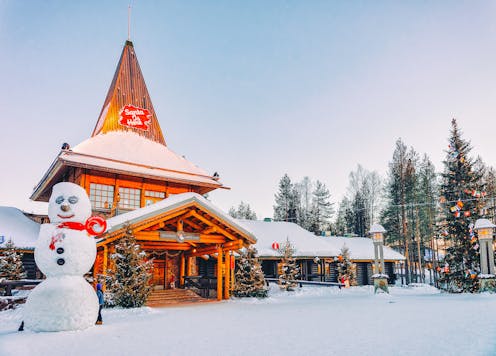
Sending a letter to Santa can be difficult as no one can agree on where exactly Santa lives. Several countries are competing to claim Santa as one of their citizens.
Finland’s tourism industry suggests Korvatunturi in Lapland is where Santa keeps his workshop, and the link between Santa and Lapland brings in hundreds of millions of tourist dollars.
Danes say Santa is in Greenland. Sweden suggests Mora is the place, and has built the theme park Santaworld.
These places certainly look the part with white snow in winter and reindeer. They’re also close to the North Pole.
Not so jolly traditions
They also have old and often quite disturbing folklore about the man in red.
Pagan Finns celebrated St Knut’s Day in wintry January by having men in furry jackets, the nuuttipukki, go from house to house with a sack of presents. Except the nuuttipukki weren’t giving gifts and would likely make children cry. They came demanding gifts and would curse bad luck to any household not handing over a present.

Eventually the gift grabbing nuuttipukki became the gift giving Joulupukki. Like other northern traditions such as the Yule Lads of Iceland, this visitor gave gifts but only to well behaved children.
By the 19th century, Santa Claus was settled in popular awareness more or less what we think of now: a jolly old man with a beard, a sleigh, reindeer and presents, living somewhere northern and cold. That image built on but sanitised the more grotesque European folklores of elves, gnomes and other supernatural creatures who either brought or demanded gifts.
 The Finnish Santa Claus, Joulupukki, greets a small boy on Helsinki Market Square in 1961.
Finnish Heritage Agency, CC BY
The Finnish Santa Claus, Joulupukki, greets a small boy on Helsinki Market Square in 1961.
Finnish Heritage Agency, CC BY
But standardising Santa’s appearance did not settle where he actually lived and worked.
In the mid-19th century the illustrator Thomas Nast portrayed Santa as a jolly old man in Harper’s Weekly, and the illustration and the archetype took off. But Nast just showed Santa in a wintry landscape.
 Merry Old Santa Claus, as drawn by Thomas Nast for Harper’s Weekly.
Wikimedia Commons
Merry Old Santa Claus, as drawn by Thomas Nast for Harper’s Weekly.
Wikimedia Commons
It could have been the North Pole, and no one in 1866 had actually been to the Pole. No explorer reached there until 1926, leaving Santa, if he did live there, undisturbed in his workshop.
Santa and territorial disputes
The medieval and pagan mythologies in Finland and Scandinavia give some credibility to these countries’ efforts to claim Santa as their own. After all, these are old legends.
Other countries take a more modern approach. The Canadian government makes sure Christmas happens each year by allowing Santa to travel through Canadian airspace. Taking that a step further, in 2013 the Conservative government of Stephen Harper issued Santa and his wife with Canadian passports.
That action might seem twee or whimsical or simply some Christmas fun for children, but it may also have shown that some governments want to claim a lot more than Santa. Harper’s gesture came at a time of an international political dispute about ownership of the North Pole and specifically Canadian claims to Artic regions.
Somewhere hotter than the Pole
But are all these countries wrong, or being opportunistic?
Despite what we think, where Santa really comes from is a lot hotter and a lot further east – and those red robes would be uncomfortable to wear.
Santa Claus is a name derived from Sinterklaas or Saint Nicholas. Along with pagan elves and gnomes, another element in the long and very complex history of Santa is the Christian bishop St Nicholas of Smyrna. Or is that Nicholas of Myra?
 Saint Nicholas depicted in a 14th-century English book.
National Library of Wales/Wikimedia Commons
Saint Nicholas depicted in a 14th-century English book.
National Library of Wales/Wikimedia Commons
Smyrna, now called Izmir in Turkey, and Myra, now Demre in Turkey, are both associated with Nicholas. Just as in northern Europe, different places in Anatolia compete to be associated with Santa.
Nicholas is patron saint of seemingly everything including archers and brewers but also children and sailors. The link with children explains the later association as Santa, especially as Saint Nicholas gave children gifts. The link with sailors is why his legend is known around the world.
 St. Nicholas Church was built above the burial place of St Nicholas, a 4th-century Christian bishop of Myra.
Sinan Şahin/Wikimedia Commons, CC BY
St. Nicholas Church was built above the burial place of St Nicholas, a 4th-century Christian bishop of Myra.
Sinan Şahin/Wikimedia Commons, CC BY
A 2017 archaeological dig under the Church of Saint Nicholas in Turkey was believed to have found the burial place and therefore the body of Saint Nicholas.
A grave full of old bones is not very Christmas-like, but it may be an authentic link between a place and a person which no amount of snow or reindeer in northern Europe could match.


