

How do mosquito repellents work? A chemistry expert explains
- Written by The Conversation
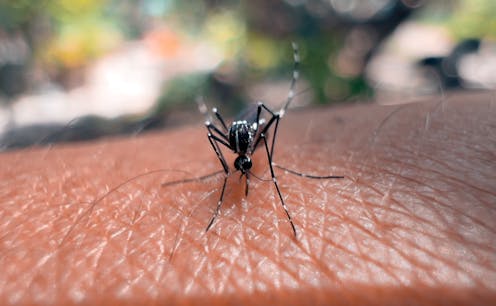
It’s summertime, and for many of us that means plenty of time outside – and, unfortunately, mosquitoes.
The combination of the increase in temperature and plenty of water is ideal for these blood-sucking insects to make their presence felt.
In the best-case scenario, they are a pest, delivering a highly unpleasant sting. At the other end of the spectrum, they are vectors for diseases responsible for more human fatalities than any other animal on Earth.
To keep them at bay, many of us will reach for the bottle of insect repellent or citronella candles in order to avoid the bite and incessant itching that comes with it. But how do these repellents actually work?
A complex interplay
A great deal of research has gone into understanding how and why female mosquitoes – they are the ones that bite us – are attracted to people.
There is evidence showing they are attracted to the carbon dioxide we exhale, lactic acid found in our sweat, and a variety of other skin odours and volatile compounds we give off. The interplay between all these factors is quite complex.
To ward off mosquitoes, physical barriers such as netting make for the best protection. However, while you might put netting around a backdoor patio and barbecue, doing this for any large space is simply not practical.
This is where repellents come in.

DEETerrent
There are a variety of mosquito repellents available.
The most tried-and-true products are based on a substance called N,N-diethyl-meta-toluamide, more commonly referred to as DEET.
This molecule has been commercially available since 1957, after the United States military discovered it was an effective insect repellent.
DEET is often used as a point of comparison for studies investigating alternatives. Studies show that, provided they are used according to direction, DEET products are safe and effective.
For example, it is recommended that when required, sunscreen is applied before the repellent. DEET products are not recommended for infants.
The exact mechanism by which DEET repels mosquitoes and other insects is still explored today.
Many studies link its success to mosquitoes having receptors that sense the presence of DEET, deterring them from closely approaching our skin. Some investigations suggest that when DEET is detected, it inhibits mosquitoes’ attraction to us, while others show evidence that mosquitoes “smell and avoid” DEET.
There are also numerous reports demonstrating mosquitoes don’t bite when they land on DEET-treated skin. This is because DEET acts as a contact-based repellent and conveys a chemical message to mosquitoes to leave. Studies suggest that DEET likely works through a combination of the processes described here.
 DEET has been commercially available since 1957.
AlexBuess/Shutterstock
DEET has been commercially available since 1957.
AlexBuess/Shutterstock
Effective alternatives
Another more recent family of mosquito repellent products rely on an active ingredient called picaridin (or icaridin).
The current consensus is that picaridin products are safe, and highly effective. For many, they are considered appealing as they don’t have as strong a scent as DEET.
Picaridin products have been reported to be equally effective as DEET, or in some cases, even slightly superior, though the outcome depends on their concentration too.
The other repellent regularly reported as being effective is para-menthane-3,8-diol (PMD).
This is produced by chemical treatment of oil of lemon eucalyptus.
Untreated, this oil isn’t effective at repelling mosquitoes. However, several studies have shown that PMD is an effective mosquito repellent.
The ability of these repellents to deter mosquitoes is dose dependent.
In all cases, it’s important that an appropriate dose is applied, with re-application sometimes required to keep protection to a maximum. The performance of these products varies according to many other variables too, including the species of mosquito.
What about citronella?
Citronella products, including candles and topical formulations, are popular choices for keeping mosquitoes away.
However, in systematic testing, these have been shown to be far less effective than DEET.
Studies have also shown that citronella candles don’t fend off mosquitoes as much as you might like.
There are many other repellent products on the market.
Given the widespread interest in preventing mosquito bites, natural remedies abound. It’s important to recognise that natural isn’t necessarily more effective and it isn’t necessarily safer.
In most reported studies, DEET and picaridin are reported as having the greatest duration of protection (of the order of hours) and greatest effect on the mosquitoes. They are more thoroughly tested than many alternatives.
When others are tested, they are often found wanting.
One study described sound-based devices as being the repellent equivalent of snake oil. And although repellent bracelets contain working ingredients, they are largely ineffective in that form. This is because of insufficient concentrations of the active ingredient being “emitted”.
When it comes to preventing disease transmission via mosquitoes, the benefits of the proven repellents far outweigh the risks.
Read more https://theconversation.com/how-do-mosquito-repellents-work-a-chemistry-expert-explains-244403


