

Friend or foe? How Trump’s threats against ‘free-riding’ allies could backfire
- Written by The Conversation
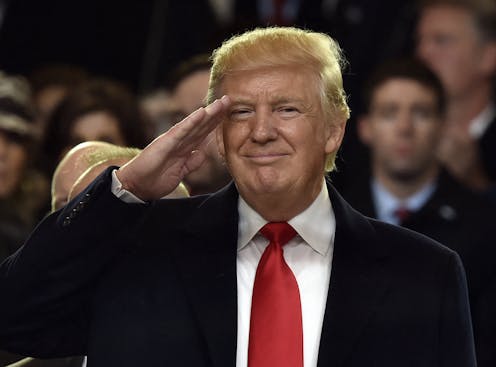
Donald Trump is an unusual United States president in that he may be the first to strike greater anxiety in allies than in adversaries.
Take the responses to his pre-inauguration comments about buying Greenland, for instance, which placed US ally Denmark at the centre of the global foreign policy radar screen and caused the Danish government – which retains control of the territory’s foreign and security policies — to declare Greenland isn’t for sale.
Canada is also in Trump’s sights with trade tariff threats and claims it should be the 51st US state. Its government has vociferously opposed Trump’s comments, begun back-channel lobbying in Washington, and prepared for trade retaliation.
Both cases highlight the coming challenges for management of the global US alliance network in an era of increased great power rivalry – not least for NATO, of which Denmark and Canada are member states.
Members of that network saw off the Soviet Union’s formidable Cold War challenge and are now crucial to addressing China’s complex challenge to contemporary international order. They might be excused for asking themselves the question: with allies like this, who needs adversaries?
Oversimplifying complex relationships
Trump’s longstanding critique is that allies have taken advantage of the US by under-spending on defence and “free-riding” on the security provided by Washington’s global network.
In an intuitive sense, it is hard to deny this. To varying degrees, all states in the international system – including US allies, partners and even adversaries – are free-riding on the benefits of the global international order the US constructed after the Cold War.
But is Trump therefore justified in seeking a greater return on past US investment?
Since alliance commitments involve a complex mix of interests, perception, domestic politics and bargaining, Trump wouldn’t be the deal-maker he says he is if he didn’t seek a redistribution of the alliance burden.
The general problem with his recent foreign policy rhetoric, however, is that a grain of truth is not a stable basis for a sweeping change in US foreign policy.
Specifically, Trump’s “free-riding” claims are an oversimplification of a complex reality. And there are potentially substantial political and strategic costs associated with the US using coercive diplomacy against what Trump calls “delinquent” alliance partners.
Free riding or burden sharing?
The inconvenient truth for Trump is that “free-riding” by allies is hard to differentiate from standard alliance “burden sharing” where the US is in a quid pro quo relationship: it subsidises its allies’ security in exchange for benefits they provide the US.
And whatever concept we use to characterise US alliance policy, it was developed in a deliberate and methodical manner over decades.
US subsidisation of its allies’ security is a longstanding choice underpinned by a strategic logic: it gives Washington power projection against adversaries, and leverage in relations with its allies.
To the degree there may have been free-riding aspects in the foreign policies of US allies, this pales next to their overall contribution to US foreign policy.
Allies were an essential part in the US victory in its Cold War competition with the Soviet-led communist bloc, and are integral in the current era of strategic competition with China.
Overblown claims of free-riding overlook the fact that when US interests differ from its allies, it has either vetoed their actions or acted decisively itself, with the expectation reluctant allies will eventually follow.
During the Cold War, the US maintained a de facto veto over which allies could acquire nuclear weapons (the UK and France) and which ones could not (Germany, Taiwan, South Korea).
In 1972, the US established a close relationship with China to contain the Soviet Union – despite protestations from Taiwan, and the security concerns of Japan and South Korea.
In the 1980s, Washington proceeded with the deployment of US missiles on the soil of some very reluctant NATO states and their even more reluctant populations. The same pattern has occurred in the post-Cold War era, with key allies backing the US in its interventions in Afghanistan and Iraq.
The problems with coercion
Trump’s recent comments on Greenland and Canada suggest he will take an even more assertive approach toward allies than during his first term. But the line between a reasonable US policy response and a coercive one is hard to draw.
It is not just that US policymakers have the challenging task of determining that line. In pursuing such a policy, the US also risks eroding the hard-earned credit it earned from decades of investment in its alliance network.
There’s also the obvious point that is takes two to tango in an alliance relationship. US allies are not mere pawns in Trump’s strategic chessboard. Allies have agency.
They will have been strategising how to deal with Trump since before the presidential campaign in 2024. Their options range from withholding cooperation to various forms of defection from an alliance relationship.
Are the benefits associated with a disruption of established alliances worth the cost? It is hard to see how they might be. In which case, it is an experiment the Trump administration might be well advised to avoid.


