

What’s the difference between Hass and Shepard avocados? It’s not just the colour
- Written by The Conversation
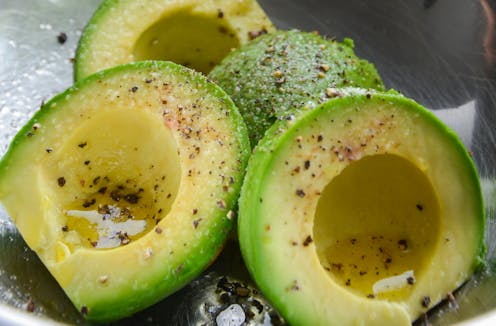
Whether with crumbled feta or poached eggs, you’d be challenged to find a cafe in Australia or farther afield that doesn’t have avocado somewhere on the menu.
This fruit (yep, it’s a fruit from a tree, not a vegetable) is widely associated with brunch culture and other trendy eating habits.
The Australian avocado industry developed in the 1960s, 30 years after the start of the first large-scale production in California. Orchards producing avocados now span all parts of Australia, except Tasmania, Australian Capital Territory and the Northern Territory.
Avocados are considered a monoculture crop: they’re grown on the same land each year, making them more susceptible to pests and creating a need for increased fertiliser use. The carbon footprint of avos is almost twice as high as that of apples, but much lower than many animal food sources.
There are now over 50 different avocado types globally, but only a few are grown commercially.
Not all avos are the same
You may not notice a difference when you get your avocado toast at a cafe. But at the shops or the market, a striking difference occurs each year in Australia.
In autumn, the familiar dark purple Hass avocado disappears and is replaced with the lighter green Shepard variety. In Australia, this typically happens between February and May.
If you don’t know the difference between the two, you may expect Shepard avos to perform the same way as Hass – and be left disappointed. There are some important differences.
Hass avocados

Hass avocados are known for their dark, pebbly-looking skin that appears almost black when ripe. They have an ovoid shape with a slight pear-like appearance. The thick skin can be a challenge to peel, often requiring a sharp knife or avocado slicer.
Hass avocado flavour is rich, creamy and buttery, with nutty undertones. Their texture is ideal for mashing, blending and spreading, creating a creamy texture in dips, guacamole and smoothies.
Hass avocados ripen – and darken in colour – slowly over several days. They remain firm to the touch when ripe, and will feel squishy when overripe. A slight give when pressed confirms Hass avos are ready to eat.
Available in Australia from May to January, Hass are the dominant variety of commercially grown avocado worldwide. They were cultivated by horticulturalist Rudolph Hass in California in the 1920s.
Shepard avocados

Shepard avocados have smooth, green skin that remains green even when they are fully ripe. They are round to slightly oblong in shape and have a slightly milder and sweeter taste, with less pronounced nutty undertones.
Shepard avocados ripen more quickly than Hass, but you won’t be able to tell that by the colour. Instead, check for softness – Shepard avocados are very soft when ripe. What might feel overripe when handling a Hass will likely be ideal ripeness if it’s a Shepard. The thin, smooth skin makes them easy to peel by hand or with a gentle squeeze.
Their buttery soft texture is firm and creamy, and they hold their shape well when cut, making them ideal for slicing, dicing and spreading despite being structurally firm.
Interestingly, Shepard avocados brown much more slowly than Hass, making them perfect for garnishes. Their milder flavour also makes Shepard avos well suited to sweet dishes, such as chocolate mousse.
Shepard avos account for approximately 10–15% of Australian avocados and are in season from February to April each year while there is a gap in the Hass season.
Australia is the only country in the world that grows Shepard avocados commercially. (They are grown in Queensland.)
Avocados and our health
As avocados contain 59% fat, people wishing to lose weight were previously advised to avoid or limit eating them.
We now know that a majority of this fat is oleic acid, a monounsaturated (healthy) fat that helps to reduce cholesterol and improve heart health.
Additionally, only 1% of an avocado is made up of carbohydrates, making the fruit popular with people following a ketogenic (keto) diet of low carbs and high fat.
People who consume avos also tend to follow a better pattern of eating in general. They eat more whole grains, fruit and vegetables and fewer discretionary or takeaway foods.
As an energy-dense food, consuming a whole avocado is about the same as eating 2.5 whole apples. Per 100 grams, avocado actually gives you less energy than an equivalent amount of cooked white rice.
As avocado dishes are visually appealing and often featured in food photography, they have become a symbol of modern eating habits.


