

‘Serious concerns’: national assessment reveals rivers flowing into the Great Barrier Reef are getting more polluted
- Written by The Conversation
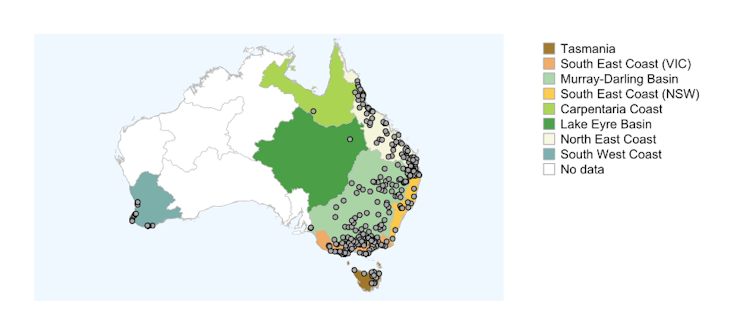
Polluted runoff is still smothering the Great Barrier Reef, our first national assessment of water quality trends in Australian rivers has revealed. The problem on the reef is getting worse, not better, despite efforts to improve farming practices and billions of dollars committed by governments to water-quality improvements.
But in good news, there are signs of improvement in the Murray-Darling Basin, where less salt, sediment and phosphorous were detected in the water.
Our latest research quantifies, for the first time, how water quality in Australian rivers has changed over the past two decades. Around half our 287 monitoring sites experienced significant changes in water quality between 2000 and 2019 on every measure we analysed. But the results for the reef and the basin stood out.
In particular, freshwater flows into the Great Barrier Reef lagoon contained increasing levels of sediment and phosphorous. If the trend continues, we have serious concerns for the health of the Great Barrier Reef and the tourist industry it supports.
Understanding river water quality
We studied water quality monitoring data from 287 river sites across Australia. The relevant agency in each state and territory collects this information and makes it available online. The data covers the following:
- salinity: too much makes water unsuitable for drinking or irrigation
- dissolved oxygen: when the level is too low it can kill aquatic life
- nitrogen and phosphorous: high levels of either can cause excessive algae growth and consumes oxygen
- sediment: too much reduces light penetration and disrupts ecosystems
We focused on sites with records of all five water quality indicators from 2000 to 2019.
River flows can vary enormously from year to year and this affects water quality. So we used statistics to account for this and identify underlying long-term trends.
In the catchments that exhibited significant changes between 2000 and 2019, about half showed improvements in dissolved oxygen, salinity and phosphorus, while the other half deteriorated. Sediment levels mostly improved (86% of catchments) over time. The story was not so good when it came to nitrogen levels, which went up in 60% of catchments.
Two regions experienced the greatest large-scale changes in water quality over that time: the North East Coast basin and the Murray-Darling Basin.

More polluted water flowing to the reef
In the North East Coast basin, many rivers capture water from inland areas, including farming regions, and carry it to the ocean near the Great Barrier Reef. So, any pollution in these rivers are carried to the reef.
Suspended sediments make the water cloudy or “turbid”. This can reduce the growth of seagrass and disrupt the growth and reproductive cycles of coral and some fish.
Phosphorous and nitrogen are essential minerals or nutrients, which is why they are used on farms as fertiliser. But too much of either can lower coral diversity, and reduce resilience of coral to bleaching and disease.
We found water quality in rivers flowing to the reef – one of the world’s seven natural wonders – had declined over the past two decades. In particular, levels of phosphorus and sediments had increased at around 5% per year on average across catchments.
This may be a hangover from intensifying land use and clearing in the 1960s and ‘70s. Land clearing can lead to more erosion of sediment and phosphorus attached to soils. Similarly, intensive agriculture can lead to increased phosphorus in rivers, due to fertiliser use.
Substantial investment has been made to improve water quality over many years. This includes almost A$1.8 billion committed by the federal and Queensland governments between 2014 and 2030. But it appears greater effort is needed to turn things around.
It can take a long time for management strategies to start having an effect on water quality. So efforts to date may not yet be showing up. Or perhaps the scale of these changes has not been enough to shift the long-term trend in water quality.
Regardless, declining water quality over the past two decades has direct implications for the future of the world heritage listed site.

Cleaning up the basin
In contrast, we found water quality in the Murray-Darling Basin was improving. Salinity levels declined, along with phosphorus and suspended sediment.
Managing salinity in the basin is a long-term issue. Much of the basin’s groundwater is naturally saline to begin with. Land clearing and agricultural activities since European colonisation have further exacerbated the problem.
But our results suggest salinity levels in the Murray-Darling Basin rivers are improving. This may be due to large-scale management actions such as improving irrigation efficiency, reducing drainage, installing salt interception, and drainage diversion schemes to divert saline groundwater away from entering the Murray River.
These changes in water quality could also be due to declines in rainfall during the Millennium drought period over the late 1990s and early 2000s. The dry conditions might have altered processes controlling flushing of salt, sediments and phosphorus into waterways. As such, the drought has likely had more complicated and long-lasting impacts on water quality than the year-to-year variation in river flow.
While our research shows water quality in the Murray-Darling Basin has improved, this does not mean funding in this area should reduce or cease. Scientists and policymakers must continue monitoring and working towards a healthy basin for future generations.
Keeping watch over water quality
Unfortunately, insufficient long-term water quality monitoring limits our understanding of water quality trends across large parts of the country.
This includes a large proportion of the western, northern and central parts of Australia. Filling these data gaps will require new and ongoing investment into water quality monitoring.
Australian water authorities need to keep checking the health of our rivers.
A national program to harness this data from states and territories, to monitor and track river water quality, is needed to continue similar Australia-wide assessments of water quality.
Such assessments are vital for providing an evidence base for federal policy and identifying future needs in river water quality protection.


