

Jim Chalmers wants to fix Australia’s broken road tax system. Here’s what one solution might look like
- Written by The Conversation
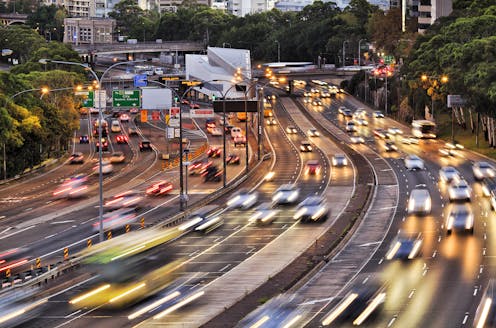
Australia’s road tax system has a problem. Revenue from the fuel excise – the primary way we tax motoring – has been declining steadily as a proportion of government revenue over the past two decades.
Politicians, policy experts and business leaders have all long called for reform. Now, change could be on the horizon.
The Australian Financial Review reports that at a closed-door dinner with business leaders in Canberra last week, Treasurer Jim Chalmers hinted that addressing falling fuel excise revenue would be a tax reform priority if Labor is re-elected.
One option would be a road user charge on electric vehicles (EVs), which obviously don’t pay fuel excise. But singling them out would undermine the government’s own efforts in promoting EVs to help meet the nation’s emissions reduction targets.
There are also other inequities in the way the current fuel excise works. Our previous research has shown Australia is ready for a rational and transparent discussion about road-user charging on all vehicles, not just electric ones.
How we tax roads today
Currently, Australian motorists pay several government taxes and other fees on their vehicles.
One is the fuel excise. This tax, collected by the Commonwealth, is paid per litre of fuel purchased and is indexed every six months to account for inflation.
Then there are registration fees, typically paid every six or 12 months and collected by state and territory governments.
Vehicle owners also have to pay compulsory third-party insurance, which in some states is bundled with registration fees.
When buying or transferring ownership of a vehicle, other fees can apply. These include stamp duty as well as the luxury car tax on vehicles priced above a certain threshold.
The system isn’t working
As a proportion of Australian taxation revenue, revenue from the fuel excise has dwindled from 7.4% in 2000 to 3.9% in 2025.
It might be tempting to blame electric cars for this decline. But this share began declining steadily long before EVs were introduced in Australia, and is projected to fall further.
Falling fuel excise revenue can be attributed to a range of other factors. Improvements in engine fuel consumption have had a substantial impact on the number of litres used to travel the same distances.
In Australia, the average fuel consumption of passenger cars in 2005 was 11.3 litres per 100 kilometres. In 2024, this figure was around 6.9 litres.
Fuel consumption rates are expected to improve further and match those in other nations with the introduction of the New Vehicle Efficiency Standard, which came into effect at the start of this year.
Public transport usage has also been trending upwards in many of Australia’s major cities since the turn of the millennium, reducing reliance on private cars.
Need for an alternative
Australia’s current road taxes are blunt instruments that don’t reflect the true societal costs of driving.
The fuel excise, for example, does not properly account for traffic congestion or emissions. A driver who travels in regional Victoria or in an outer suburb of Sydney for local shopping or school drop-offs will pay the same excise as a driver who contributes to congestion by travelling into the city centre.
Similarly, car registration fees are not related to the number of kilometres travelled, congestion created, or emissions produced by driving.
One of the most widely known alternatives alternatives to a fuel excise tax is a pay-per-distance road user charge. Such charges work by charging vehicles a fee per kilometre travelled.
This would not be a new tax on top of existing taxes – it would replace current fuel excise and car registration fees.
Adjustments to this model can include exempting some groups from the charges (such as low-income families, taxis and emergency service vehicles), adjusting charges for different categories of vehicles, and applying congestion charges under certain conditions.
Failed attempts
Targeting electric vehicles with a road user charge has been an acute priority for many states, as they are currently completely exempt from paying the fuel excise.
In 2021, the Victorian government introduced a controversial distance-based charge for EVs. But this scheme was challenged in the High Court and ruled unconstitutional.
Victoria’s measure was found to be a form of excise, and only the Commonwealth can impose such a tax.
Following the ruling, the treasurer asked state and territory treasurers to look into the design of a national scheme in December 2023. But this process reportedly stalled.
Support for reform
Today, there are about 300,000 EVs on Australian roads (including around 248,000 battery electric cars and 53,500 plug-in hybrids).
That’s only a tiny fraction of the 21 million cars registered across the nation. Over coming decades, as EVs take a greater share of total vehicles on the road, the hit to already flagging fuel excise revenue will become acute.
In the meantime, our own previous research and public surveys show Australia is ready for a rational and transparent discussion about road-user charging on all vehicles, not only electric vehicles.
We found most respondents would support such charges if they were transparent, equitable and replace or reduce other road taxes.


