

Grief, strength and resistance: The Black Woman of Gippsland is a powerful reckoning with colonial myths
- Written by The Conversation
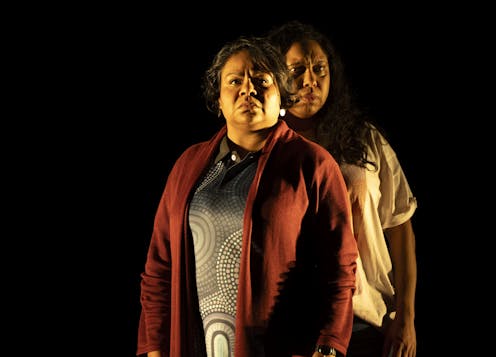
A woman is tossed ashore, bedraggled and alone. She is believed to be a survivor of a shipwreck, possibly from the Britannia or the Britomart, both lost in the Bass Strait that year.
In 1846, the colony of Melbourne was gripped by panic as rumours spread that a white woman had been shipwrecked off the coast of Gippsland and was being held by a group of First Nations people at Port Albert.
It was Angus McMillan, a Scottish pastoralist and perpetrator of several massacres of Gunaikurnai people, who first claimed to have seen a white woman at a First Nations camp near the area. Her alleged captivity captured the colonial imagination, with newspapers speculating wildly about the fate of a “virtuous” white woman lost in the Gippsland bushland.
The legend of the “white woman of Gippsland” became one of the most enduring myths of colonial Australia. Though never verified, it was used to justify violent “rescue missions” and brutal massacres across Gunaikurnai Country.
Nearly two centuries later, Andrea James’ The Black Woman of Gippsland reclaims this history.
Restaging myth
Written and directed by the Yorta Yorta and Gunaikurnai playwright, a descendant of the Thorpe and Pepper clans, The Black Woman of Gippsland restages the myth as a contemporary mystery centred on truth, memory and survival.
Based on real events and set on James’ grandmother’s Country, it continues a powerful tradition of First Nations storytelling on stage.

James’ play flips the colonial script. It shifts attention away from the imagined white captive and toward the real lives, losses and resistance of the Gunaikurnai people.
Through a bold act of theatrical truth-telling, the audience is drawn into a story that refuses silence and resists erasure.
Set in the present, the myth’s long shadow stretches into the life of Gunaikurnai PhD student Jacinta, played by the staunch Chenoa Deemal. Jacinta’s research into the so-called white woman legend draws her into a tangled web of historical violence and intergenerational trauma.

Ursula Yovich is deadly as Aunty Rochelle, the no-nonsense family protector whose warmth and authority ground the story. Zach Blampied brings levity to Jacinta’s teenage cousin, Kyle, through his likeable, easygoing presence. Ian Bliss delivers a chilling portrayal of a small-town sergeant shaped by denial and quiet menace.
Through these contemporary perspectives, The Black Woman of Gippsland exposes the myths Australia continues to uphold and the truths it still refuses to hear.
Resisting realism
Blending projected imagery and stylised design, the production resists realism in favour of memory, spirit and sensation.
The set (Romanie Harper) and lighting (Verity Hampson) gives a dreamlike, immersive atmosphere. James Henry’s sound design and vocals by Yovich add emotional and cultural depth.
 The production resists realism in favour of memory, spirit and sensation.
Pia Johnson/Melbourne Theatre Company
Most strikingly, colonial records have been transformed into song and passed on to the Gunaikurnai community, with the guidance of Elder Wayne Thorpe and choreography by Brent Watkins.
This is theatre that breathes beyond the stage, reconnecting culture and story across generations.
Grief, strength and resistance
Though grounded in a specific place, The Black Woman of Gippsland speaks to a broader national truth. Colonial myths have shaped Australia’s identity, often justifying violence in the name of “civilisation”.
Stories like the white woman of Gippsland were not harmless fictions – they underpinned massacres, fear campaigns and some of the first Black deaths in custody.
As a Ngemba woman from another part of this continent, I recognise the grief, strength and resistance woven through this story. This is not my Country, but the violence this myth enabled is something all our communities feel.
 James has created a moving and necessary work that centres stories long denied.
Pia Johnson/Melbourne Theatre Company
The Black Woman of Gippsland speaks powerfully to cultural survival, intergenerational knowledge and the urgent need for reckoning, even when it is deeply uncomfortable.
The Black Woman of Gippsland is not easy viewing, nor is it meant to be. It asks us to sit with the silences in this nation’s history and challenges us to listen not just with empathy, but with accountability.
The truth is complex, and Australia has a long history of turning away when First Nations voices speak too clearly.
Still, with generosity, rage and care, James has created a moving and necessary work that centres stories long denied. The question audiences must ask is how long awareness can stand in place of action – and whether we are willing to move beyond it.
The Black Woman of Gippsland is at the Melbourne Theatre Company as part of the YIRRAMBOI Festival until May 31.


