

How the North West Shelf expansion risks further damage to Murujuga’s 50,000-year-old rock art
- Written by The Conversation
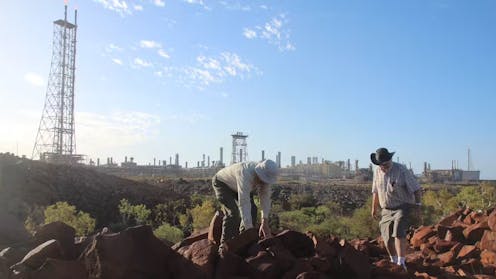
Yesterday, new environment minister Murray Watt approved an extension for the North West Shelf liquefied natural gas project. The gas plant at Karratha, Western Australia, will run until 2070.
This expansion – and the pollution it will release – has led to a recommendation by the International Council on Monuments and Sites to defer UNESCO’s decision on the world heritage listing of the nearby Murujuga rock art.
Two of the recommendations prior to renomination of the site are to “ensure the total removal of degrading acidic emissions” and “prevent any further industrial development adjacent to, and within, the Murujuga Cultural Landscape”.
Murujuga has more than one million petroglyphs, some up to 50,000 years old.
It has the oldest depictions of the human face in the world and records the lore and traditions of Aboriginal Australians since the first human settlement of this continent. It is strikingly beautiful and is of enormous cultural and spiritual importance to the Traditional Owners.
Despite the immense significance of the site, a large industrial precinct has been built at its centre.
Read more: Green light for gas: North West Shelf gas plant cleared to run until 2070
Concerns about the Murujuga Rock Art report
On Friday, the Western Australian Government released the long awaited Murujuga Rock Art Monitoring Program Year 2 report. This report examines the effect of industrial pollution upon one of the world’s most significant rock art sites.
We have conducted our own independent project into the impact of industrial emissions on Murujuga since 2018. Many of our findings support the details in this report but the government’s report summary and subsequent political commentary downplays the ongoing impacts of acidic emissions from industry on the world unique rock art.
The most significant findings are the Weathering Chamber results. These subjected all rock types from Murujuga to the air pollutants released by industry. The results showed that all were degraded, even with relatively low doses of sulphur dioxide (SO₂) and nitrogen dioxide (NO₂).
The second highly significant finding is that “there is statistically significant evidence of elevated porosity of granophyre rock surfaces”. This is centred on the industrial precinct in Murujuga. The report acknowledges industrial pollution is the most likely cause.
This degradation and elevated porosity of the rocks puts the survival of the petroglyphs at risk.
On our research team, Jolam Neumann’s still to be published PhD thesis at the University of Bonn, Germany, considered the impacts of industrial pollution on Murujuga rocks.
He used actual samples of gabbro and granophyre rock collected from Murujuga and simulated six years of weathering under current pollution conditions. He found elevated porosity in both rock surfaces. He also collected the residue to understand what was eroded from the rock and how.
He found there was significant degradation of birnessite (manganese) and kaolinite (clay) from the surface. The dark red/brown surface of the rock became porous and started to break down.
His work confirms industrial emissions are the cause of the elevated porosity in the report. His work shows the seriousness of the porosity: it is symptomatic of a process causing the rapid disintegration of the rock surface.
Damage is ongoing
With Murujuga Rock Art Monitoring Program report showing evidence of damage to the art from pollution, the state government chose to emphasise in their report summary that a defunct power plant from the 1970s and 1980s was likely the culprit.
The report’s data suggests this power plant produced about 3,600 tonnes of NO₂ per year, and less than 400 tonnes of SO₂ per year. Current industry in the immediate area produces more than 13,000 tonnes of NO₂ per year and more than 6,500 tonnes of SO₂.
If the old power plant damaged the art then contemporary industrial emissions will be damaging the rock art at least five times faster.
Neumann also gained access to a piece of rock collected in 1994 by archaeological scientist Robert Bednarik, and stored in his office in Melbourne for the past 30 years.
The area where this rock came from now has elevated porosity, but the Bendarik rock shows no signs of it. This means the bulk of the industrial damage is likely more recent than 1994 – and is ongoing.
Losing 50,000 years of culture
The rock art was formed by engraving into the outer thin red/brown/black surface of the rock, called rock varnish, exposing the blue-grey parent rock beneath.
This rock varnish was made in a process that involved the actions of specialised microbes called cyanobacteria. They concentrate manganese and iron from the environment to form an outer sheath to protect themselves from the harsh desert environment.
The rock varnish forms at an incredibly slow rate: 1 to 10 microns in 1,000 years (a human hair is about 100 microns).
These organisms can only thrive when the rock surface acidity is near neutral (pH 6.5–7). Their manganese sheaths are crucial to the integrity of the rock varnish, it binds it together and holds it to the underlying rock.
If you lose the manganese you lose the rock varnish and the rock art.
Neumann found the proportion of manganese in the Bednarik rock sample was 18.4% by weight. In samples collected in the same area in 2021, the manganese content had fallen to 9.6%. The depth of the varnish was reduced, and the varnish layer was full of holes where the manganese had been degraded.
The damage by industry over the last 26 years was clearly visible.
Increased porosity is reducing the density of the rock varnish layer and leading to its eventual degradation. There is also an absence of cyanobacteria close to the industrial sites, but not at more distant sites, suggesting industrial emissions are eliminating the varnish-forming microbes.
Where to next?
Industrial pollution has degraded the rock art and will continue to do so until the industrial pollution levels at Murujuga are reduced to zero.
There are two well-recognised ways to eliminate NO₂ emissions. One uses selective catalytic reduction to convert NO₂ to nitrogen and water. The second method is to replace all gas burning heat production processes with electricity.
The use of such technologies should form part of the conditions to the ministerial approval of the North West Shelf extension.


