

Sharks come in many different shapes and sizes. But they all follow a centuries-old mathematical rule
- Written by The Conversation
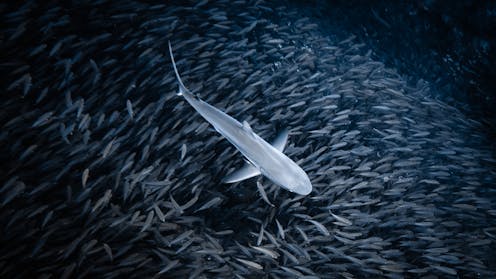
From hand-sized lantern sharks that glow in the deep sea to bus-sized whale sharks gliding through tropical waters, sharks come in all shapes and sizes.
Despite these differences, they all face the same fundamental challenge: how to get oxygen, heat and nutrients to every part of their bodies efficiently.
Our new study, published today in Royal Society Open Science, shows that sharks follow a centuries-old mathematical rule – the two-thirds scaling law – that predicts how body shape changes with size. This tells us something profound about how evolution works – and why size really does matter.
What is the two-thirds scaling law?
The basic idea is mathematical: surface area increases with the square of body length, while volume increases with the cube. That means surface area increases more slowly than volume, and the ratio between the two – crucial for many biological functions – decreases with size.
This matters because many essential life processes happen at the surface: gas exchange in the lungs or gills, such as to take in oxygen or release carbon dioxide, but also heat loss through skin and nutrient uptake in the gut.
These processes depend on surface area, while the demands they must meet – such as the crucial task of keeping the body supplied with oxygen – depend on volume. So, the surface area-to-volume ratio shapes how animals function.
Despite its central role in biology, this rule has only ever been rigorously tested in cells, tissues and small organisms such as insects.
Until now.
Why sharks?
Sharks might seem like an unlikely group for testing an old mathematical theory, but they’re actually ideal.
For starters, they span a huge range of sizes, from the tiny dwarf lantern shark (about 20 centimetres long) to the whale shark (which can exceed 20 metres). They also have diverse shapes and lifestyles – hammerheads, reef-dwellers, deep-sea hunters – each posing different challenges for physiology and movement.
Plus, sharks are charismatic, ecologically important and increasingly under threat. Understanding their biology is both scientifically valuable and important for conservation.

How did we test the rule?
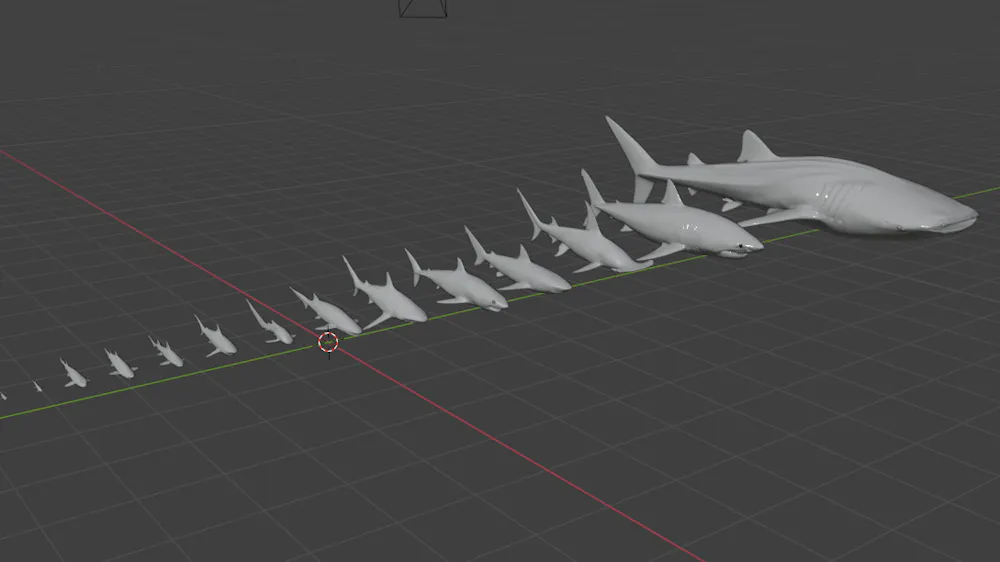
We used high-resolution 3D models to digitally measure surface area and volume in 54 species of sharks. These models were created using open-source CT scans and photogrammetry, which involves using photographs to approximate a 3D structure. Until recently, these techniques were the domain of video game designers and special effects artists, not biologists.
We refined the models in Blender, a powerful 3D software tool, and extracted surface and volume data for each species.
Then we applied phylogenetic regression – a statistical method that accounts for shared evolutionary history – to see how closely shark shapes follow the predictions of the two-thirds rule.
What did we find?
The results were striking: sharks follow the two-thirds scaling rule almost perfectly, with surface area scaling to body volume raised to the power of 0.64 – just a 3% difference from the theoretical 0.67.
This suggests something deeper is going on. Despite their wide range of forms and habitats, sharks seem to converge on the same basic body plan when it comes to surface area and volume. Why?
One explanation is that what are known as “developmental constraints” – limits imposed by how animals grow and form in early life – make it difficult, or too costly, for sharks to deviate from this fundamental pattern.
Changing surface area-to-volume ratios might require rewiring how tissues are allocated during embryonic development, something that evolution appears to avoid unless absolutely necessary.
But why does it matter?
This isn’t just academic. Many equations in biology, physiology and climate science rely on assumptions about surface area-to-volume ratios.
These equations are used to model how animals regulate temperature, use oxygen, and respond to environmental stress. Until now, we haven’t had accurate data from large animals to test those assumptions. Our findings give researchers more confidence in using these models – not just for sharks, but potentially for other groups too.
As we face accelerating climate change and biodiversity loss, understanding how animals of all sizes interact with their environments has never been more urgent.
This study, powered by modern imaging tech and some old-school curiosity, brings us one step closer to that goal.


