

Overhead power lines kill millions of birds a year. Scientists found a way to help cut the devastating toll
- Written by The Conversation
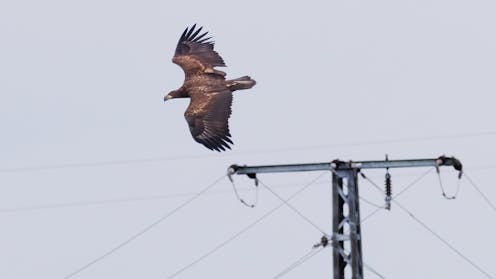
Millions of birds are killed by power lines each year. Sometimes they collide with the lines when flying and are either electrocuted or fatally injured. Other times they are electrocuted when perching on power poles.
Power line collisions are one of the leading causes of injury and death for large birds of prey. In Tasmania, an endangered population of wedge-tailed eagles lost 110 individuals to power lines between 2017 and 2023.
New research I led, the first of its kind in Australia, used GPS tracking data to predict which power lines were most dangerous for these eagles.
We hope the findings will help protect birds and other wildlife from overhead wires as electricity networks expand.
Power lines and birds: a fatal mix
Overhead power lines span more than 90 million kilometres of our planet. The network keeps growing as demand for electricity rises and renewable energy projects expand into new areas.
In the United States alone, between 12 and 64 million birds are estimated to be killed by power lines each year. These deaths can damage populations of some species.
Birds can also be killed when perched on poles – for example, if they stretch their wings and connect two energised parts.
The economic costs can be considerable – disrupting electricity services, causing fires and damaging infrastructure.
Energy companies can reduce the risks through various measures. They include attaching objects to power lines to make them more visible to birds, and redesigning poles to reduce the likelihood of electrocution.
But these solutions can be expensive, and challenging to implement on a large scale. So, prioritising the riskiest power lines is the most cost-effective solution.
The presence of bird carcasses has traditionally been used as a way to identify high-risk power lines. But this approach can give a biased picture, because people are more likely to find dead birds in accessible, less vegetated areas.
New research by my colleagues and I explores a different approach.
Tracking Tasmania’s wedgies
We used GPS tracking of animal movements to predict which power lines were most dangerous for Tasmania’s wedge-tailed eagles.
GPS tracking can record a bird’s location, altitude and speed – as frequently as every few seconds. This detailed information can show how birds behave around power lines, helping identify when and where they’re most at risk.
In 2017, my colleagues and I attached lightweight GPS trackers to 23 Tasmanian wedge-tailed eagles, then analysed six years of tracking data. We identified more than 9,400 power line crossings at risky altitudes.
We then linked these crossings to different landscape features. This allowed us to build a model predicting where eagles are most likely to cross power lines at dangerous heights across Tasmania.
Power line crossings were most likely at or near open land, forest edges, rural residential developments, wet forest and freshwater sources. Risky crossings peaked in autumn and winter.
Almost half of known collisions occurred on the 20% of Tasmania’s power line network with the highest risk.
Importantly, we tested our predictions against locations where eagles had collided with power lines. The model accurately predicted many of these collision sites, confirming that areas with more low-flying eagle activity carry a greater risk of collisions.
This means our model can not only pick up on known hotspots, but can reveal risky areas that would be missed if carcass records were used exclusively to identify risk. It also means dangerous power lines can be identified before birds have died.
A powerful new tool
Our research is part of a growing number of studies examining animal movement to improve wildlife management.
Risky animal behaviours have been monitored using GPS trackers and then used to inform models predicting the risk of wildlife interactions with road vehicles, wind turbines and aircraft.
Recently, GPS tracking data was used in Europe, North Africa and North America to map and reduce wildlife risks around power lines.
Like ours, these studies can help guide where devices should be attached to lines and inform where new lines are built.
GPS tracking data offers a powerful tool to guide the sustainable design of power lines, target mitigation efforts, and make our expanding energy infrastructure safer for wildlife.


