

Jaws at 50: the first summer blockbuster is still a film that bites – even when the shark didn’t work
- Written by The Conversation
When I was eight years old, on a Saturday night before surf lifesaving training, my dad put on the film Jaws and it changed my life forever.
Unlike the generations of filmgoers who were afraid of sharks and going into the water during its initial release in 1975, I fell in love with the water and sharks.
Steven Spielberg’s film was the first summer blockbuster, received Academy Awards for sound, editing and music, and became the first film to earn US$100 million at the United States box office.
It was only the third film for the 28-year-old Steven Spielberg, and his second theatrical release (his first film, Duel, was made for TV), and success arrived only after much trouble.

A marketed behemoth
Chief of Police Martin Brody (Roy Scheider) has recently moved from New York City to Amity Island with his wife, Ellen (Lorriane Gary), and their two children. As the small town prepares for its crucial 4th of July celebrations, a series of shark attacks threatens the festivities – and the town’s summer economy.
Mayor Larry Vaughan (Murray Hamilton) insists on keeping the beaches open for “summer dollars”. When the shark strikes again, local fisherman Quint (Robert Shaw) is hired to hunt it down. Brody and visiting marine biologist Matt Hooper (Richard Dreyfuss) insist on joining the expedition to save the island.
The film was advertised as a suspense and horror monster movie. In what director Spielberg described as a marketing “blitzkrieg” campaign, Jaws, was released in the summer – peak swimming season.
Universal Pictures made sure every household knew about the film. There were multiple TV spots, a cover on Time Magazine, talk show appearances from cast and crew, and a wave of merchandise. It was the most money the company had ever spent on a film’s pre-release marketing.
The first American film released in more than 400 theatres at once, Jaws found its audience with overwhelmingly positive reviews and word of mouth – because Jaws was also extremely well made.
Wrangling the shark
Peter Benchley was hired to adapt his novel, but another screenwriter, Carl Gottlieb, was brought in to redraft Benchley’s more serious narrative and provide comic relief.
Jaws was initially planned for 55 days of shooting, but ballooned to 159 days and $8 million over budget. The main reason: the shark.
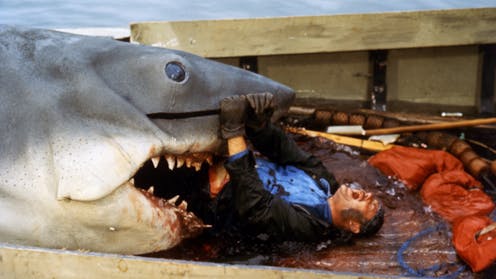
Apart from one scene using real underwater shark footage from Australians Ron and Valerie Taylor, the shark was mechanical. There were three sharks made for the film, all nicknamed “Bruce” after Spielberg’s lawyer.
Martha’s Vineyard in Massachusetts depicted the fictional Amity Island, and much of the second half was shot in water.

The mechanical shark sank … a lot. No wonder Spielberg named the temperamental and unreliable shark after his lawyer.
With the lack of a functioning shark, Spielberg made the artistic decision – echoing Alfred Hitchcock – to suggest the shark’s presence rather than show it outright in the film’s first half.
Spielberg even quotes Hitchcock’s Vertigo shot (a dolly zoom) in the scene when Brody realises a shark attack is unfolding under his watch.
Even without appearing onscreen, the shark has an overwhelming presence and effect on the audience, thanks to John Williams’ music: most of the film’s cues are associated with the shark.
Tension onscreen
One of my favourite moments in the film is in the aftermath of an attack on the young Alex Kintner (and poor dog Pippet!). Brody is slapped in the face by the mother of the slain Alex – but this is followed by a cute and wholesome encounter between Chief Brody and his son Sean.
As a father, Brody’s failure to prevent the attack on Alex reflects his loss of authority to capitalism. The water is the island’s summer revenue, and the hungry shark swims in it.
The film could have seen an early shark attack and immediately launched a shark hunt. However, the shark doesn’t appear much at all for a monster movie due to its malfunctioning. This worked in the film’s favour.
Instead, the film relied on good writing and strong performances to heighten the tension and build anticipation for the rare moments the shark has onscreen.
A lot of the film’s success comes from the dynamic and well-written trio of Brody, Hooper and Quint. In the final act set at sea with just the three leads on a boat surrounded by the shark, they needed to deliver – and they did, arguably stealing the movie from the shark.
Possibly the most famous scene in the entire film comes when the shark is fully revealed for the first time. Startled by its size, Brody backs into the cabin and delivers an improvised line: “you’re gonna need a bigger boat”.
Dreyfuss and Shaw famously didn’t get along in real life. You can see that tension play out onscreen. It arguably enhances their performances.
Still, one of the most iconic moments comes when Dreyfuss’s Hooper is left speechless by Quint’s USS Indianapolis monologue, describing being in the water with sharks after the warship was torpedoed.
The monologue was scripted, but Shaw improvised much of it.
A cinema classic
Jaws is now a cinema classic.
It launched Spielberg’s illustrious career, scared an entire generation from going into the water, and also inspired a new generation of marine activists – such as myself – who love sharks and the ocean.
I hope you’ll join me in revisiting Amity Island one more time to watch this timeless film that, apart from its mechanical shark, completely works.


