

How to curb short-sightedness in kids

Kids should play outside more to reduce the risk of short-sightedness and potential adult blindness
We are in the grips of a ‘myopia epidemic’: more than 20 per cent of Australians have myopia or short-sightedness, tipped to rise to 50 per cent by 2050.
The condition typically develops during school years and, in severe cases, can lead to blindness. Children with early-onset myopia are at highest risk.
Children’s eye health is the theme of World Sight Day on Thursday 10 October.
For most people, with myopia, being short-sighted is an inconvenience. However, for some, myopia can lead to blindness. Ahead of World Sight Day (10 October), researchers at the Lions Eye Institute have some eye-opening advice.
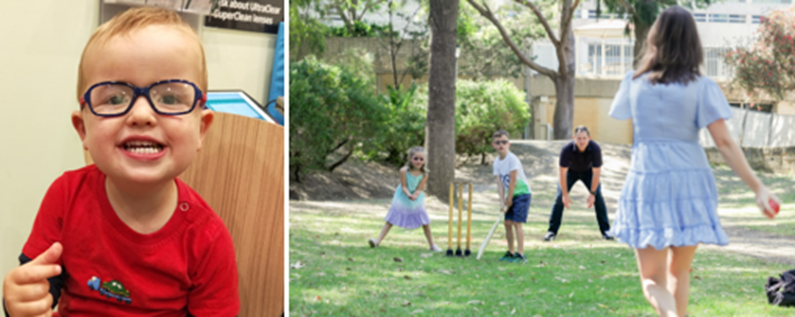
While many parents are forever telling kids to get off their mobile phones, evidence reveals spending time on small screens isn’t the critical issue. Rather, it’s the lack of outdoor time, alongside time spent glued to larger computer screens or reading books.
Research by the team at the Lions Eye Institute also shows people who have had skin cancer are half as likely to have myopia. Their advice is to responsibly balance myopia and skin cancer prevention by aiming to safely increase time outdoors, early or late in the day.
The Perth-based institute is investigating eye growth and genetic factors in children to develop population-based measures for use in standard preschool health checks to predict which children need early intervention to protect their sight.
Lead researcher, Professor David Mackey AO says: “Preschool and primary school children at greatest risk will need interventions, which include increased time outdoors, low-concentration atropine drops, peripheral defocus lenses and possibly other treatments being investigated.
“There’s a global myopia epidemic. In many cities in China, more than 90 per cent of university students are living with myopia. Currently about 6 million Australians – or more than 20 per cent of us – have myopia and we’re heading for 50 per cent by 2050.”
So, what’s causing the myopia epidemic? And can we reduce the risk for our children?
According to Prof Mackey, there’s no simple answer. He points to a range of factors working together. Genetic predisposition is important in some children. But so are environmental factors including:
- lack of time spent outdoors;
- increased ‘near work’ to larger screens; and
- increased time in education.
- lack of time spent outdoors;
- increased ‘near work’ to larger screens; and
- increased time in education.
In a recent paper, Prof Mackey and his colleagues looked at the impact of screen time and when myopia develops.
“We found that about 14 per cent of young adults developed myopia between the ages of 20 and 28 years," he said. We also found that looking at small screens didn’t seem to have an effect. Neither did watching TV.
“However, near work on larger computer screens did have an effect. So, we think that doing near work and reading books are doing the damage, exacerbated by children and adults spending less time outdoors in daylight and more time indoors for work or education.
“Our recommendation to Australian families is simple: increase the amount of time your kids spend outside, aiming for two hours a day, but follow SunSmart guidelines. It is best to spend time outdoors early in the morning or late in the afternoon as, during the first and last three hours of daylight, the UV Index is below 3 throughout most of the year across Australia.”
While, for most people, myopia is merely an inconvenience requiring correction with glasses, contact lenses or refractive surgery, some of us are at greater risk of myopia leading to blindness from retinal detachment, glaucoma and myopic macular degeneration.
Those who develop myopia early in life are more likely to progress to severe myopia and at higher risk of long-term harm. This is a major public health concern.
Lions Eye Institute researchers, led by Prof Mackey and Dr Samantha Lee, have identified a simple test that can guide which children are treated for myopia at a very early stage. Similar to height and weight measurements taken during childhood, they propose routinely measuring children’s axial length – namely, the length of each eye, from the front of the cornea to the back of the eye.
“We need to identify children with severe myopia earlier in life so we can intervene and avoid a lifetime of challenging eye disease leading to blindness,” Prof Mackey said. “Some children will just have longer eyes, but if the axial length increases faster over time, that’s a good predictor of future myopia”.
Lions Eye Institute is calling on all ophthalmologists and optometrists working with kids to use the test and hopes it will be globally adopted as a routine preschool screening test.


