

Jet ski accidents are tragic but preventable. Here’s how to reduce the risk
- Written by The Conversation
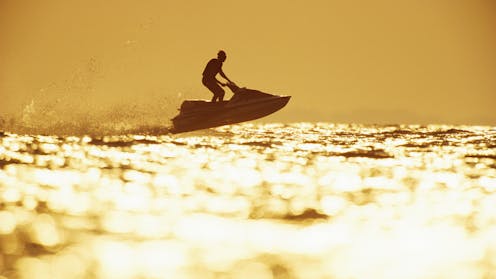
Two teenage boys were thrown from a jet ski during a ride on the Georges River in Sydney’s south this week. One died at the scene. The other lost an arm, and was rushed to hospital in a serious condition.
The exact cause of the crash is being investigated and a report will be prepared for the coroner.
Sadly, this tragic incident is not isolated. While fatal jet ski crashes are relatively rare, serious injuries are not.
Here’s what we know about jet ski accidents, who’s at risk, and how to prevent them.
Jet skis are now more common
Jet skis have become a familiar sight on Australian waterways, with sales peaking during the early years of the COVID pandemic. There are now almost 100,000 registered jet skis nationwide.
So what was once a niche summer thrill has become a more mainstream recreational activity, particularly for young Australians.
As the number of jet skis on our waterways grows, so too will the risks.
How often do accidents happen?
Most jet ski crashes occur in daylight hours, are twice as likely on weekends, and tend to spike during warmer months. Injuries typically happen close to shore (often within 50 metres) where crowded conditions increase the risk of colliding with other vessels, swimmers or fixed obstacles.
Fatal jet ski accidents in Australia have claimed the lives of riders, passengers, swimmers and kayakers.
Across New South Wales, Queensland and Victoria, there are up to three deaths per 100,000 licence holders. There are an estimated 19–26 serious injuries per 100,000 licence holders, depending on the state.
But these figures likely understate the true picture as many non-fatal injuries go unreported unless hospitalised.
For example, data from research sponsored by the United States Coast Guard suggest that for every moderate injury captured in accident reports, more than 30 actually occur. For every severe injury, it’s likely 1.65 actually occur.
Who is at risk?
Global jet ski statistics indicate about 85% of jet ski injuries involve male riders.
Risk-taking behaviour and being an inexperienced rider are also risk factors, with young adults dominating injury statistics.
One review found about 60% of jet ski crashes involved the rider drinking alcohol.
What types of injuries?
Recreational riders often typically travel at 60–80 kilometres per hour. But these machines can reach speeds above 100km/h. This can generate immense force in the event of a collision.
In a crash, riders are ejected from the jet ski or collide directly with water, the craft, another vessel or fixed objects. So the leading causes of death and serious injury on jet skis are from these traumatic impacts.
A study from a US trauma centre looked at 127 people injured in jet ski incidents and found most injuries involved broken bones. The legs were most commonly affected, followed by arms, spine and hips.
Hitting the handlebars was a major cause of open fractures (when a broken bone pierces the skin), some of which later became infected.
Women and children face particular risks
However, there is a distinct and concerning injury pattern for female passengers.
Women riding on the back of a jet ski (as a passenger) are especially at risk of serious injuries to the genital and anal area. This can happen if they fall off backwards and land directly on the powerful stream of water coming from the jet nozzle.
Case reports describe incidents of vaginal lacerations, rectal injuries and pelvic floor damage. Such injuries are rare but can be devastating and life-threatening. Sometimes there are permanent complications, such as the risk of infertility or incontinence.
Children also face unique and often severe risks. A US study looked at 66 children hospitalised in jet ski accidents. It found most were boys with the average age of around 12 years old, and nearly three-quarters operated the jet ski themselves. About 70% of injuries involved collisions with another vessel or object. Four children died, all from head trauma after crashing into stationary objects. More than 40% were left with some degree of disability.
What now?
The risks from jet skis are real and too often underestimated. But many injuries can be prevented:
we need public education campaigns to remind riders of the risks and to promote better behaviour. This would remind riders to slow down in congested areas, avoid reckless turns, and be especially careful with passengers. As alcohol is a common factor in crashes, drinking in moderation before riding should also be stressed
women are recommended to wear neoprene protective shorts, or wetsuits, instead of ordinary swimwear. A growing number of medical professionals are now backing this as essential safety gear, not optional, to reduce the risk of perineal injuries from water jets
manufacturers can redesign handlebars to reduce the severity of impact injuries. They can also build in safeguards that reduce jet pressure when no one is seated at the rear (to safeguard the health of a passenger who falls off backwards)
states also need consistent rules on minimum rider age, training and licensing. The laws vary widely. These inconsistent regulations create confusion and loopholes, especially when riders cross borders.


