

When a beach walk feels like grief: disasters like SA’s algal bloom cut us off from nature when we need it most
- Written by The Conversation
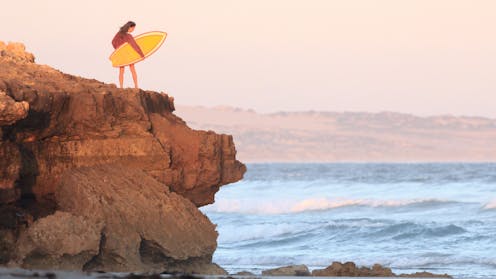
In March 2025, surfers and swimmers were the first to notice the harmful algal bloom taking hold in South Australian waters. People catching waves at a popular break on the Fleurieu Peninsula later reported feeling sick with flu-like symptoms.
Over the five months since, an “unprecedented” environmental disaster has unfolded, devastating marine ecosystems and the South Australian economy. It has also fundamentally changed the way people connect to the ocean.
This particular bloom – caused by Karenia mikimotoi – is deadly to various marine species, while in humans it can cause milder illness and irritation.
But the impact on mental health and wellbeing is profound.
When people can no longer use “blue spaces” such as the ocean to surf, swim, fish and walk on the beach, they are losing activities that calm and relax them – exactly when they’re most sick with worry about their beloved coastline.
A perfect storm
South Australia’s algal bloom is the result of a “perfect storm” – a marine heatwave, nutrient rich water from previous flooding, and a rare cold-water upwelling.
Current public health advice tells surfers and swimmers to stay out of water if it looks “discoloured, foamy, or where there’s dead marine life”.
Given that dead marine life is washing up across many South Australian beaches, this means it’s hard to find any place to surf or swim.
Recreational fishers are advised that catching fish (and other marine species) is safe if it’s cleaned thoroughly before eating. But many are not throwing their lines in due to concerns about depleting the surviving marine life.
Blue spaces and health
Activities such as swimming, surfing and fishing are not only enjoyable, they have a range of health benefits.
There is mounting empirical evidence about the range of benefits from spending time in “green spaces”, such as parks and bushland.
In 2020, a review of evidence about “blue spaces” – meaning oceans, rivers and lakes – found similar benefits.
For example, swimming outdoors in nature – sometimes known as “wild swimming” – can reduce fatigue and improve mental health. There is also early evidence that it can promote immune functioning.
Surfing also has physical and mental health benefits, and increases community connections. One study of recreational fishers found three in four (75.5%) fish for stress relief.
But these are benefits people in areas affected by the algal bloom are no longer getting.
Grief and anxiety
The algal bloom means people can’t access blue spaces and their health benefits. In fact, the devastation can mean engaging with blue spaces actually makes people’s mental health worse, through worry and grief about the environment.
Eco-anxiety describes the extreme fear, worry, sadness or a generally heightened emotional state we may feel in response to changes in the climate or environment. When people experience grief and other negative emotions about changes to a place they love, this is sometimes called “solastalgia”.
Both eco-anxiety and solastalgia can be responses to global changes, such as warming temperatures and rising sea levels. But they are felt most acutely among those affected directly by a disaster.
Research after Australia’s 2019–20 bushfires found high levels of eco-anxiety and solastalgia among those who survived, with the environment becoming a source of pain and grief.
Given this harmful algal bloom is being referred to as an “underwater bushfire”, it is unsurprising we are seeing people describe similar concern, worry, sadness and loss.
I am part of a team from the University of South Australia currently researching this impact, by surveying people who live near and use the beach to better understand their experience.
Are there any silver linings?
Grief about the destruction of a place we love is the sign of how much we care about it – and this can be galvanising.
Research shows eco-anxiety can be a form of practical anxiety. This means unlike other forms of worry it is more likely to also drive behaviour change.
We are already seeing this in South Australia. Over 12,000 recordings on iNaturalist – a website where members of the community upload photos and help identify species – provide shocking visual evidence of the loss and devastation.
Distressed beachgoers who are participating in citizen science programs such as these help keep the spotlight on the disaster, as well as rescuing stranded sea animals and protesting for action from government and industry.
Amid the grief, it’s important to try and still maintain our connection to our environment. When we can’t spend time in our usual natural spots, we can still benefit from connecting with nature beyond blue spaces – even if it’s simply visiting a park or planting something new.


