

Planning your next holiday? Here’s how to spot and avoid greenwashing
- Written by The Conversation
More of us than ever are trying to make environmentally responsible travel choices. Sustainable travel is now less niche and more mainstream, with 93% of travellers in one survey saying they would consider sustainable choices.
Accordingly, an increasing number of hotels have become certified. This means they have been officially checked and approved to meet sustainability standards by an independent organisation.
The World Sustainable Hospitality Alliance says hotels need to reduce waste and emissions by as much as 66% by 2030 to deliver meaningful change. The World Travel and Tourism Council reports that more than 5,000 hotels worldwide have adopted its independent verification program.
Major chains, including Hilton, Marriott and Accor, have also set measurable sustainability targets. These commitments are shared with guests through hotel websites, signs in lobbies and cards placed in rooms.
So when it comes to booking accommodation, navigating the sheer volume of buzzwords and promises – “eco”, “sustainable”, “green”, “responsible” – can feel overwhelming.
When you’re planning your next trip, how can you check whether the sustainability claims live up to the promises?
Don’t believe all the claims
When hotels present themselves as environmentally friendly or sustainable through marketing, but don’t live up to those claims, it’s called greenwashing.
In our study, just published in the Journal of Vacation Marketing, we conducted focus groups with Australian travellers and asked them how well they understood hotel sustainability messages.
We learned that guests don’t always believe claims. They viewed simple actions, like skipping daily room cleaning or turning off the air-conditioning, as too small to really count. One traveller said:
They only mention towel reuse, but nothing else, but what about food waste or cleaning chemicals?
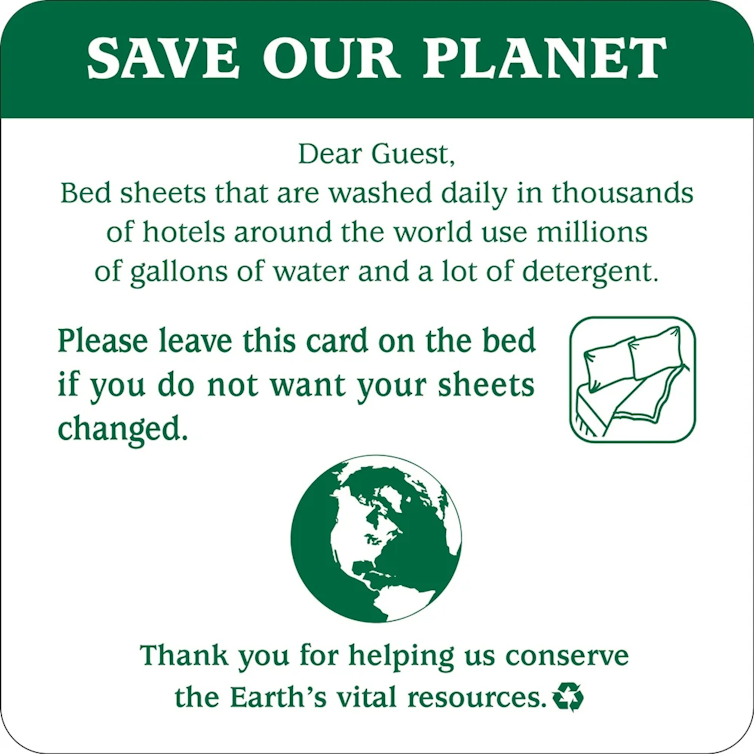
Motivations of hotels were often questioned, too. Guests felt that hotels expected them to do most of the “green” work, such as reusing towels or using the in-room recycling bin.
That made them feel the responsibility was being pushed onto them. It also created suspicion that sustainability is disguised as cost-cutting, so trust in the hotels’ initiatives suffered. Other travellers noted:
They had signs all over the place, and for me, it felt like they were trying too hard and making it seem better than it actually was.
Hotels talk a lot about being green, but to me, it feels more like branding than real action.
When the promises are backed by action
But when hotels explain exactly what they’re doing, show proof of their actions, and admit where they’re improving, guests feel more confident. They may even pay more for their stay.
What we found supports a growing consensus among travellers.
Nobody wants to fall for greenwashing, and consumers want to feel empowered to make the right choice for the environment. Guests want to know if they’re at risk of supporting greenwashing, so they can choose hotels whose efforts are verifiable.
Information matters. So when hotels get their messages wrong, they can undermine the trust of their customers.

In recent years, a number of registers have been established that certify sustainability actions taken by hotels. External registers are financially independent of the tourism industry, and have minimum standards required for registration.
Here’s what to watch for
Not everybody can become an expert in sustainability, so we have put together a list of things you can look out for when you’re booking accommodation, as well as what you can do to help other travellers.
Look for independent proof. Book with hotels with recognised third-party certifications, such as EarthCheck or Green Key. If there is no certifier named and no explanation of what was checked, treat the claim as marketing, not evidence.
Check for details. Trustworthy green claims use concrete details such as percentages, dates and clear actions. Phrases like “eco-friendly,” “sustainable”, or “planet positive” without statistics or examples are too vague to trust.
Compare the claims against what you see. Test promises against reality. Reviews, guest photos and what you notice on arrival should show real changes, such as refillable toiletries, recycling and less waste, not just posters.
Ask: who is really doing the work? Many “eco” messages ask guests to reuse towels or skip cleaning, which are actually cost-cutting initiatives. Better signs are investments in efficient systems, using solar power, water-saving fixtures and proper recycling. If the towel card is all you see, the balance is wrong.
Look for honesty about limits. No hotel is perfect, and honest ones admit it. Brief explanations of current limitations with future goals are more believable than claims of being fully sustainable.
Watch out for suspicious language and pressure. Be cautious of absolute claims like “zero impact” or “100% sustainable” without proof. Also be wary of messages that make you feel guilty for wanting normal comfort.
Use your power as a consumer. Ask simple questions before you book and notice how clearly the hotel replies. Check independent review sites, too. After your stay, mention specific practices, good or bad, in your review to deter hotels from greenwashing behaviour.
Not just a green label
Travel is changing, and so are travellers. More people want holidays that feel good for them and for the planet.
When you know what to look for, you can spot shaky green claims and choose hotels that match your values. That pressure matters. It nudges the industry to be authentic, cuts down on greenwashing, and supports the hotels that are actually doing the work, not just putting a green label on the door.
We would like to acknowledge Dr Farah Shishan from the University of Jordan who contributed to this research.


