

Australia needs to get real about Trump’s changing America
- Written by The Conversation
Canadian Prime Minister Mark Carney’s Davos speech should unsettle Australian strategic thinkers, who have been raised in the belief the US alliance is the unshakeable foundation of Australia’s regional security.
Carney’s point – that American leadership is no longer a reliable anchor for the international system – had strong appeal in Europe and Canada. But it also highlights what is now clearly the weakest link in the US-Australia alliance – not American capability, but American reliability.
Deterrence is not just a matter of military hardware and presence. It relies on confidence that commitments will be honoured, risks will be borne, and allies will not be treated with disdain. When US policy becomes more transactional and less predictable, that confidence weakens — even if the underlying military power remains formidable.
But what is the alternative to Pax Americana? Washington’s traditional allies each face their own unique strategic circumstances, and their answers will naturally vary.
Trump renewed tariff threats against Canada after Carney’s Davos speech.In Australia, we have largely managed to keep our head down. We have not been the direct target of American tariffs or sovereignty threats like Canada and Europe. Nor have we publicly challenged Washington in the way some others have – most recently in response to Trump’s apparent contempt for allied sacrifice.
Instead, Australia has doubled down on alliance management. This is mostly visible through AUKUS, which is hanging on doggedly despite growing questions about timeframes, costs and long-term sustainability.
AUKUS reflects Canberra’s judgement that remaining deeply embedded in the US strategic system is preferable to standing outside it. But it also exposes the Australian government to charges it is accepting new forms of dependence on future American and British political decisions, industrial capacity we do not control, and timelines that stretch beyond the current strategic decade.
It is a wager on alignment and continuity at a moment when both are uncertain. That reality frames how Australia should respond to Carney’s call.
Eroding confidence and trust in the US
Throughout the post-war era, Australian governments have spoken about the US alliance in warm, expansive terms: shared values, shared history, shared sacrifice. The relationship was framed not only as strategically necessary, but morally reassuring. That language is becoming hard to sustain.
Public confidence in the United States has weakened considerably since Trump took office again and began pushing an “America First” doctrine. In public debate, criticism of American conduct increasingly competes with, and sometimes displaces, concerns about China’s rising power.
For Australia, this creates an uncomfortable dilemma. The US remains the only power with the military reach and technological depth to shape the regional strategic balance and constrain China’s ambitions.
Yet, the political foundations that made reliance on that power relatively predictable — and domestically saleable — are eroding.
Managing that tension is now a core task of Australian statecraft. The appointment of Greg Moriarty as Australia’s next ambassador to Washington is very welcome. He brings not only deep knowledge of our own military requirements and the US system, but something equally important: long experience in the Asia-Pacific region. He knows better than most that the US-Australia alliance cannot be separated from the dynamics of Australia’s neighbourhood.
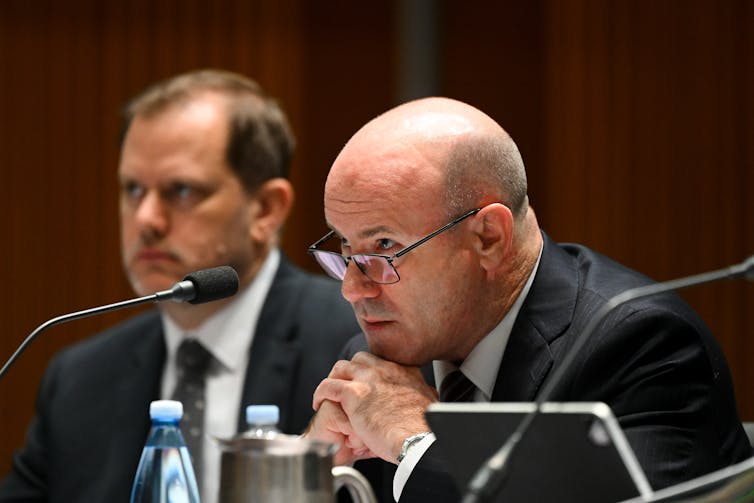
But a growing challenge for the Australian government he serves will be to persuade the public that China — rather than the United States — is still our primary strategic problem.
If the public conversation shifts from managing China’s rise to managing America’s decline, governments will struggle to explain why uncomfortable investments, risks and trade-offs with the Trump administration are required.
What unchecked Chinese influence would mean
Australia should maintain cautious about Beijing’s regional behaviour, even while strengthening our bilateral economic ties with China.
The issue is not whether China builds roads, stadiums or ports in the Pacific. It is what an overall environment of uncontested Chinese strategic hegemony in the region would mean for Australia.
If China gains a stronger foothold in the Pacific, regional civil society leaders warn their governments would face pressure to align political positions, security choices and domestic rules with Chinese preferences.
For Australia, the consequences would be profound. Our ability to operate militarily, diplomatically and economically in our own region would narrow. Our capacity to support Pacific partners in resisting coercion would weaken. And our freedom to make independent strategic choices would be constrained.
It is important to acknowledge Canberra is not standing still.
The Albanese government has made real progress in strengthening regional partnerships to help buffer the unpredictable US alliance. This includes the new alliance with Papua New Guinea, recently concluded defence cooperation treaty with Indonesia, and the overall intensified, respectful Pacific engagement we have seen in recent years. All of this reflects a more deliberate effort to embed Australia more deeply in its own region.
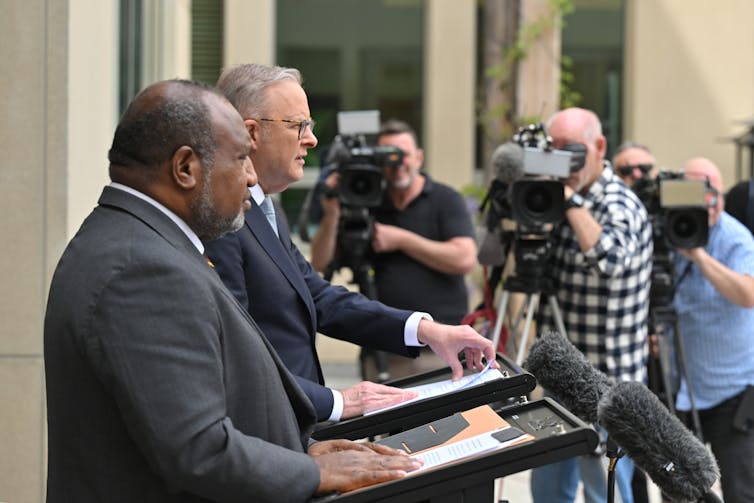
These steps deepen Australian influence, give regional partners more choices, and reduce the risks associated with over-reliance on any single external power. But they do not remove the underlying strategic dilemma.
The US still plays an important role in our region, albeit with more caveats than Canberra has traditionally acknowledged.
Let’s be clear. The US does not really contribute much to Pacific economic development and never really has. Its regional relevance lies in its strategic and military weight – the ability to deter high-end conflict and complicate China’s calculations.
But capability is not the same as commitment. Uncertainty itself can be truly destabilising.
American power may still shape the regional environment, but it does so unevenly and with greater risk of miscalculation. China does not need to defeat the US to exploit this; it only needs to test thresholds and capitalise on ambiguity.
Put simply, the protection the US offers is less absolute — and far less reassuring — than Australian rhetoric often implies.
The way forward: not abandonment, but adjustment
First, Australian leaders need to speak more plainly about the US alliance in order to maintain public support.
This means no longer trumpeting shared virtue, but being honest about what is actually a conditional, interest-based arrangement with a larger power whose values and priorities do not always align with our own.
Second, Australia must continue to hedge more deliberately. This includes deepening defence cooperation with Japan and India, enhancing strategic partnerships across Southeast Asia, and sustaining Pacific engagement. All of this becomes more important as US certainty declines.
Third, as others have argued, Australia must invest more seriously in its own capabilities — diplomatically, militarily and politically — so our security is not wholly contingent on a single power.
The era of comforting myths is over. The alliance still matters — but it is more fragile and conditional now. Recognising that is the necessary starting point for safeguarding Australian security.
Read more https://theconversation.com/australia-needs-to-get-real-about-trumps-changing-america-274424


