

Bumblebees can perceive rhythm, despite their brains being the size of a sesame seed
- Written by The Conversation
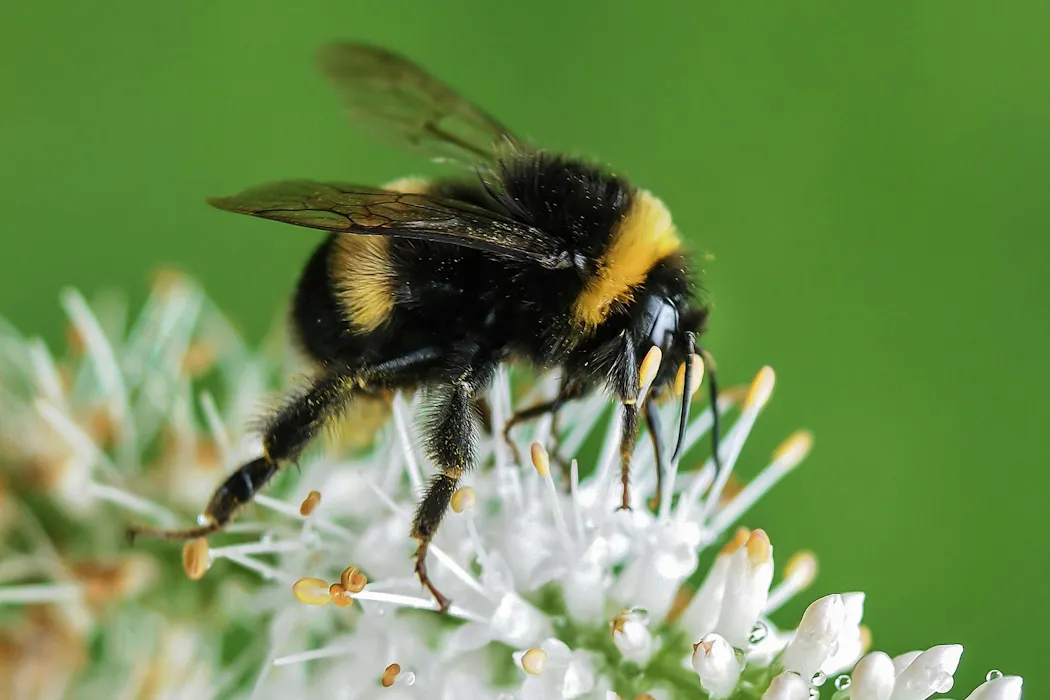
Humans are creatures of rhythms. As far as we know, humans have always sung and always danced. We can recognise a song by its rhythm alone, regardless of whether it is played fast or slow.
We seem to have an almost effortless capacity to pick up on rhythmic patterns, and we have presumed this ability to require the very large and powerful human brain.
But our new research, published today in the journal Science, shows humans are not alone in mastering rhythm. Even the bumblebee, which has a brain the size of a sesame seed, has an ability to quickly learn abstract rhythms.
A world full of rhythms
Rhythms are everywhere in nature.
We hear them in the songs of birds and frogs and the ultrasonic hunting chirps of bats. And we see them in the flashing displays of fireflies, the rhythmic shakes of a peacock’s tail, the waggle dances of honey bees and the courtship dances of fruit flies.
But, up to now, we have assumed these were innate rhythmic patterns: the animals are not learning a rhythm; they are simply rolling out an evolved behavioural program.
Apart from humans, only a few species of birds and mammals have been shown to be able to learn and recognise the structure of a rhythm regardless of whether it is played fast or slow.
This reinforced the perception that only smart animals with big brains can learn a rhythm. But big-brained animals are the exception in the animal kingdom. Most animals have evolved tiny brains (by our standards) and they can still solve all the problems they need to solve to survive and thrive.
But can they recognise rhythm?
Following the bumblebeat
To explore this, our team from Southern Medical University and Macquarie University worked with bumblebees – big beautiful bees that are easy to keep and train, and are hugely motivated to collect sips of nectar to take back their nest.
Working with individually labelled bumblebees, we trained them to forage from artificial flowers with embedded LED lights we could control. One flashing light pattern offered a sugary treat, while flowers with another flashing pattern did not.
The only way bees could distinguish the patterns was by their rhythmic structure. In this way we could train the bees to prefer one rhythmic pattern of flashes over another – for example, dot-dash-dot-dash (repeating) versus dot-dot-dash-dash (repeating).
In one experiment, bees learned that one flashing light pattern indicated rewarding sugar water, while another flashing pattern indicated an unpalatable solution. Source: Bee lab at Southern Medical University.Once the bees had been trained for an afternoon, we tested them on flashing flowers that offered no sugar. We found bees preferred to visit the flower flashing the rhythm that had been rewarded with sugar in training. This shows they could learn to recognise a rhythm linked to reward.
Without any extra training of the bees, we could show they could recognise their trained rhythm regardless of whether it was played faster or slower. This shows bees had learned a rhythm regardless of tempo – the first evidence that bees had learned a flexible rhythm.
Recognising the rhythm
To test the bees further, we asked whether they could recognise a rhythm regardless of how it was presented.
Bees are deaf at the frequencies we can hear, but are very sensitive to vibration. We trained bumblebees in a maze with a vibrating floor at the junction in the maze.
We could make the floor pulse with rhythm. Using this technique, we trained bees that one rhythm (say, dot-dot-dash-dash) meant the sugar reward was located in the left arm of the maze, whereas another rhythm (say, dot-dash-dot-dash) meant the sugar reward was in the right arm.
We knew bees could learn the maze because their success in finding the sugar first time improved with training. Once the bees were trained and performed well in the maze, we changed the maze so now there was a flashing LED light at the junction and no vibrating floor.
The bees trained with vibration were able to use the rhythmic pulses of light to work out which arm of the maze to pick to find the sugar. This showed bees could recognise a rhythm regardless of how it was played out. In other words, the bees had a sense of abstract rhythm.
As far as we know, this ability has only previously been shown in humans.
In one experiment, bees could recognise rhythm regardless of whether it was delivered via pulsing lights or vibrations. Video: Bee lab at Southern Medical University.Changing the rhythm of our understanding
That the bumblebees did so well in these tests of rhythm learning changes how we think about what is needed to perceive and learn rhythm.
In humans and mammals, rhythm learning is very complicated, involving multiple regions of our large and complex brains.
But perhaps there are simpler ways a tiny brain can achieve the same thing.
Brains themselves are full of rhythms as neurons pulse with impulses. Many neural circuits use rhythmic properties of synchronous and asynchronous nerve impulses to organise their function. Perhaps there is something in the rhythmic properties of brains themselves that attunes them to detect rhythms in nature.
If we can capture that insight, and give miniature sensors a capacity to detect rhythmic temporal structure, there could be all sorts of applications: from lightweight solutions to speech and music recognition to diagnosis of heart irregularities, or pre-epileptic brain waves.


