

Friendship, honey and the simple life: 100 years of Winnie-the-Pooh
- Written by The Conversation
Isn’t it funny How a Bear likes honeyBuzz buzzI wonder why he does
Just over a century ago, the satirical writer and playwright A.A. Milne, suffering from the after-effects of fighting in the trenches of World War I, started writing some poems for his only child, Christopher Robin.
They were published in a collection, When We Were Very Young and they caused a literary sensation for a reading public looking for comfort in difficult times.
Two years later, Milne followed up with the stories of the Hundred Acre Wood in his book Winnie-the-Pooh, based on the tangle of scrub and trees at the bottom of his garden and populated by Christopher Robin’s toys.
Winnie-the-Pooh, Piglet, Rabbit, Eeyore, Tigger, Kanga and Roo, and Owl, each distinctive characters in their own right, chatted and played, going on adventures, solving problems, presided over by Christopher Robin, the wise child who knows what to do.


This philosophical streak runs through all Milne’s work for children: in his follow-up to Winnie-the-Pooh, The House at Pooh Corner (1928), and his second collection of poems, Now We Are Six (1927). In 1929 he adapted another children’s classic, Kenneth Grahame’s The Wind in the Willows, for the stage. Also a pastoral, featuring anthropomorphised animals rather than toys, it promoted the English countryside as a space for gentle reflection on the good life and friendship.
The Wind in the Willows has a wild quality. Such wildness does not impinge greatly in the Pooh stories: the characters are toys rather than animals and the god-figure is Christopher Robin.
Asked, for instance, to help resolve a squabble between Eeyore and Tigger, after Tigger’s loud sneeze has frightened Eeyore into falling into the river, Christopher Robin concludes: “Well, … I think – I think we all ought to play Poohsticks”. This is a simple game in which players drop sticks on the upstream side of a bridge over running water and wait to see which one emerges first. (See: How to Play Pooh Sticks)
Living in the moment
Why is Winnie-the-Pooh called Winnie-the-Pooh? The name Winnie comes from a North American black bear at the London Zoo, which was brought to Britain from Winnipeg, Canada. Like many London children, Christopher Robin was taken to the London zoo to see the animals, and he shortened the name Winnipeg to “Winnie”. “Pooh,” on the other hand, came from a swan, encountered on a family holiday. This mixture of inside-joke and idiosyncratic names created by a very young child adds to the book’s whimsy.
 Goodreads
In their appeal to the good life and emphasis on friendship and community, these books have struck a chord with readers well beyond the nursery. Best known in this vein is Benjamin Hoff’s book The Tao of Pooh, a philosophical work that connects the behaviour of Pooh and friends with the principles of Daoism, which emphasise the importance of simplicity, naturalness and effortlessness.
In this regard, the innocent everyman Pooh exemplifies the ability to live in the present moment, and to live a life of simple “being”.
As such, he is the valuable sounding-board for the other characters, beset by life difficulties and behavioural dysfunction: the hyperactive Tigger, the depressive Eeyore, anxious Piglet, busy Rabbit and so-on. He offers solutions to their problem, without criticising them, in doing so providing stability for them and for readers.
Certainly, when one visits the 100 Acre Wood, one is aware of entering a place of calm, of smallness, a place attuned to nature where the oddities of human character and behaviour are distilled into small, funny, calming stories. It is a world close to beauty, but also tolerant of imperfection.
According to Daoism, the secret of life lies in accepting things according to their true nature, neither blaming nor praising.
What of Christopher?
It helps, too, that Pooh Corner is visually lovely: the illustrations by E.H. Shephard present Pooh and friends as cute and appealing, while remaining faithful to the toys that inspired them.
Goodreads
In their appeal to the good life and emphasis on friendship and community, these books have struck a chord with readers well beyond the nursery. Best known in this vein is Benjamin Hoff’s book The Tao of Pooh, a philosophical work that connects the behaviour of Pooh and friends with the principles of Daoism, which emphasise the importance of simplicity, naturalness and effortlessness.
In this regard, the innocent everyman Pooh exemplifies the ability to live in the present moment, and to live a life of simple “being”.
As such, he is the valuable sounding-board for the other characters, beset by life difficulties and behavioural dysfunction: the hyperactive Tigger, the depressive Eeyore, anxious Piglet, busy Rabbit and so-on. He offers solutions to their problem, without criticising them, in doing so providing stability for them and for readers.
Certainly, when one visits the 100 Acre Wood, one is aware of entering a place of calm, of smallness, a place attuned to nature where the oddities of human character and behaviour are distilled into small, funny, calming stories. It is a world close to beauty, but also tolerant of imperfection.
According to Daoism, the secret of life lies in accepting things according to their true nature, neither blaming nor praising.
What of Christopher?
It helps, too, that Pooh Corner is visually lovely: the illustrations by E.H. Shephard present Pooh and friends as cute and appealing, while remaining faithful to the toys that inspired them.
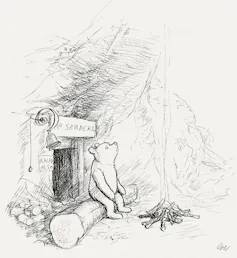 An early illustration by E.H. Shephard.
Wkipedia
Pictures such as one where Pooh and Piglet climb a gate together show the odd-couple balance of their friendship – brave Pooh, fearful Piglet – trusting one another in difficult circumstances.
Christopher Robin Milne had a somewhat difficult time as a child thrust into the spotlight when the books found fame. It is hard enough having one’s childish cuteness paraded around family and friends; harder still when one’s reputation precedes one.
In adult life, Christopher Robin owned a successful bookshop and before he died in 1996, he did reach a measure of acceptance of his father’s work. In 2001, Disney Corporation paid a large sum of money to Milne’s estate and other rights holders of Winnie-the-Pooh. His wife Lesley and daughter Clare decided the money should be used to fund a charity supporting people with disabilities. The Clare Milne Trust has been in operation since 1999.
2026 will be a year of busy celebration for Winnie-the-Pooh. Disney, unsurprisingly, will launch new merchandise. An academic conference on 100 years of the 100 acres will be held at the University of Cambridge.
For the rest of us, it may be time to dig out our childhood copies of Milne’s books, to spend a little time with old friends from these best of old stories, hanging out in the 100 Acre Wood, doing not very much and thinking a little about life.
An early illustration by E.H. Shephard.
Wkipedia
Pictures such as one where Pooh and Piglet climb a gate together show the odd-couple balance of their friendship – brave Pooh, fearful Piglet – trusting one another in difficult circumstances.
Christopher Robin Milne had a somewhat difficult time as a child thrust into the spotlight when the books found fame. It is hard enough having one’s childish cuteness paraded around family and friends; harder still when one’s reputation precedes one.
In adult life, Christopher Robin owned a successful bookshop and before he died in 1996, he did reach a measure of acceptance of his father’s work. In 2001, Disney Corporation paid a large sum of money to Milne’s estate and other rights holders of Winnie-the-Pooh. His wife Lesley and daughter Clare decided the money should be used to fund a charity supporting people with disabilities. The Clare Milne Trust has been in operation since 1999.
2026 will be a year of busy celebration for Winnie-the-Pooh. Disney, unsurprisingly, will launch new merchandise. An academic conference on 100 years of the 100 acres will be held at the University of Cambridge.
For the rest of us, it may be time to dig out our childhood copies of Milne’s books, to spend a little time with old friends from these best of old stories, hanging out in the 100 Acre Wood, doing not very much and thinking a little about life.
Read more https://theconversation.com/friendship-honey-and-the-simple-life-100-years-of-winnie-the-pooh-276175


