Curious kids: what is inside teeth?
- Written by The Conversation
What is inside teeth? – Nicholas, age 5, Australian Capital Territory

Great question, Nicholas. It is important for us to know what’s inside teeth as they help us eat, and eating gives us the energy to do our daily activities.
Our teeth are not just for chewing, though. We also need teeth for speaking, because different teeth contribute to different sounds. For example, we need upper front teeth to speak words starting with “f” or “v” sounds.
How teeth develop
The teeth in the upper jaw are called as maxillary or upper teeth, and those on the lower jaw are called as mandibular or lower teeth. Then each jaw has two side-to-side halves. All up, that’s four quadrants of teeth.
We have two sets of teeth. There are 20 teeth in the first set. We commonly call these “milk teeth” or “primary teeth”. They start forming while we are in the womb, even before we are born! The first one starts coming out of the gums when we are six months old, and most people have all their milk teeth by the age of three.
We keep our milk teeth until we are six years old, when we start losing them and the “adult teeth” or “permanent teeth” start coming in. By 14 or 15 years of age, most of us will have all our adult teeth except the last tooth in each side of the jaws. Some people call these “wisdom teeth”. There are 32 teeth in an entire adult set, with an equal number of teeth on each side.
We have four different types of teeth:
- incisors – front teeth to help cut food
- canines – sharp and pointy teeth on each side for tearing food and controlling how the teeth slide on each other
- premolars – that we only get in the adult teeth set
- molars – back teeth which work with premolars to help chew, grind and crush food.
Read more: Curious Kids: what is brain freeze?
Protection, pain and the bit in between
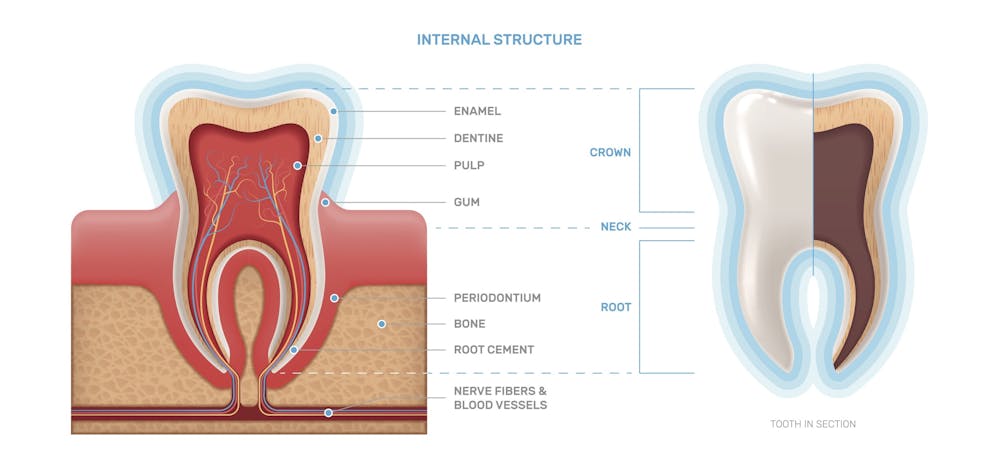
Each tooth can be divided into two parts. The crown is the part of the tooth we can see in the mouth, while the root sits within the gum and bone of the jaw. Some teeth have more than one root.
And each tooth has two layers: enamel and dentine, with pulp at the centre which has nerves and blood. Roots do not have enamel but another layer called cementum.
Enamel is the hardest substance in the body and protects the dentine and pulp, just like a helmet protects your head.
Dentine is the second layer and makes up most of the tooth.
We feel pain in the tooth when the innermost part, pulp, is involved.
Scientists have been working hard to find how special cells called “stem cells” in pulp could be used to repair other parts of the teeth, gums and even other body parts such as the spinal cord, brain and heart.
Read more: Curious kids: why don’t whales have teeth like we do?
Protecting the whole tooth
Hopefully you’ve already got into the habit of brushing twice every day with a fluoridated toothpaste for at least two minutes.
Tooth decay is caused by germs that love to feast on sugary or treat food in our mouth. We can stop that happening by saving lollies and sweets for special occasions and cleaning every tooth really well.
When teeth are not well cared for, they can develop tooth decay, which could cause pain when it involves that pulp deep inside your teeth. It’s important to visit an oral health professional (such as your family dentist or hygienist) regularly. They can tell you how to take good care of your teeth and treat damaged teeth when required.
 Don’t forget your toothbrush!
Shutterstock
Read more https://theconversation.com/curious-kids-what-is-inside-teeth-187258