News Daily

The Times

Australia

  • Written by The Conversation
'Let it rip': Barangaroo, a masterclass in planning as deal-making

The redevelopment of the 22-hectare Barangaroo precinct on Sydney Harbour has long been a masterclass in poor urban development governance and lack of due process. It was meant to transform the former docklands into a world-class example of architectural and public space design. Instead, Sydney got a world-leading example of unsolicited urbanism, and a casino.

Unsolicited urbanism is a project of city-shaping initiated by developers, not government. It clearly favours powerful development and financial players. Instead of being subject to proper public planning processes, outcomes are often predetermined.

Read more: Australian cities pay the price for blocking council input to projects that shape them

In the case of Barangaroo, secretive monopolies over the site have been legitimated. A culture of planning-as-deal-making has been normalised.

A coalition of key state government figures and the real estate and development lobbies have targeted not just this prime harbour-side site for development, but the planning system itself.

The latest furore over the site involves a proposal to modify approved plans for Central Barangaroo. The changes would greatly increase floorspace, including a new 20-storey tower above a metro train station, and shrink a public park. It’s the last tranche of buildings that will sit between the highly developed southern end and Barangaroo Reserve at the northern end.

It’s another example of how planning here operates. The planning minister and not the Independent Planning Commission will make the decision.

Read more: Crown Sydney casino opens – another beacon for criminals looking to launder dirty money

The latest chapter in a decade-long saga

The story begins with the Hill Thalis-led competition-winning entry for the Barangaroo masterplan. It was effectively discarded in 2009-2010 – revised out of existence.

Since then the public justification for the project has relied on two main arguments:

  1. it should restore the harbour headland at the northern end of the site to something like its original form and character

  2. its southern portion should be home to “world-class architecture” and “icons”.

The second argument was standard guff reliant on “starchitects” and the rhetoric of global landmarks.

The first was more compelling. Often rehearsed in public by former prime minister Paul Keating, the argument was that the headland was a vital aspect of the city’s most important heritage, the harbour landscape. Reconstructing it was much more important, Keating suggested, than protecting the form and some of the residual industrial heritage of the container port.

Setting aside Philip Thalis’ judgment that it is a “kitsch, historicist fantasy”, where does this leave the current proposal (modification 9) for Central Barangaroo?

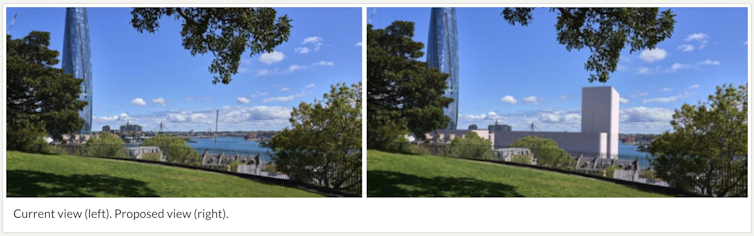
It involves notable development impact on the harbour landscape as seen from the harbour itself and from one of Sydney’s most significant public open spaces, Observatory Hill.

The expanded development and new tower would be in an area always envisaged as low-rise. The reason was to protect views and the historic landscape.

The National Trust NSW urged its members to make submissions against the proposed Central Barangaroo Concept modification. National Trust NSW

Read more: How Sydney's Barangaroo tower paved the way for closed-door deals

Part of a wider story of failure

This latest Barangaroo chapter is part of a longer story of urban governance failure.

Under the NSW Liberal government of the past decade, a raft of “reforms” have chipped away at the integrity and credibility of the planning system. Our research has tracked the longer history of how these changes have underwritten unsolicited urbanism, as shown below.
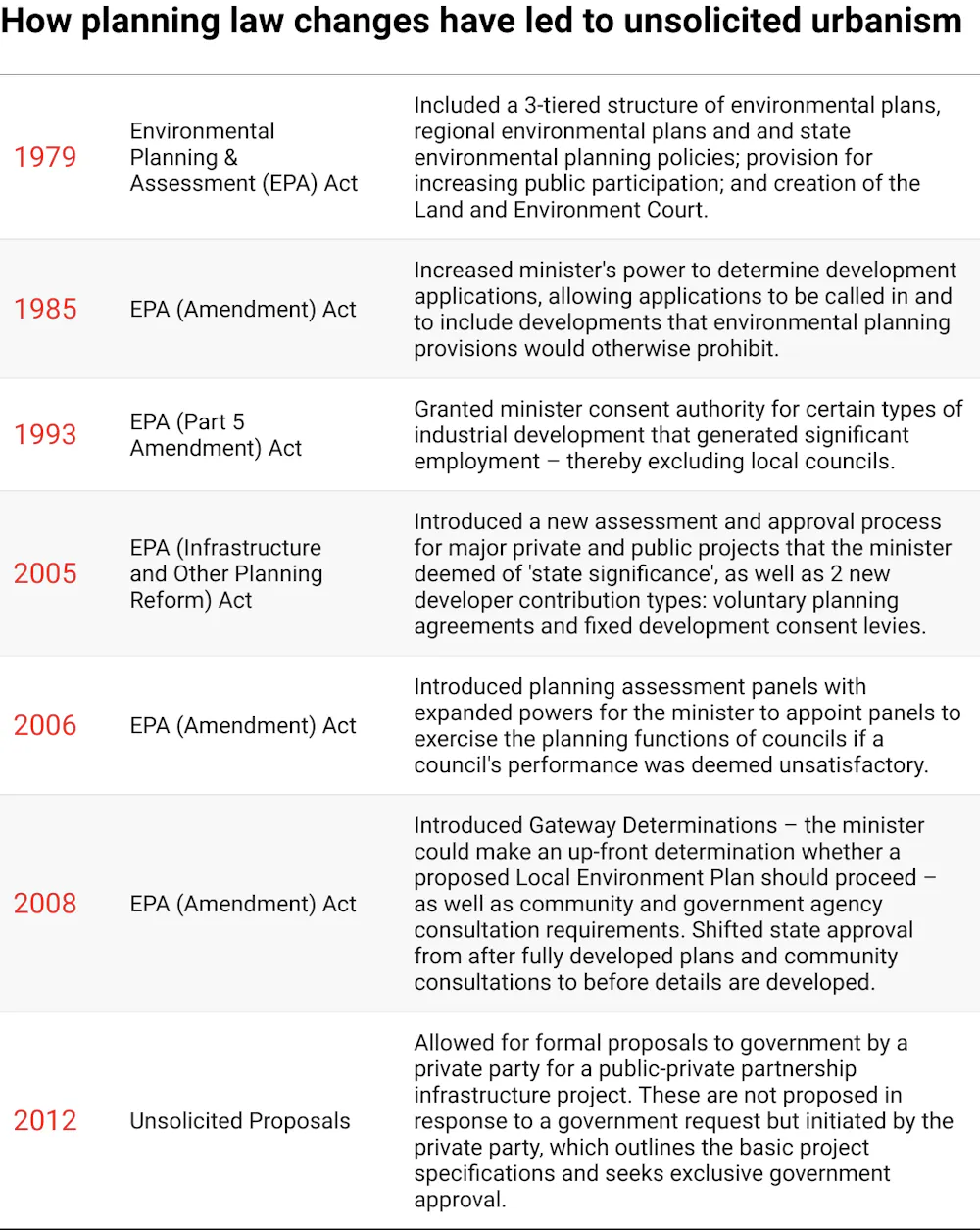
Table showing the planning law changes since 1979 that have led to unsolicited development proposals
Table: The Conversation, adapted from Rogers & Gibson (2020), CC BY We have seen small development loopholes open up over building heights and floorspace ratios, and the much more significant rise of the unsolicited proposal process at Barangaroo. NSW is not alone here. In Victoria, the West Gate Tunnel project in Melbourne is another controversial case of unsolicited urbanism. Read more: West Gate Tunnel saga shows risk of 'lock-in' on mega-projects pitched by business The rise of planning-as-deal-making involves a geographical sleight of hand. Rather than work to a broad strategic plan for a city or a whole precinct, it reduces public debate to a discrete discussion about a specific planning or development process, or a new section of the site. The objective of this incremental approach is twofold: to gain access to government land to undermine the planning process that guides how this land should be used for maximum public benefit. What is lost is accountability for how a project fulfils the broader goals of strategic city planning. A “let it rip” mentality pervades the development sector and sections of the government too. Any long-term plan, land parcel, public infrastructure or zoning process is seemingly up for grabs, liable to be sold off, changed or up-scaled. The planning system is increasingly fragmented and disjointed. Merit and the public good have made way for developer business cases. Anyone standing in the way of development approval is charged with self-serving NIMBYism, no matter how valid their concerns. Will the government heed Sydneysiders’ concerns? Sydney CBD occupancy rates have flatlined. The Committee for Sydney is advocating reinvigoration based on diversity and inclusivity. The latest Barangaroo plans won’t deliver this. Instead, real estate interests want more exclusive and higher-density residential high-rise development on land that could be used differently, were social, cultural and environmental considerations given priority. In 2016 the NSW Audit Office urged greater transparency and public reporting of unsolicited proposals. It warned these “pose a greater risk to value for money than procurements done through open, competitive and transparent processes”. Read more: Market-led infrastructure may sound good but not if it short-changes the public The latest controversy comes amid scandals engulfing the state government, following a federal election won and lost on issues of public integrity and evidence-based policy-making, from climate to pandemic management. The public have lost trust in politicians to represent citizens’ best interests. They are suspicious of corruption, and detest “deals for mates”. While people may not understand the technicalities of planning proposals, amendments and “state significant” developments, they do sense the cards are stacked against the public interest. The battle lines have been drawn over this fateful final piece of Barangaroo. The government’s decision will reveal where its loyalties lie, and whether any integrity in planning can be salvaged before voters pass judgment in the 2023 state election.

Read more https://theconversation.com/let-it-rip-barangaroo-a-masterclass-in-planning-as-deal-making-188434

Split Corrugated Conduit for Flexible Cable Protection

For wiring assemblies in vehicles, machinery and equipment, choosing suitable cable protection helps keep cables organised and reduces direct contact with surrounding parts. Mojak Plastics supplies plastic tubing and conduit options for different installation needs, and split corrugated conduit can... Read more

Trailers Melbourne Buyers Can Compare: When Box Trailers Make Sense

For many homeowners, businesses and tradespeople, trailers Melbourne customers use every week need to be versatile enough for changing loads. A box trailer can be particularly useful because its enclosed sides help contain cargo while providing a straightforward loading area... Read more

Bottle Label Printing That Balances Design and Readability

Product labels need to attract attention while making information easy to find and understand. On a bottle, the available space may be limited by the container’s shape, so every design decision matters. Bottle label printing should account for visual hierarchy... Read more

Office Cleaning Melbourne: Planning a Consistent Workplace Routine

Businesses looking for office cleaning Melbourne need a plan that reflects the way their workplace operates. A clean office supports day-to-day organisation, helps shared spaces remain presentable and gives employees and visitors a more orderly environment. Eco Green Cleaning Management... Read more

Pinboard Solutions for Offices, Schools and Shared Information Spaces

Why a Pinboard Remains Useful A pinboard provides a simple way to display information that needs to remain visible without being rewritten. Lawdex supplies fabric and cork options for offices, schools, staff areas and other environments. A pinboard can be used... Read more

Retractable Hose Reel: A Practical Guide To Choosing The Right Hose Storage

A retractable hose reel can make hose storage more organised, accessible and practical in workshops, commercial facilities, service areas and other working environments. Instead of leaving a hose coiled across the floor or requiring staff to manually wind it after... Read more