News Daily


Men's Weekly

Australia

  • Written by The Conversation
Linguistics locates the beginnings of the Austronesian expansion – with Indigenous seafaring people in eastern Taiwan

The study of Indigenous languages spoken in maritime South-East Asia today has shed new light on the beginnings of the Austronesian expansion. This was the last major migration of people spreading out across the Pacific Ocean and, ultimately, settling Aotearoa.

Scientists all agree that people speaking Austronesian languages started out from Taiwan and settled the Philippines around 4,000 years ago. They used sails as early as 2,000 years ago. Together with other maritime technologies, this allowed them to disperse to the islands of the Indo-Pacific ocean.

There they assimilated with existing populations and eventually reached as far as Easter Island to the east, Madagascar to the west, Hawaii to the north and New Zealand to the south.

This map shows the direction of the Austronesian expansion from Taiwan into the Pacific.
This map shows the direction of the Austronesian expansion from Taiwan into the Pacific. PNAS 112/44 Matisoo-Smith et al, CC BY-ND

But linguists had found little evidence about where precisely the migration started and which Indigenous group was involved in the expansion.

Our new research provides this missing linguistic evidence, based on an overlooked grammatical affix. It suggests the Amis of eastern Taiwan are the closest relative of the Malayo-Polynesian people (including Māori) in the Austronesian language family.

This finding complements recent research in archaeology and genetics, which also suggests the Austronesian expansion likely began along the east coast of Taiwan. Contemporary Indigenous groups in this part of Taiwan are known to have long-standing seafaring traditions.

Landscape image showing a small settlement.
The Amis of eastern Taiwan are the closest relative of the Malayo-Polynesian people, including Māori. Author provided

The Austronesian language tree

Austronesian is the second-largest language family in the world. Austronesian languages are spoken from Madagascar to Polynesia, including te reo Māori, and have been the focus of considerable research. But many basic questions remain about the origin and primary dispersal of this language group.

The consensus over the past 50 years had been that Malayo-Polynesian is an Austronesian primary branch with no identifiable closer relationship with any language in the homeland:
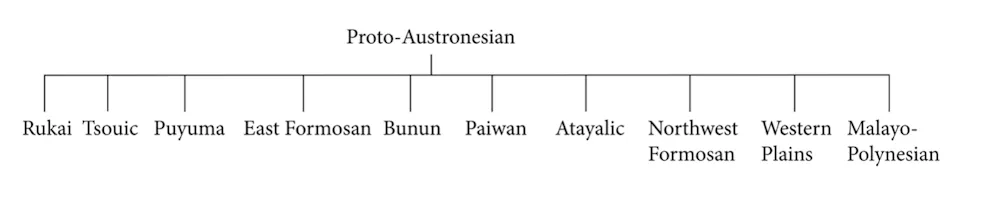
However, archaeological evidence indicates a 1,000-year pause prior to the migration. This suggests Malayo-Polynesian should have split off from a certain Indigenous group in Taiwan, rather than starting up as an independent branch. In our research, we discovered new evidence relating to Malayo-Polynesian’s root. It comes from a special use of the grammatical affix ma in four Indigenous Austronesian languages. Spreading along the east coast of Taiwan, all four languages (Amis, Kavalan, Basay-Trobiawan, Siraya) show a special use of ma that allows the actor of an action to be included in the sentence, for example: Amis: Ma-curah ni Kulas ku lumaq. Kulas burned the house. This sentence structure is strictly banned in all other Indigenous languages of Taiwan, but is widely observed in Malayo-Polynesian languages. Tagalog: Ma-sunog ni Kulas ang bahay. Kulas will burn the house. Strong seafaring traditions Intriguingly, all four languages have known seafaring traditions, and all belong to the East Formosan primary branch of Austronesian. Their shared use of ma with Malayo-Polynesian thus suggests a new subgrouping in which these two groups share a common origin. This hypothesis suggests the East Formosan people – including the Amis, the largest Indigenous group of Taiwan – are most closely related to Malayo-Polynesian, including Māori, in the Austronesian homeland. It also traces the starting point of Austronesian expansion to eastern Taiwan, where three of these four languages are still spoken today. Read more: What wind, currents and geography tell us about how people first settled Oceania Our findings point to a revised linguistic subgrouping more consistent with the socio-historical view that a seafaring community began the out-of-Taiwan expansion. It coincides with recent findings in archaeology, which put the starting point of the Austronesian expansion in eastern Taiwan. It also aligns with three recent genetic studies. All three reveal a particularly close connection between the Amis and Malayo-Polynesian populations. Read more: Who were the Toaleans? Ancient woman's DNA provides first evidence for the origin of a mysterious lost culture Exclusively shared vocabulary between Amis and Malayo-Polynesian languages lends further support to this idea. The Amis word poki for vagina, for example, is etymologically unrelated to equivalent words found in other Austronesian languages of Taiwan. Instead, it has the same linguistic derivation as the corresponding words in various Malayo-Polynesian languages. Papora (Taiwan) huci, Thao (Taiwan) kuti, Bunun (Taiwan) kuti, Paiwan (Taiwan) kutji, Puyuma (Taiwan) kuti. Amis (Taiwan) poki, Tagalog (Philippines) púki, Malay (Malaysia) puki, Javanese (Indonesia) puki, Tetun (Timor) huʔi-n, Gitua (Papua New Guinea) pugi. Future investigation of more shared traits between Malayo-Polynesian and East Formosan languages will shed further light on their relationships.

Read more https://theconversation.com/linguistics-locates-the-beginnings-of-the-austronesian-expansion-with-indigenous-seafaring-people-in-eastern-taiwan-186547

Cleaner Floors, Healthier Homes: Lefant M3L Arrives as Australians Prioritise Pet-Friendly Hygiene

As pet ownership continues to rise, Australians are placing greater emphasis on maintaining a hygienic indoor environment for both family members and their animals. Issues such as dander, loose fur, and tracked-in dirt require consistent cleaning to support better home... Read more

How Home Removalists Save Time, Money, and Energy During Your Move

Moving to a new home is an exciting chapter in life, but the process of getting there can be overwhelming. From packing and organizing to transportation and unpacking, relocation involves a long list of tasks that can consume both your... Read more

Fulfilment Australia: Streamlining ECommerce Operations for Business Growth

As eCommerce continues to thrive, efficient order fulfilment has become one of the most critical components of customer satisfaction and business success. Companies across the nation are turning to professional fulfilment Australia providers to manage inventory, packaging, and shipping operations... Read more

Evaporative Cooling Cleaning Melbourne: Keeping Your System Fresh, Efficient, and Healthy

As Melbourne’s summers grow hotter, many homes rely on evaporative cooling systems to stay comfortable. While these systems are energy-efficient and environmentally friendly, they require regular maintenance to perform at their best. Professional Evaporative Cooling Cleaning Melbourne services are essential... Read more

4 Benefits of Exploring Australia in an Off Road Caravan

Australia’s vast landscapes offer a kind of freedom that can only be fully experienced on the open road. For travellers seeking caravans for sale, choosing one built for adventure can transform any journey into a memorable one. This article will... Read more

The Importance of Professional eCommerce Web Design for Online Success

The online shopping industry has grown at a rapid pace, and with it, customer expectations have evolved. Today, having a basic website is not enough to attract and retain customers. Businesses must invest in professional eCommerce web design that not only... Read more