

Frozen in time, we've become blind to ways to build sustainability into our urban heritage
- Written by The Conversation
It was hard to keep up with all the bad news coming out of the recent Australia State of the Environment report. The dire state of natural places and First Nations heritage rightly attracted attention. However, one important finding was overlooked: the poor state of Australia’s so-called historic heritage.
The report found this heritage is at risk on many fronts. It’s under pressure from land development, resource extraction, poorly managed tourism, climate change and inadequate management and protections.
In a familiar framing, the report points the finger at urban development and other changes. However, this mindset itself is actually an obstacle to protecting our urban heritage.
Change in our cities, and to our heritage, is both inevitable and necessary. Our relationships to neighbourhoods and places constantly evolve, as we learnt during COVID-19 lockdowns.
Policy ideas framed by sustainability, such as adaptive management that encourages heritage places to change and evolve, are more sensible. Flexible and creative responses to heritage places should be allowed.
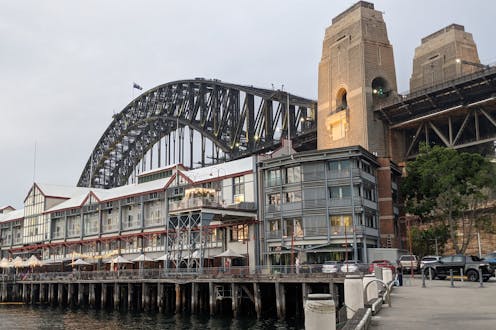
An example of embracing change is the Walsh Bay Arts Precinct in Sydney. The project has reimagined maritime heritage for culture and the arts.
Adopting new perspectives won’t only preserve our historic buildings and places by enabling us to shape them for today’s needs. It will also mean urban heritage can contribute to cities becoming more socially, economically and environmentally sustainable.
Read more: Sustainable re-use and recycling work for heritage buildings and places too
A problem of definitions
The historic heritage that the report finds is deteriorating refers to places, buildings and structures dating from 1788 onwards. But the very idea of “historic heritage” is out-of-date.
The term originally contrasted colonial built heritage with so-called “pre-history”. Indigenous heritage was generally seen as being in the past rather than continuing into the present or having a future.
A more precise term, “cultural heritage”, embraces the diverse historical and societal values that shape cities and historic environments. It better recognises that our urban cultural heritage is a product of colonisation and dispossession and located on Indigenous Country.
On the ground, we see a few examples of more progressive activities. The deeply researched City of Melbourne Hoddle Grid Review embraced Indigenous perspectives, social values and modern buildings. But this is an unusual case of innovation.
Read more: Why heritage protection is about how people use places, not just their architecture and history
A problem of knowledge
For heritage to contribute more to social sustainability, by ensuring places reflect and strengthen diverse communities, we need more robust knowledge about existing protections.
We simply lack that data. Australia has no heritage reporting mechanisms across national, state and local heritage jurisdictions.
As a result, the State of the Environment report was unable to provide a fuller picture of the state of urban heritage: what is protected, why and how it is protected, nor its values and condition. The report was not funded for this kind of comprehensive data collection, nor for widespread site visits.
We cannot identify which Australian communities and histories – whether First Nations, colonial or multicultural stories – are represented within heritage lists. The five-year report identifies only six targeted projects exploring gaps in state heritage registers. Only one of these studies foregrounds social value.
Centralising community perspectives in heritage remains a challenge. For example, when the City of Ballarat collaborated with residents to identify places of importance, the insights could not be translated into protections because planning laws don’t adequately recognise community heritage expertise. Work needs to be done to integrate heritage management and social sustainability.
Read more: How can we meaningfully recognise cities as Indigenous places?
A problem of adaptation
Expanding the scope of urban heritage enables new perspectives on how it can contribute to economic and environmental sustainability. Economic development can threaten heritage, but also rescue it from decay. Leading heritage projects treat existing physical and social spaces as significant but underutilised resources.
The regeneration of Sydney’s Kings Cross, for example, seeks to return glitz and glamour to the area, albeit minus its gritty and subversive character. Heritage and communities are both enhanced and diminished through development and investment.
The report rightly identifies climate change as a threat to heritage places. Yet, across jurisdictions, inadequate emphasis is placed on heritage as a driver of climate adaptation. Reworking existing environments, buildings and structures, whether or not they are heritage-listed, is a sustainability trend.
Indeed, the report encourages the retention of existing buildings for their embodied energy due to the resources that have gone into constructing and maintaining them. But it maintains the premise that development tends to undermines conservation.
This longstanding mindset stands in the way of widespread adaptive reuse. Adopting broader perspectives and new approaches empowers heritage for sustainability agendas.
Although not heritage-listed, Broadmeadows Town Hall (1964) in Melbourne has been conserved and transformed in a sophisticated and functional way. At Melbourne’s Southbank, the listed Robur Tea House may soon finally be revitalised. Reworking the 1880s industrial building with a skyscraper above may well be the best way forward.
Read more: We can't afford to just build greener. We must build less
What’s stopping us from doing better?
With clear parallels to today, the Inquiry into the National Estate reported in 1974 that Australia’s heritage had been “downgraded, disregarded, and neglected”. The Commonwealth government took dramatic action by establishing the independent and innovative Australian Heritage Commission (1975–2004).
In recent times, however, the Commonwealth has greatly reduced its involvement in conserving urban heritage. Every state and local government now has its own approaches, resulting in fragmented governance arrangements. The lack of national leadership, co-ordination and innovation has led to us falling behind international approaches.
Personalities of Historic Places – Why Do Historic Places Matter?Urban heritage can strengthen communities and help foster an inclusive and democratic society only by engaging with a diversity of places and stories. Widespread adaptation and reuse of both listed and non-listed heritage places can support economic and environmental sustainability.
New and radical perspectives are needed to keep heritage relevant and thriving in cities.
James Lesh’s book Values in Cities: Urban Heritage in Twentieth-Century Australia will be launched at the Robin Boyd Foundation in Melbourne on August 24 2022.


