

For the first time, robots on Mars found meteorite impact craters by sensing seismic shock waves
- Written by The Conversation
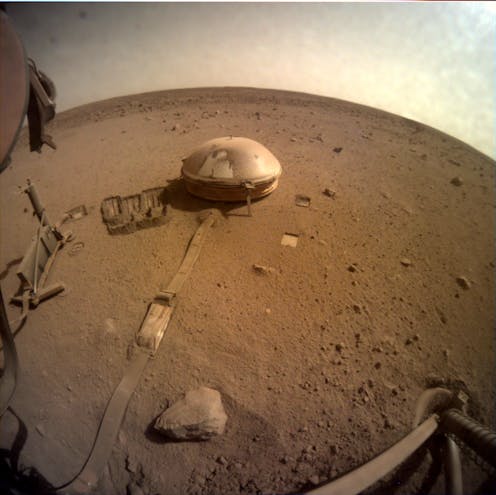
Since 2018, NASA’s InSight mission to Mars has recorded seismic waves from more than 1,300 marsquakes in its quest to probe the internal structure of the red planet. The solar panels of the car-sized robotic lander have become caked with Martian dust, and NASA scientists expect it will completely power down by the end of 2022.
Read more: First recorded 'marsquakes' reveal the red planet's rumbling guts
But the internal rumblings of our planetary neighbour aren’t the only things that InSight’s seismometers detect: they also pick up the thuds of space rocks crashing into the Martian soil.
In new research published in Nature Geoscience, we used data from InSight to detect and locate four high-speed meteoroid collisions, and then tracked down the resulting craters in satellite images from NASA’s Mars Reconnaissance Orbiter.
Rocks from space
The Solar System is full of relatively small rocks called meteoroids, and it’s common for them to collide with planets. When a meteoroid encounters a planet with an atmosphere, it heats up due to friction – and may burn up entirely before reaching the ground.
On Earth, we know these incoming meteoroids as shooting stars, or meteors: beautiful events to observe in the night sky. Sometimes a meteoroid explodes when it reaches the thicker atmosphere closer to the ground, creating a spectacular airburst.
Occasionally, a space rock survives its fiery path through the air and drops to the ground, where it is known as a meteorite.
A few of these meteorites hit the surface at such speed they blast a hole in the ground called an impact crater. Compared to a human lifetime, these events are very rare on Earth.
Recording space rock impacts
Scientists have detected the vibrations from meteoroid airbursts using seismic detectors numerous times, including a recent survey of bright meteors above Australia.
However, only once has a high-speed space rock crashing into the ground been observed both visually and with modern seismic equipment. This was an impact crater that formed in 2007 near the village of Carancas in Peru.
Numerous impacts were detected on the Moon by the network of seismic sensors set up during the US Apollo missions of the 1960s and ’70s. However, there was no recording of a natural impact associated with visual detection of a new crater.
Read more: The moon is still geologically active, study suggests
The closest things to such an observation were artificial impacts: the crash-landings of the booster rockets of the ascent modules that lifted Apollo astronauts off the Moon.
These human-made impacts on the Moon were recorded both in seismic data and visual imagery from orbit. These data were recently used to test simulations of how impacts produce seismic waves.
Martian meteorites
Incoming meteoroids make waves in the atmosphere and also the ground. The atmosphere of Mars is equivalent to 1% of the Earth’s, and has a different chemical composition. This means meteor events on Mars take a different form.
For meteor events large enough to drop a meteorite, the fate of the meteorite and any resulting crater is different from what we have come to expect on our home planet.
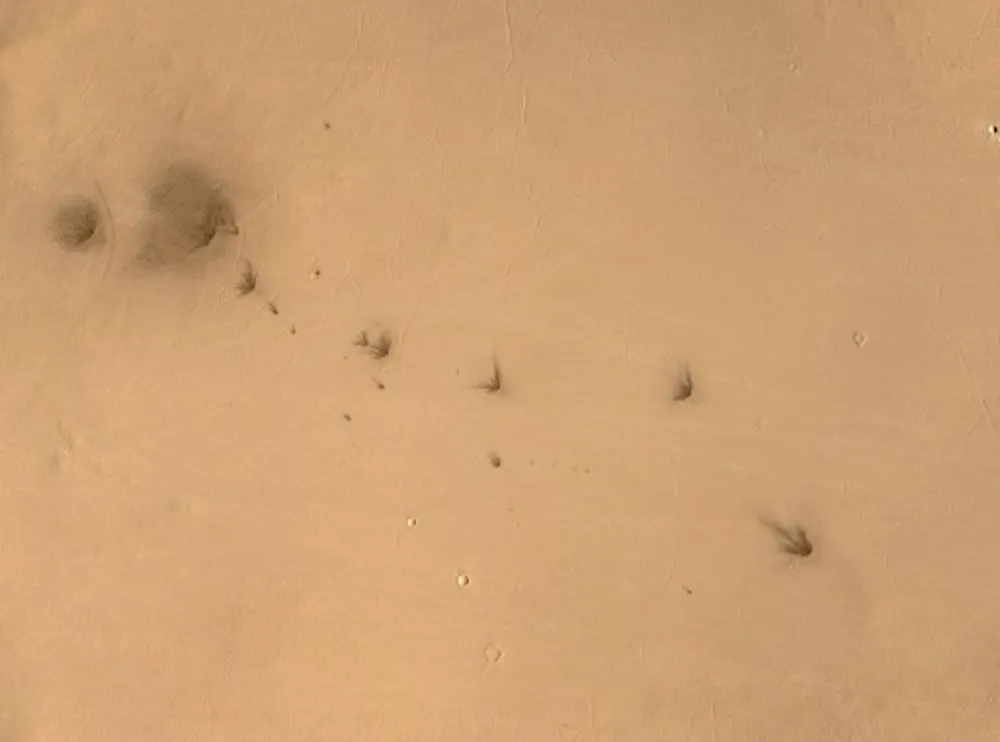
Here on Earth, or on the Moon, single craters are the norm. On Mars, however, about half the time a high-speed space rock will burst in the atmosphere shortly before impact, resulting in a tightly grouped cluster of craters.
The separation of these individual fragments remains close at ground level, forming a cluster of small impacts.
From vibrations to craters
Recently, the InSight mission has observed acoustic and seismic waves from four meteoroid impact events. These waves travel at different speeds, and comparing their different arrival times and other properties allowed us to estimate the location of the impacts.
These impact locations were then confirmed with satellite imaging from the Mars Reconnaissance Orbiter.
Knowing the size and exact location of these impact craters helps us calculate the size and speed of the incoming space rock and how much energy the impact released.
Once we are confident we know something about the impact that created the seismic waves we detected, we can use the waves to learn about the interior of Mars. What’s more, when we compare seismic observations on Mars with observations from Earth and the Moon, we can learn more about how the planets formed and how the Solar System evolved.


