

In a win for Traditional Owners, Origin is walking away from the Beetaloo Basin. But the fight against fracking is not over
- Written by The Conversation

What a difference six months makes. Before the federal election, the Beetaloo Basin in the Northern Territory was to have spearheaded Australia’s “gas-led recovery”. But Origin Energy this week announced it would sell its share of the basin project ahead of a wider exit from new gas ventures.
The Beetaloo Basin holds a truly enormous amount of fossil carbon – prompting Greens leader Adam Bandt to describe it as a “climate bomb”.
Origin’s exit is not a killing blow to the controversial project. But it shows increasing corporate jitters about investing in gas. And the announcement came as major iron miner Fortescue announced plans to eliminate fossil fuel use within eight years.
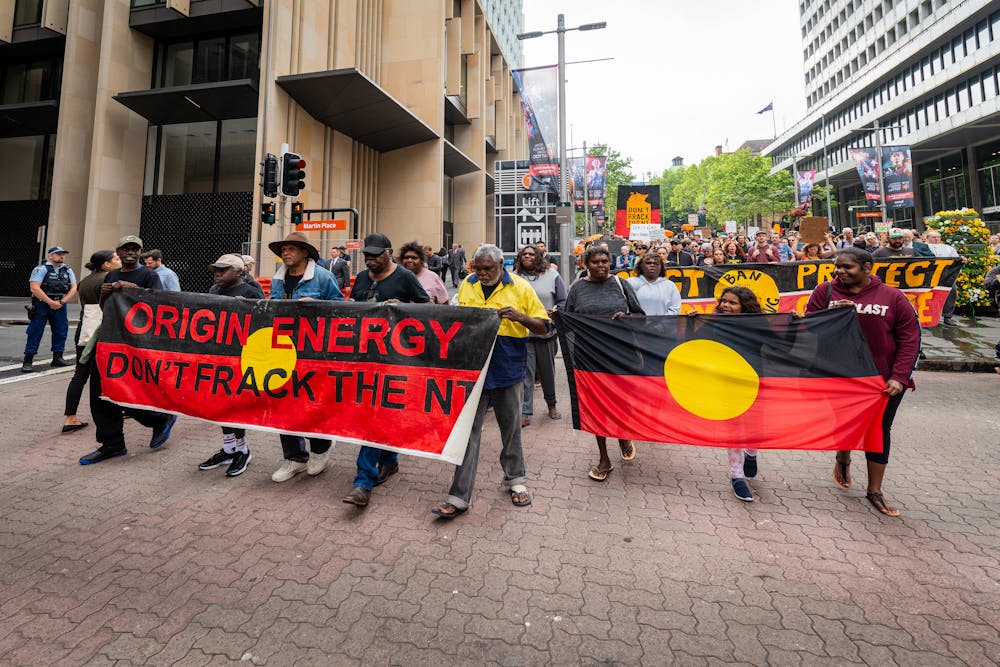
Origin’s exit is a major win for the region’s Traditional Owners, many of whom feared the fracking would cause large-scale environmental damage, as well as harming the climate. But Origin has sold its rights to frack Beetaloo – so the fight is far from over.
What is this basin and why does it matter?
Oil and gas are usually found in geological basins – large, low-lying areas filled with rocks and sediment. The Beetaloo Basin covers 28,000 square kilometres and lies around 500 kilometres south-east of Darwin. Origin’s former exploration area lies near the town of Daly Waters.
Fracking the basin has been planned since 2004. The former Morrison Coalition government planned a so-called “gas led recovery” to accelerate its development, fuelled by large amounts of taxpayer money to encourage the fossil fuel industry to frack the remote area.
The move was unpopular with the region’s Traditional Owners, with fracking described by Traditional Owner Ned Jampijinpa Hargraves as “digging up my body, breaking my Tjukurpa (Dreaming)” in a government inquiry.
Local Traditional Owners formed the Nurrdalinji Native Title Aboriginal Corporation to fight fracking, in partnership with local pastoralists.
Origin’s statement makes no mention of these tensions in its decision. Indeed, it talks of “strong support” from the local community, including native title holders.
Despite this rhetoric, the work by Traditional Owners and pastoralists created enormous pressure for Origin to back out of the project.
 The fight against fracking has seen a partnership between Traditional Owners and local pastoralists.
AAP
This win demonstrates yet again how Indigenous people around the world are playing a key role in warding off the worst of the climate crisis.
This occurs not only when Indigenous people oppose fossil fuel projects on their land, but through their management of 38 million square kilometres of land across 87 countries.
This is an enormous estate – one quarter of the Earth’s land surface – and often covers land rich in biodiversity.
Australia’s First Nations peoples hold rights and interests in land covering about 40% of the continent, again land that has been sustainably managed by First Nations peoples for thousands of years and is therefore highly environmentally valuable.
Land management is central to combating climate change, through nature-based solutions such as storing carbon in trees, soils and mangroves and seagrass meadows. First Nations communities have at least 60,000 years of knowledge of how to care for Country in ways which can aid climate adaptation, mitigation and repair.
What next?
Origin has sold its rights to a company half-owned by Tamboran Resources Limited.
Under the previous Coalition government, Tamboran subsidiary Sweetpea Petroleum received A$7.5 million of public money to drill exploration wells in the Beetaloo. Tamboran and Sweetpea refused to appear at a 2021 Senate inquiry into oil and gas activities in the Beetaloo Basin – a move the Senate committee declared was “unacceptable”.
Tamboran is now trying to raise $133 million to pay Origin for the rights and invest the rest in developing the project.
As the International Energy Agency has warned, we cannot open new fossil fuel projects if we hope to limit global temperature rise to the crucial 1.5℃ threshold.
For more than a decade, climate activists have called on institutions to divest themselves of their fossil fuel holdings. Origin has divested itself of Beetaloo and BHP is divesting its oil and gas portfolio.
But these are not true victories for the climate if the fossil fuel assets are sold to be extracted and burned by another company.
Keeping it in the ground
If we are serious about saving our planet we need to legislate to close down fossil fuel assets and force shareholders and investors to cop the losses.
In selling its share, Origin has taken an estimated loss of up to $90 million. But the fight against fracking in the Beetaloo is not over.
Still, it’s important to recognise what’s been achieved. As Johnny Wilson, Chair of Nurrdalinji Corporation said:
We hope this is the start of more companies turning their back on gas production where we live. Fracking is not what we want … The government should give up backing the industry with taxpayers’ money and invest in health, education and clean energy from the sun because that’s what will keep our future strong.


