

Dora Maar and Françoise Gilot were much more than Picasso's muses or lovers. They are important artists in their own right
- Written by The Conversation

Among Picasso’s partners were two formidable female artists: Dora Maar (1907–97) and Françoise Gilot (1921-).
For a long time, these women were known primarily as his muse or lover, but further scrutiny of their extensive careers reveals that they were also his collaborators and innovative artists in their own right.
Both women profoundly influenced Picasso, and both were exceptional talents.
The Picasso Century, currently at the National Gallery of Victoria, offers a rare opportunity to see their work in Australia.
Charismatic and unconventional Dora Maar

In Dora Maar, with and without Picasso: a biography (2000), Mary Ann Caws writes that Picasso first saw Dora Maar in Cafe les Deux Magots. Sitting alone, she was using a penknife to stab the tabletop between her gloved fingers, staining the white flowers of her gloves with blood.
The pair were later introduced when Maar worked as the set photographer on Jean Renoir’s The Crime of Monsieur Lange (1936). They soon began a relationship.
By all accounts, Maar was intelligent, charismatic and unconventional. When she met Picasso she had a successful and established career as a photographer.
Surrealists had been dismissive of photography until Maar demonstrated its potential, creating some of the movement’s most powerful and important works.
According to NGV’s Meg Slater, Gilot’s centrality to Surrealism arose through experimentation in her commercial photography, as well as her commitment to radical left-wing politics. She was remarkable for a woman at that time.
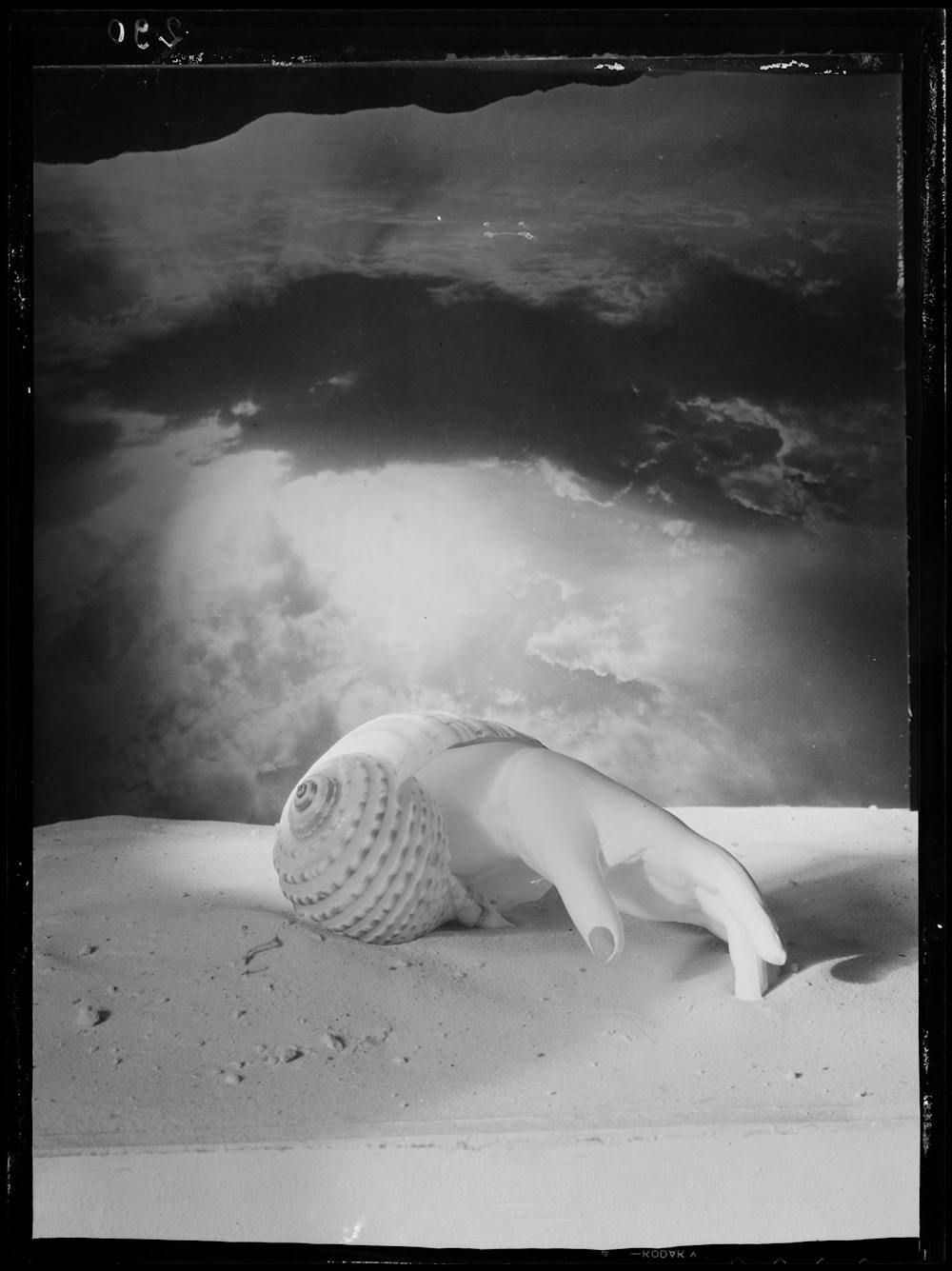 Dora Maar Untitled (Hand - shell) 1934 Tireur Tirage de Daniel Valet Epreuve gélatino - argentique 56,6 x 38 cm / 23,4 x 17,5 cm (hors marge)
Centre Pompidou, Paris, Musée national d’art moderne - Centre de création industrielle Acquisition
Maar has been identified with the nine “Weeping Woman” canvases, which depict how Picasso saw her, profoundly impacted by Guernica’s bombing during the Spanish Civil War.
But these portraits have reductively characterised her as a volatile and emotional woman. Maar said “all [of Picasso’s] portraits of me are lies”.
Maar often photographed Picasso during their relationship, most notably in creating his 1937 anti-war work Guernica. She was represented within the painting as a figure holding a light.
According to Musée Picasso-Paris’ curator Emilie Bouvard, Maar “did not simply document Picasso painting the great mural. In fact, her Surrealist photography influenced the work itself”.
Renowned for moving from one lover to another, Picasso left Maar for Françoise Gilot – notoriously the only woman to leave him.
Critically reflective Françoise Gilot
 Gilot and Picasso in 1950, with their children Claude, standing, and Paloma.
AP Photo
Gilot had an extraordinary life. Before 25 she had lived through the Nazi occupation of Paris, studied dance under Isadora Duncan’s protégée and taken “morning walks with Gertrude Stein”.
She achieved expertise in ceramics well before she met Picasso. It was during their almost 10-year relationship that he took an interest in ceramics, eventually producing 3,500 works.
Gilot was physically and psychologically abused by Picasso and lived with very little autonomy throughout their relationship. Many of her works testify to this.
The Earthenware (1951) shows a window with bars. Paloma asleep in her crib (1950) depicts windows without views. Adam forcing Eve to Eat an Apple (1946) is an image of coercion with a disturbing likeness to Picasso and Gilot.
In 1953 she left with their children, Claude and Paloma. Outraged, Picasso began to sabotage her artistic career. In 1964 she published a memoir, Life with Picasso, following his three legal challenges to stop it.
She is unusual for writing critically reflective pieces on her own work, situating her as well ahead of her time.
The female gaze
The “female gaze” refers to the way female artists express their own unique experience of living in the world as women. Gendered experiences are only one influence among many, but they profoundly impact any creative work.
My first impression of Gilot’s female gaze is that she takes a micro view of the world around her.
Her 1940s still life works take the domestic and emphasise her seclusion at that time (Picasso had isolated her from family and friends).
She finds inspiration in the small things, the domestic, rather than racing to the monumental or heroic.
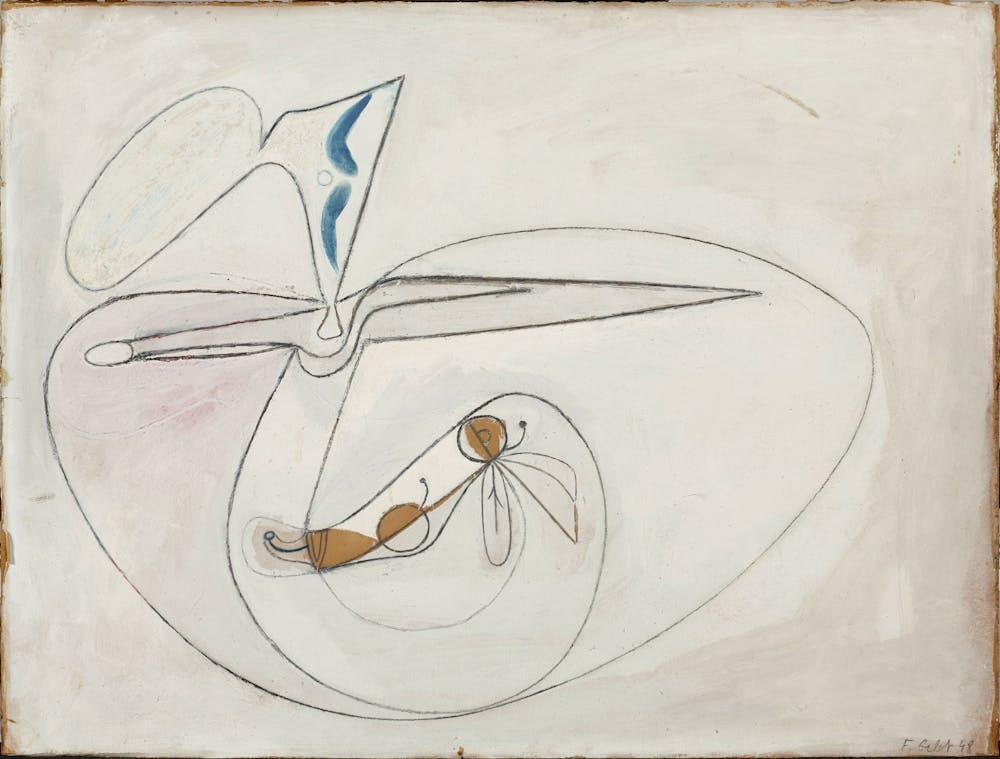 Françoise Gilot Plat de cerises et couteau espagnol 1948 gouache, pencil, charcoal and coloured pencil on cardboard 49.5 x 67.0 cm , 63.5 x 78.6 cm (framed)
Centre Pompidou, Paris, Musée national d’art moderne – Centre de création industrielle
According to Gilot in an interview in Vogue, she met Picasso in 1943 when he brought a bowl of cherries to her table.
This may be referenced in Plate of cherries and a Spanish knife (1948). Gilot described this painting as “the most ordinary, mundane and non-poetic of things” and offers that she chose the domestic deliberately in an act of resistance to expectations that she be a housewife.
From this painting we can glimpse her her feminism and her female perspective.
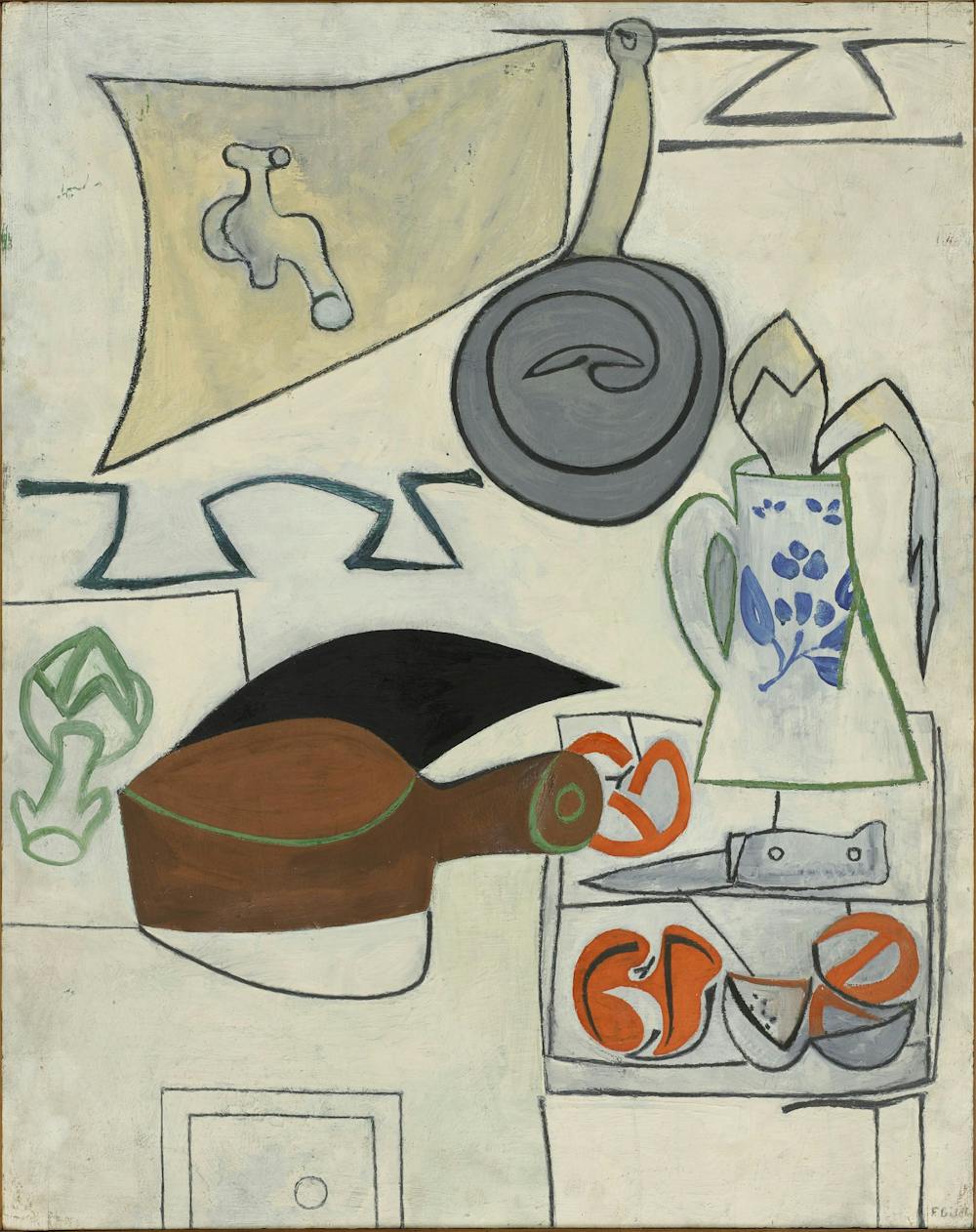 Françoise Gilot Sink and tomatoes ( Evier et tomates ) 1951 Oil on plywood 91.8 x 72.8 cm.
Acquired by the French State in 1952; accessioned in 1953 Centre Pompidou, Paris Musée national d’art moderne / Centre de création industrielle
Maar’s portraits and advertising images resist objectifying the female figure, directing viewers with the subject’s gaze to something just out of sight.
While often erotic, they don’t present women as objects. The shadow in Assia (1934) emphasises and celebrates both her form and power.
Maar’s iconography emphasises the female. She incorporates wavy locks of hair, spiders and manicured nails in hair oil advertising images such as Publicity Study (Pétrole Hahn) (1934-1935), face cream advertisement Les années vous guettent (The Years are Waiting for You) (1932) and surrealist images such as Untitled (Hand-Shell) (1934).
Maar and Gilot were creative collaborators, not just muses of Picasso.
Before and after him, their artistic achievements – and exceptional volumes of creative work – locate them as important artists. These include Maar’s retrospective at the Tate (2019-20), and Gilot’s many exhibitions.
Across their long careers their output straddled a variety of media and styles, each with her own female gaze.
The Picasso Century is at the NGV until October 9.


